Taxes On Escrow Account
Description
Get your form ready online
Our built-in tools help you complete, sign, share, and store your documents in one place.
Make edits, fill in missing information, and update formatting in US Legal Forms—just like you would in MS Word.
Download a copy, print it, send it by email, or mail it via USPS—whatever works best for your next step.
Sign and collect signatures with our SignNow integration. Send to multiple recipients, set reminders, and more. Go Premium to unlock E-Sign.
If this form requires notarization, complete it online through a secure video call—no need to meet a notary in person or wait for an appointment.
We protect your documents and personal data by following strict security and privacy standards.

Make edits, fill in missing information, and update formatting in US Legal Forms—just like you would in MS Word.

Download a copy, print it, send it by email, or mail it via USPS—whatever works best for your next step.

Sign and collect signatures with our SignNow integration. Send to multiple recipients, set reminders, and more. Go Premium to unlock E-Sign.

If this form requires notarization, complete it online through a secure video call—no need to meet a notary in person or wait for an appointment.

We protect your documents and personal data by following strict security and privacy standards.
Looking for another form?



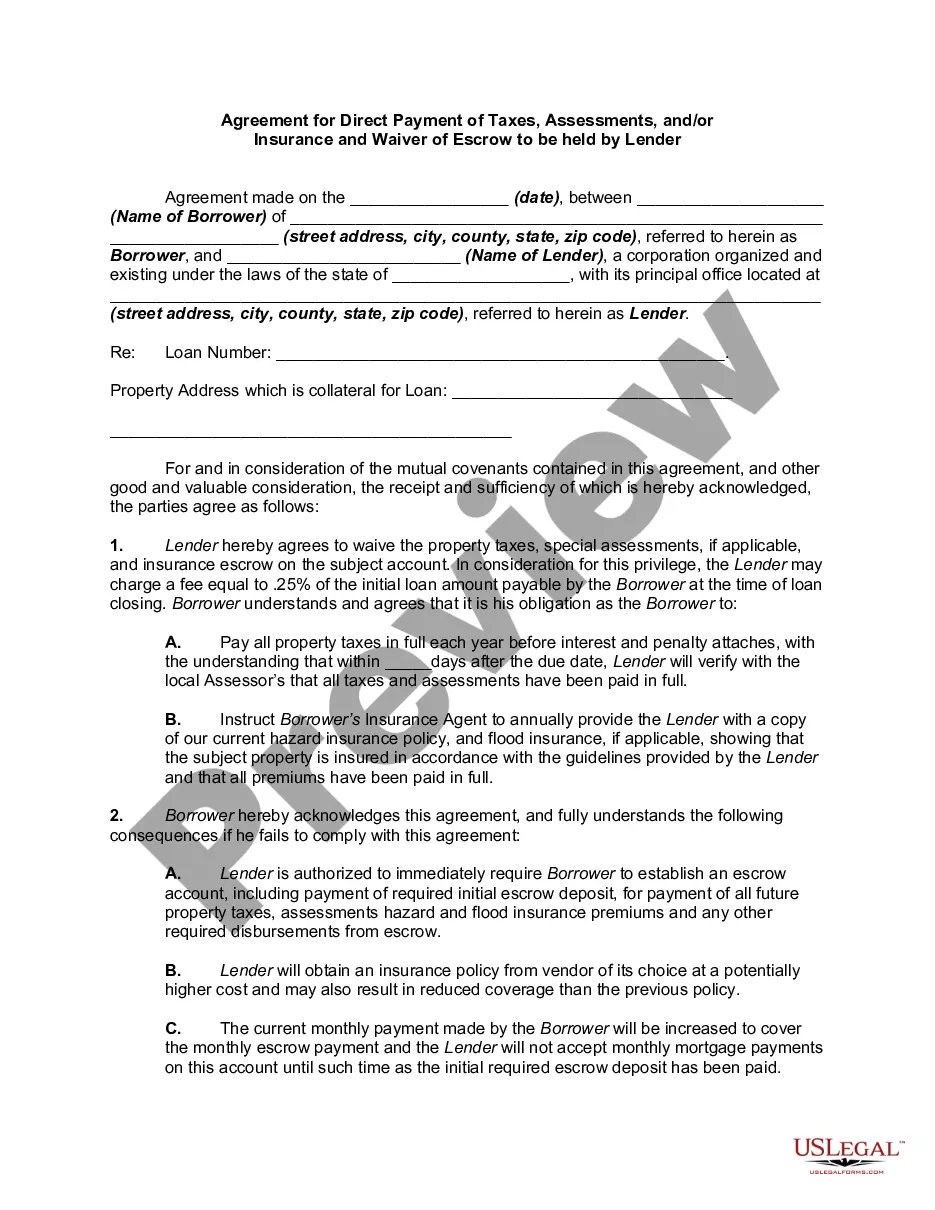
How to fill out Agreement For Direct Payment Of Taxes, Assessments, And/or Insurance And Waiver Of Escrow To Be Held By Lender?
Utilizing legal templates that adhere to federal and local statutes is essential, and the internet provides numerous choices to select from.
However, what’s the benefit of spending time searching for the properly drafted Taxes On Escrow Account example online if the US Legal Forms digital library already has such templates gathered in one location.
US Legal Forms is the largest online legal directory with over 85,000 fillable templates created by attorneys for any professional and personal situation.
Review the template using the Preview feature or through the text outline to ensure it satisfies your requirements.
- They are simple to navigate with all documents categorized by state and intended use.
- Our experts stay informed on legislative changes, ensuring your documentation is current and compliant when obtaining a Taxes On Escrow Account from our site.
- Acquiring a Taxes On Escrow Account is straightforward and rapid for both existing and new users.
- If you already possess an account with an active subscription, Log In and save the document sample you require in the desired format.
- If you are new to our website, follow the steps below.
Form popularity
FAQ
While escrow accounts provide convenience, there can be downsides. One potential issue is that you may not have immediate access to your funds, as they are held by the lender until tax payments are due. Additionally, if your property taxes increase, your monthly payments may rise, affecting your budget. Understanding the taxes on escrow accounts can help you prepare for these changes.
Your escrow payment may be higher than your actual taxes due to various factors. Lenders often estimate your annual property taxes based on previous years' amounts, plus a cushion to cover any potential increases. Additionally, your escrow account may also include payments for homeowners insurance and mortgage insurance, which can inflate the total. Understanding how taxes on escrow accounts work can help you plan your finances better, and using platforms like US Legal Forms can provide clarity on managing these payments.
The formula for calculating escrow is fairly simple. The tax and home insurance bills for the upcoming year are totaled and then divided by the number of payments per year. (If your mortgage servicer collects for a cushion, the amount needed for that cushion will be factored into the equation as well.)
After closing on a house, escrow accounts are mainly used to pay taxes and insurance. This works by applying for a mortgage. If you go through a mortgage lender to take out a loan in order to buy a home, you may end up using the money in your escrow account to help you with your monthly payments.
Escrow refunds generally come when there's an expense that's smaller than expected, such as a lower insurance bill or fewer taxes. Your mortgage servicer pays the lower amount and then, when the servicer conducts an escrow analysis, the difference will be refunded to you, typically by check.
These bank accounts are set up by your mortgage servicer to hold funds for paying property taxes, homeowners insurance and other expenses on your behalf, and there are several reasons why they may have a surplus. If you've received an escrow refund check, the money is yours to keep and use as you desire.
It's automatic Having your mortgage lender or servicer hold your property tax and homeowners insurance payments in escrow ensures that those bills are paid on time, automatically.