Accruing Vacation Time In Quickbooks
Description
Get your form ready online
Our built-in tools help you complete, sign, share, and store your documents in one place.
Make edits, fill in missing information, and update formatting in US Legal Forms—just like you would in MS Word.
Download a copy, print it, send it by email, or mail it via USPS—whatever works best for your next step.
Sign and collect signatures with our SignNow integration. Send to multiple recipients, set reminders, and more. Go Premium to unlock E-Sign.
If this form requires notarization, complete it online through a secure video call—no need to meet a notary in person or wait for an appointment.
We protect your documents and personal data by following strict security and privacy standards.

Make edits, fill in missing information, and update formatting in US Legal Forms—just like you would in MS Word.

Download a copy, print it, send it by email, or mail it via USPS—whatever works best for your next step.

Sign and collect signatures with our SignNow integration. Send to multiple recipients, set reminders, and more. Go Premium to unlock E-Sign.

If this form requires notarization, complete it online through a secure video call—no need to meet a notary in person or wait for an appointment.

We protect your documents and personal data by following strict security and privacy standards.
Looking for another form?






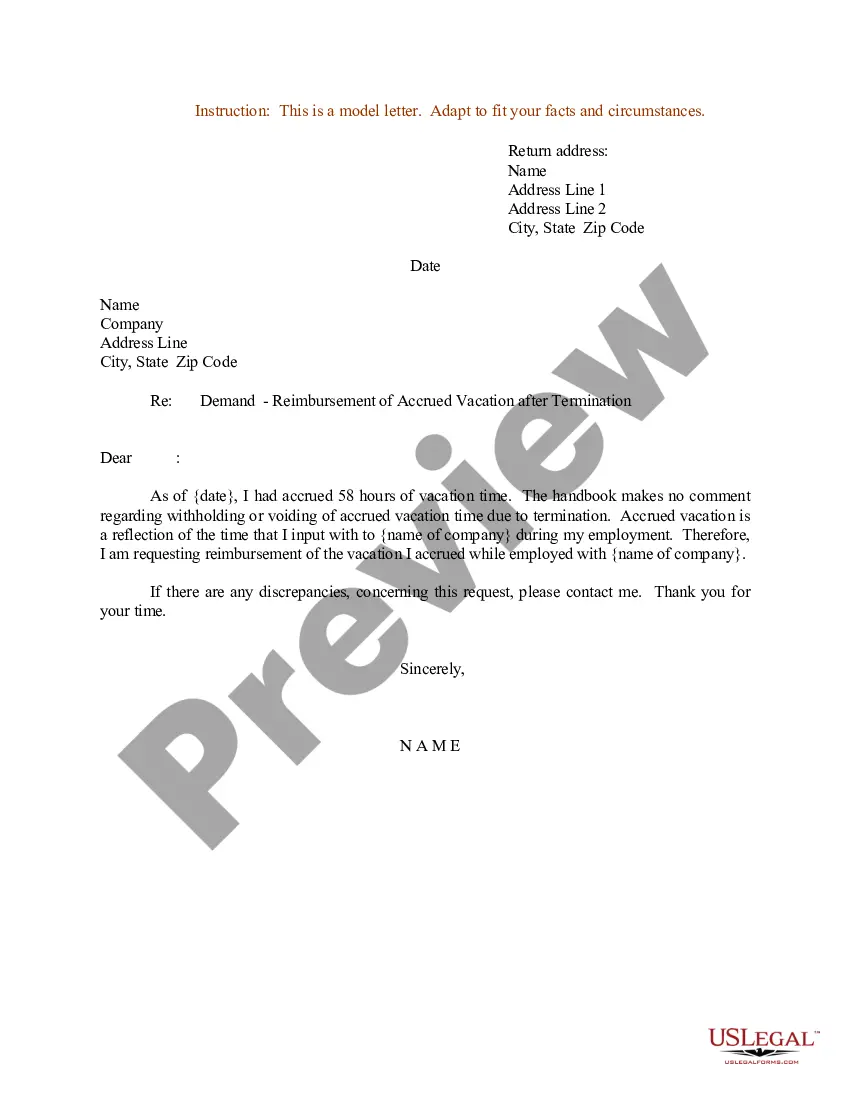
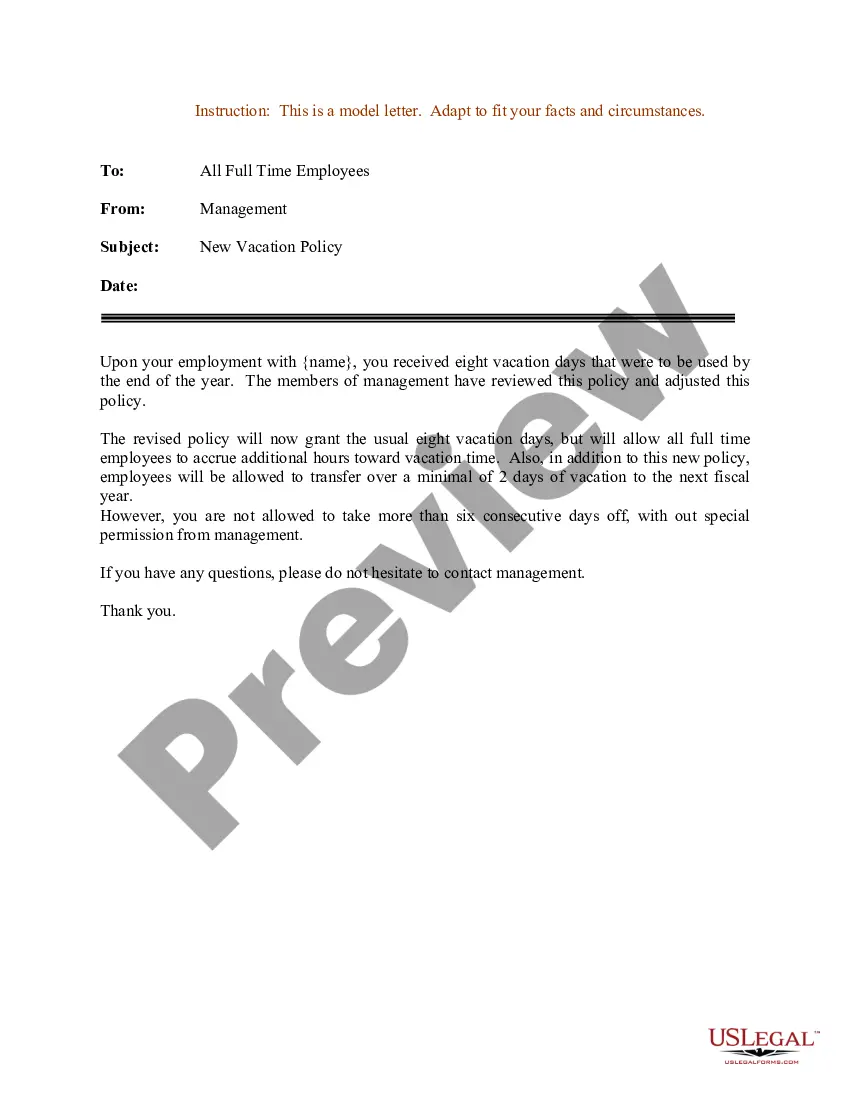
How to fill out Sample Letter For Demand - Reimbursement Of Accrued Vacation After Termination?
Managing legal documentation can be daunting, even for the most adept professionals.
When you seek information on Accruing Vacation Time In Quickbooks and lack the time to find the suitable and current version, the process can be stressful.
Access legal and business forms specific to your state or county. US Legal Forms meets all your requirements, from personal to corporate documents, all in one location.
Utilize sophisticated tools to complete and manage your Accruing Vacation Time In Quickbooks.
Here are the steps to follow once you find the form you require: Verify that it is the correct form by previewing it and reviewing its description.
- Access a repository of articles, guides, handbooks, and resources related to your circumstances and needs.
- Save time and effort searching for the necessary documents, and use US Legal Forms’ advanced search and Preview tool to find Accruing Vacation Time In Quickbooks and obtain it.
- If you hold a monthly subscription, sign in to your US Legal Forms account, search for the form, and retrieve it.
- Check your My documents section to view the documents you have previously saved and to manage your folders as needed.
- If this is your first encounter with US Legal Forms, create a free account to gain unlimited access to all the resources available in the library.
- A robust web form directory can make a significant difference for anyone looking to handle these matters proficiently.
- US Legal Forms is a leader in the online legal forms industry, offering more than 85,000 state-specific legal documents accessible to you at any time.
- With US Legal Forms, you can.
Form popularity
FAQ
Recording vacation accruals involves tracking each employee's earned vacation time and updating their balances. In QuickBooks, you can set this up through payroll settings, allowing you to record the amount accrued on a regular basis. The software will help you generate reports to see total accrued time and balances, making it easy to manage vacation time for your team.
To record vacation accruals in QuickBooks, navigate to the payroll section and choose the employees who are eligible for PTO. You can enter the accrued hours directly into their payroll records or set up automatic calculations in the software. This integration helps you keep accurate records of accrued vacation time and ensures compliance with your company policies.
Yes, QuickBooks does handle PTO accruals effectively. By establishing accrual policies, you can track time off as it accumulates, simplifying the management of employee time off. This feature ensures that all employees receive the right amount of accrued vacation time based on your specified rules. In this way, accruing vacation time in QuickBooks becomes a seamless process.
To accrue PTO in QuickBooks, start by setting up a PTO policy under your payroll settings. This ensures that your employees earn vacation time according to your company’s guidelines. You can customize the accrual rate based on hours worked or a fixed annual amount. Once set up, QuickBooks automatically calculates and adds the accrued time to each employee's balance.
To accrue vacation time, you need to establish a clear policy that defines how much time employees earn over a specified period. This can be based on hours worked, length of service, or other criteria. Tracking these hours accurately is essential, and using an efficient method ensures transparency and compliance. When employing systems like QuickBooks, you can simplify accruing vacation time in QuickBooks, making it easier for both you and your employees.
The formula for vacation accrual usually involves taking the total number of vacation days offered and dividing it by a standard time frame, such as a year. For instance, if your company offers 15 days of vacation annually, divide that by 12 months to determine the monthly accrual rate. This method allows you to calculate and manage vacation time efficiently in QuickBooks.
To account for vacation accruals in QuickBooks, you first need to set up a payroll item specifically for vacation time. Next, record the amount of vacation time employees have earned based on your company's policy. This ensures that the accrual reflects accurately in your financial reports, helping you manage vacation liabilities effectively.