Homeowner Responsibility For Sewer Line
Description
Get your form ready online
Our built-in tools help you complete, sign, share, and store your documents in one place.
Make edits, fill in missing information, and update formatting in US Legal Forms—just like you would in MS Word.
Download a copy, print it, send it by email, or mail it via USPS—whatever works best for your next step.
Sign and collect signatures with our SignNow integration. Send to multiple recipients, set reminders, and more. Go Premium to unlock E-Sign.
If this form requires notarization, complete it online through a secure video call—no need to meet a notary in person or wait for an appointment.
We protect your documents and personal data by following strict security and privacy standards.

Make edits, fill in missing information, and update formatting in US Legal Forms—just like you would in MS Word.

Download a copy, print it, send it by email, or mail it via USPS—whatever works best for your next step.

Sign and collect signatures with our SignNow integration. Send to multiple recipients, set reminders, and more. Go Premium to unlock E-Sign.

If this form requires notarization, complete it online through a secure video call—no need to meet a notary in person or wait for an appointment.

We protect your documents and personal data by following strict security and privacy standards.
Looking for another form?
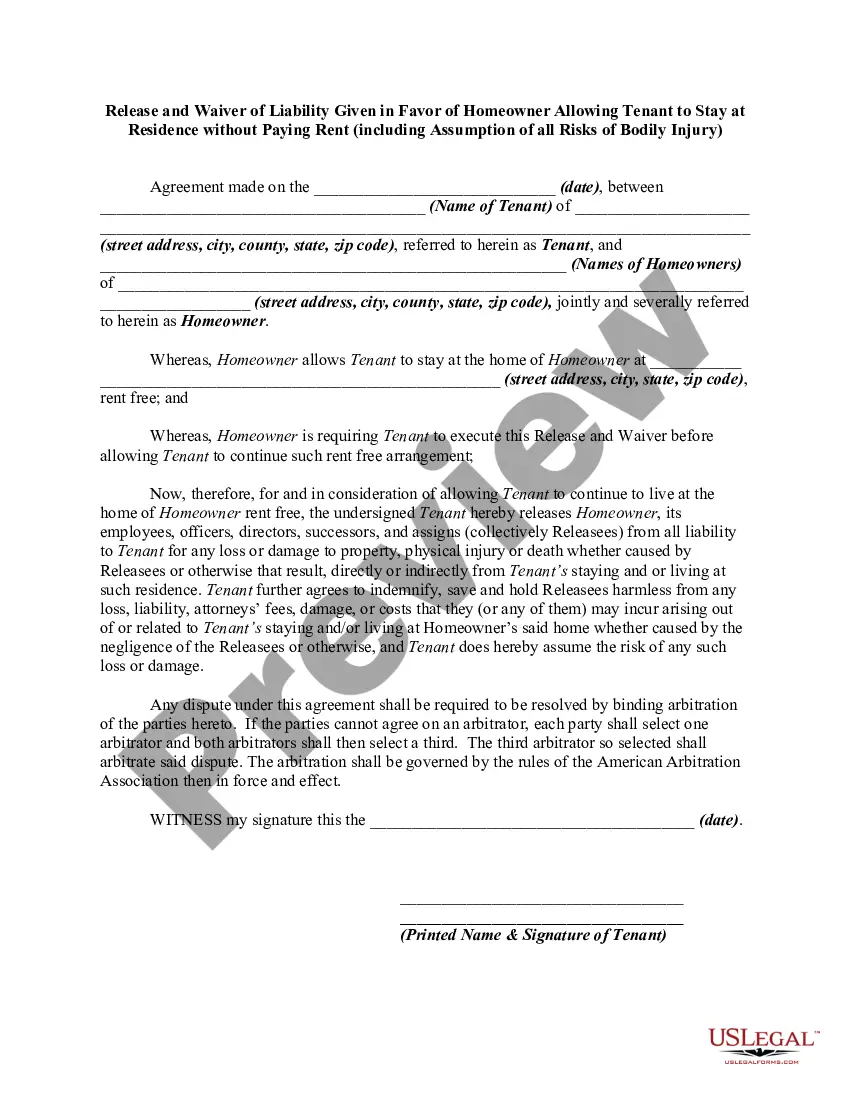
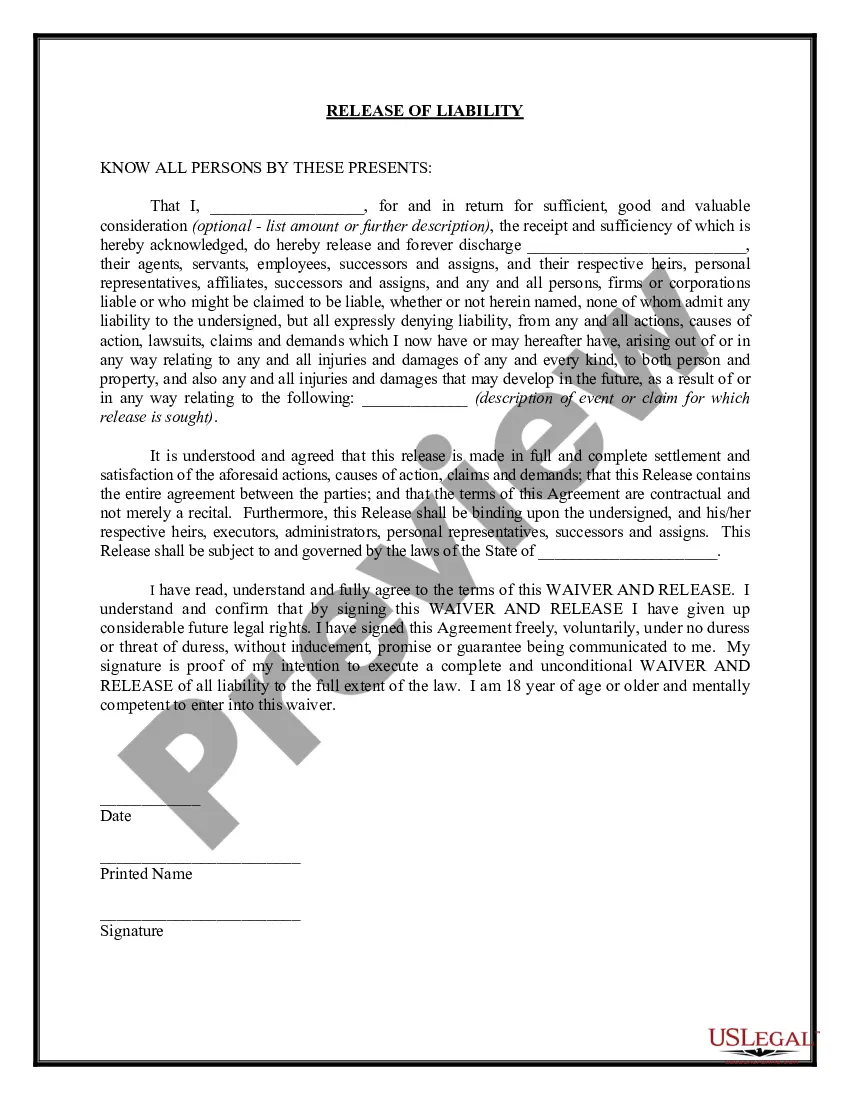
How to fill out Release And Waiver Of Liability Given In Favor Of Homeowner Allowing Tenant To Stay At Residence Without Paying Rent Including Assumption Of All Risks Of Personal Bodily Injury?
Creating legal documents from the ground up can occasionally be daunting. Certain situations may require extensive research and significant financial investment. If you’re seeking a more straightforward and economical method of generating Homeowner Responsibility For Sewer Line or any other documents without unnecessary obstacles, US Legal Forms is always accessible.
Our online collection of over 85,000 current legal forms encompasses nearly every facet of your financial, legal, and personal concerns. With just a few clicks, you can promptly access state- and county-specific forms meticulously prepared for you by our legal experts.
Utilize our website whenever you require a dependable and trustworthy service through which you can effortlessly locate and download the Homeowner Responsibility For Sewer Line. If you’re already familiar with our services and have previously registered an account with us, simply Log In to your account, choose the template, and download it instantly or re-download it at any time later in the My documents section.
Don’t have an account? No problem. It takes minimal time to register and browse the catalog. However, before diving straight into downloading the Homeowner Responsibility For Sewer Line, consider these suggestions.
US Legal Forms has a flawless reputation and over 25 years of expertise. Join us today and make document completion a straightforward and efficient process!
- Examine the document preview and descriptions to confirm that you’ve located the form you need.
- Verify if the form you select adheres to the regulations and laws of your state and county.
- Choose the most appropriate subscription plan to purchase the Homeowner Responsibility For Sewer Line.
- Download the form. After that, complete, sign, and print it.
Form popularity
FAQ
Yes, homeowners usually bear the responsibility for sewer line replacement. This includes costs related to repairs and replacements, which can be significant. It's essential to be aware of this responsibility to adequately prepare for potential expenses. For those needing guidance, US Legal Forms offers resources to help homeowners understand their rights and responsibilities regarding sewer lines.
Homeowner responsibility for sewer line issues often falls on the property owner. Typically, homeowners are responsible for sewer lines that run from their home to the main sewer line, while municipal authorities manage the public sewer system. Each state and locality may have different regulations, so it's wise to check local laws regarding sewer line responsibilities. US Legal Forms can provide valuable resources to help clarify your obligations.
The homeowner responsibility for sewer line varies depending on your specific homeowners association (HOA) rules. In many cases, the HOA covers common areas and shared infrastructure, which may include sewer lines. However, you should review your HOA agreement to clarify your responsibilities and those of the HOA. If you have questions, US Legal Forms can assist you in understanding your obligations.
Homeowner responsibility for sewer line can lead to tax implications. Generally, if you replace a sewer line, it may be considered a capital improvement, which can potentially be deducted when you sell your home. However, it's crucial to consult a tax professional to understand your specific situation and how the IRS views these expenses. Utilizing a platform like US Legal Forms can help you navigate the necessary paperwork.
Homeowner responsibility for sewer line maintenance can be complex. Generally, homeowners insurance does not cover main sewer line replacement unless specific coverage is included in your policy. It's important to review your policy and check for endorsements that may cover sewer line issues. If you find yourself facing unexpected sewer line repairs, consider using platforms like US Legal Forms to access legal documents that can help you navigate your responsibilities and options.
The main sewer line is outside the home, while drain lines are inside your house. When these systems need maintenance or repairs, the type of plumber you should call will depend on whether the problem is in a drain line inside your home or the main sewer line outside your home.
Mix baking soda and vinegar in the ratio of and add the mixture in 60 gallons of water. Use the plunger or drain snake as you pour the water into the drain. If you are wondering how to unclog main sewer line, the pressure of the water will dislodge the debris easily.
If you discover a sewer backup in the basement, there are a few things you can do immediately. Check all the toilets, sinks and waste pipes for blockages. If there is a blockage that you can clear, clear it. ... Avoid using the toilets or sinks until the blockage has been removed. ... Check your home's sewer clean out.
A common reason for a sewer backup are clogs in the drain pipes or main sewer lines beneath the ground. The source of the blockage may be grease, hair, or other solid materials. Clogs can also happen if the sump pump in your basement fails.
Public sewer lines: These pipes are owned by your city or town. The city is responsible for maintaining these pipes, which is why you pay your property taxes. Private sewer lines: These pipes are owned by your homeowner's association (HOA).