Artist Performance Agreement With Royalty
Description

Get your form ready online
Our built-in tools help you complete, sign, share, and store your documents in one place.
Make edits, fill in missing information, and update formatting in US Legal Forms—just like you would in MS Word.
Download a copy, print it, send it by email, or mail it via USPS—whatever works best for your next step.
Sign and collect signatures with our SignNow integration. Send to multiple recipients, set reminders, and more. Go Premium to unlock E-Sign.
If this form requires notarization, complete it online through a secure video call—no need to meet a notary in person or wait for an appointment.
We protect your documents and personal data by following strict security and privacy standards.

Make edits, fill in missing information, and update formatting in US Legal Forms—just like you would in MS Word.

Download a copy, print it, send it by email, or mail it via USPS—whatever works best for your next step.

Sign and collect signatures with our SignNow integration. Send to multiple recipients, set reminders, and more. Go Premium to unlock E-Sign.

If this form requires notarization, complete it online through a secure video call—no need to meet a notary in person or wait for an appointment.

We protect your documents and personal data by following strict security and privacy standards.
Looking for another form?








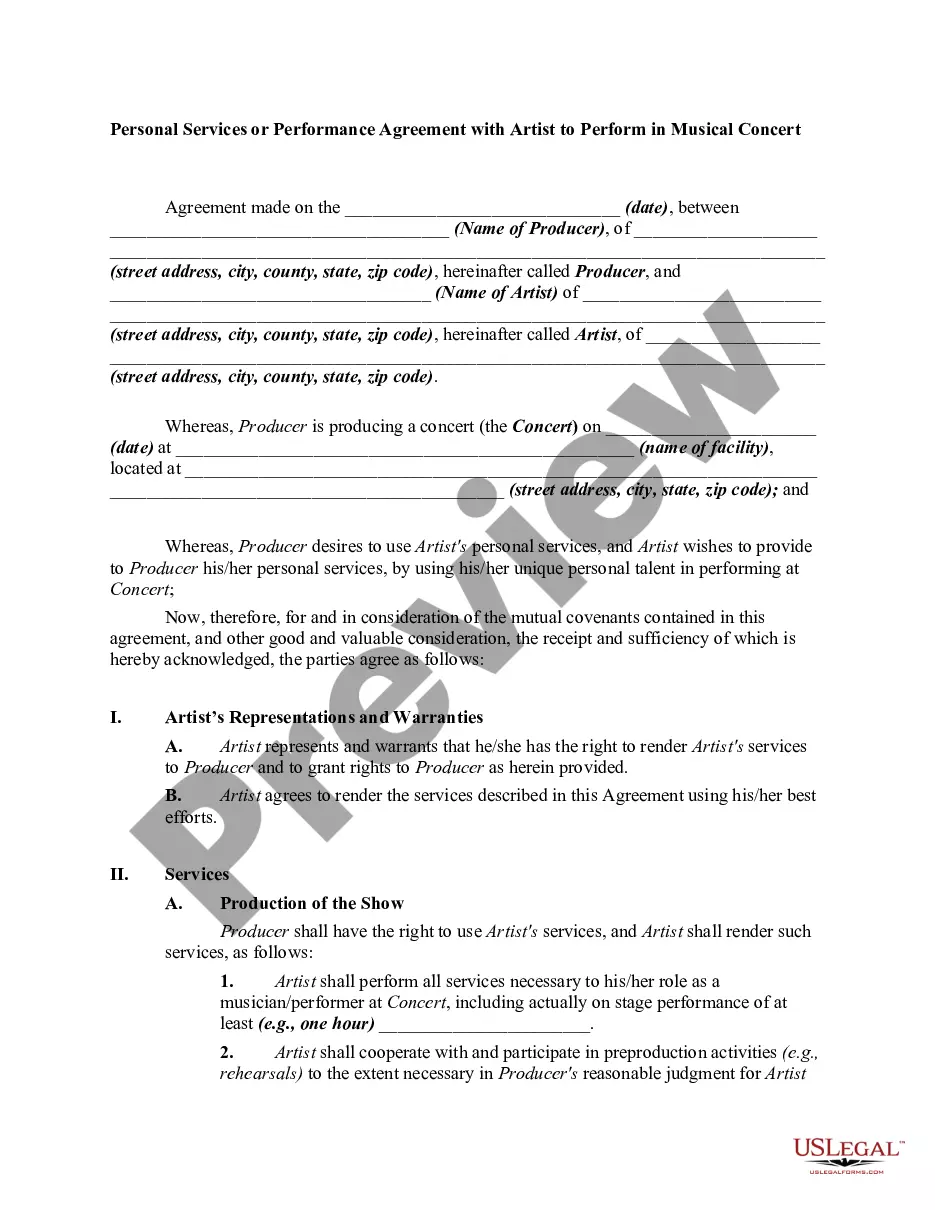
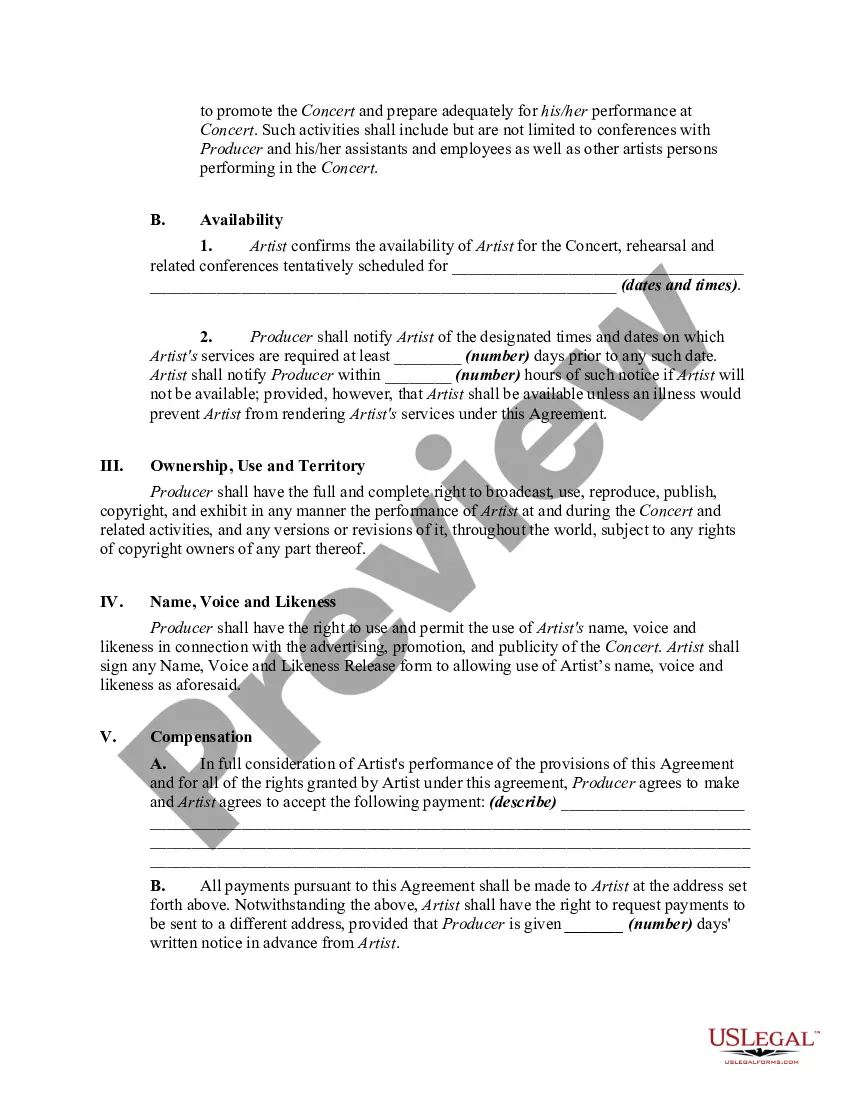
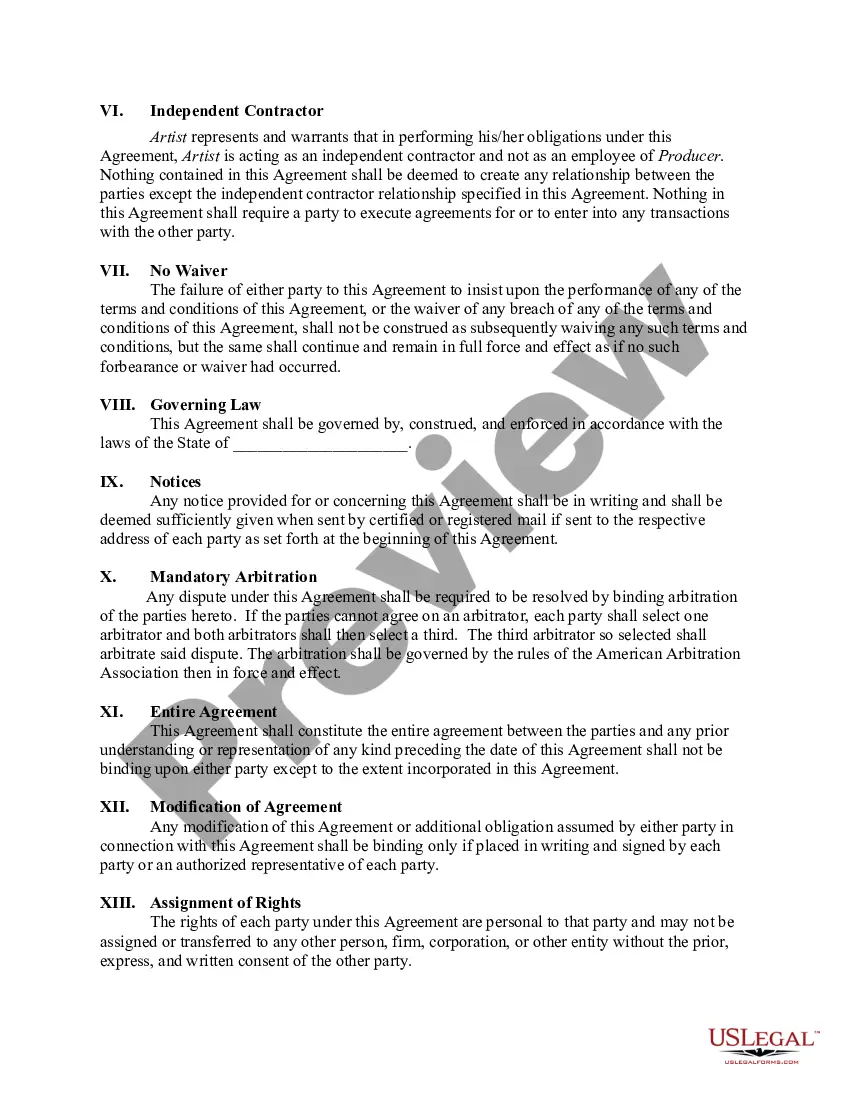
How to fill out Personal Services Or Performance Agreement With Artist To Perform In Musical Concert?
There's no longer a necessity to waste time searching for legal documents to meet your local state obligations.
US Legal Forms has gathered all of them in a single location and improved their availability.
Our site provides over 85,000 templates for various business and individual legal situations categorized by state and usage area.
- All forms are expertly crafted and confirmed for legitimacy, so you can feel confident in acquiring an updated Artist Performance Agreement With Royalty.
- If you are acquainted with our service and already possess an account, you need to verify that your subscription is active before obtaining any templates.
- Log In to your account, select the document, and click Download.
- You can also revisit all saved documents whenever needed by accessing the My documents tab in your profile.
- If you have never utilized our service before, the process will require additional steps to finalize.
- Here’s how new users can obtain the Artist Performance Agreement With Royalty from our collection.
- Review the page content diligently to confirm it includes the template you need.
- Utilize the form description and preview options if available.
Form popularity
FAQ
Recording artists earn royalties from the direct sale of their recordings on CDs and other media. They do not earn royalties when their songs are publicly performed like when their songs are played on the radio and TV, or in bars and restaurants.
Record Label Royalties It is an industry norm for a new artist to only receive 10-16% of their sales. The reason for this incredibly high (or low depending on your point of view) percentage is Record Labels take on all the financial risk that Artists never could imagine taking on their own.
Under the traditional recording agreement, recording artist royalties usually range from 10% to 25% of the suggested retail price for top-line albums (although many record companies have begun to compute royalties on the wholesale price).
The artists and record labels receive a share of the streaming royalties, neighboring royalties, digital performance royalties, and sync fees. At the same time, the publisher and songwriters receive the performance royalties, mechanical royalties, and sync fees (with the PROs and distributors also taking their cut).
For major label record deals, a typical artist royalty is in the 12-20% range. This lower royalty is a reflection of the increased investment that comes with a major label. In other words, you make less from record sales, but should be benefitting from a much larger investment in recording and marketing.