Security Interest Legal Definition
Description

Get your form ready online
Our built-in tools help you complete, sign, share, and store your documents in one place.
Make edits, fill in missing information, and update formatting in US Legal Forms—just like you would in MS Word.
Download a copy, print it, send it by email, or mail it via USPS—whatever works best for your next step.
Sign and collect signatures with our SignNow integration. Send to multiple recipients, set reminders, and more. Go Premium to unlock E-Sign.
If this form requires notarization, complete it online through a secure video call—no need to meet a notary in person or wait for an appointment.
We protect your documents and personal data by following strict security and privacy standards.

Make edits, fill in missing information, and update formatting in US Legal Forms—just like you would in MS Word.

Download a copy, print it, send it by email, or mail it via USPS—whatever works best for your next step.

Sign and collect signatures with our SignNow integration. Send to multiple recipients, set reminders, and more. Go Premium to unlock E-Sign.

If this form requires notarization, complete it online through a secure video call—no need to meet a notary in person or wait for an appointment.

We protect your documents and personal data by following strict security and privacy standards.
Looking for another form?






How to fill out Assignment Of Interest Of Seller In A Security Agreement?
The Legal Definition of Security Interest displayed on this page is a reusable formal template composed by experienced attorneys in accordance with federal and state regulations.
For over 25 years, US Legal Forms has supplied individuals, businesses, and legal experts with more than 85,000 authenticated, state-specific forms for various business and personal circumstances. It’s the fastest, easiest, and most trustworthy method to obtain the documents you require, as the service ensures bank-level data protection and anti-malware safeguards.
Re-download your documents at any time as needed. Access the My documents section in your profile to retrieve any previously saved templates. Subscribe to US Legal Forms to have authenticated legal templates for all of life's situations readily available.
- Search for the document you need and verify it.
- Browse through the sample you looked for and preview it or review the form description to ensure it meets your needs. If it doesn’t, utilize the search bar to locate the correct one. Click Buy Now once you've identified the template you want.
- Sign up and Log In.
- Select the pricing option that fits you and create an account. Use PayPal or a credit card for a quick payment. If you already possess an account, Log In and verify your subscription to continue.
- Obtain the editable template.
- Choose the format you prefer for your Security Interest Legal Definition (PDF, Word, RTF) and save the template on your device.
- Fill out and sign the documents.
- Print the template to complete it manually. Alternatively, utilize an online multifunctional PDF editor to swiftly and accurately fill out and sign your form digitally.
Form popularity
FAQ
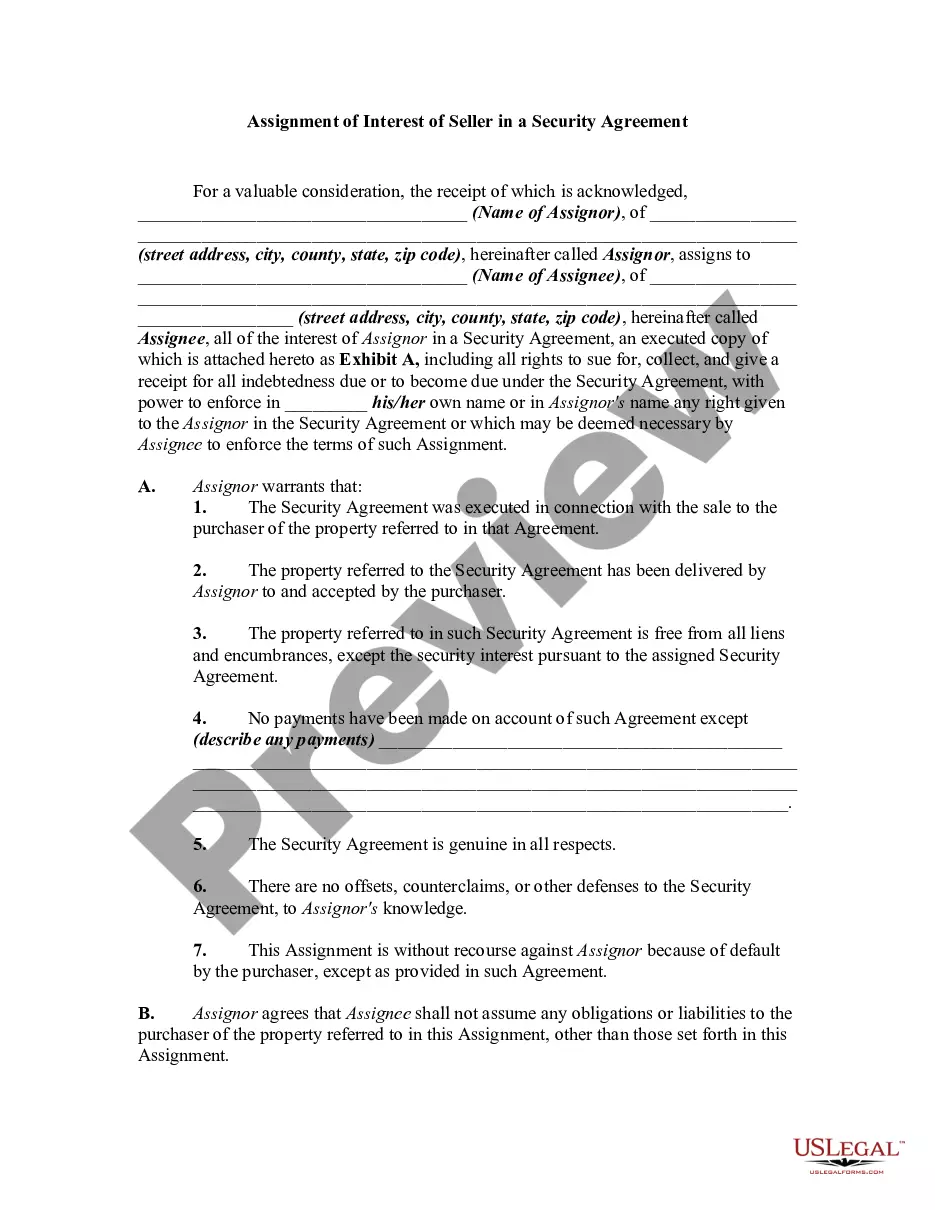
Interest in someone else's property, created by contract or by law. A mortgage is one type of security interest created by contract. A garnishment is one type of security interest created by law. See Collateral and Secured transaction.
A security interest means that if you don't make the mortgage payments as agreed, or if you break your agreement with the lender, the lender can take your home and sell it to pay off the loan. You give the lender this right when you sign your closing forms.
A security interest on a loan is a legal claim on collateral that the borrower provides that allows the lender to repossess the collateral and sell it if the loan goes bad. A security interest lowers the risk for a lender, allowing it to charge lower interest on the loan.
There are two types of security interests: possessory and non-possessory. With a possessory security interest, the secured party has possession of the collateral. With a non-possessory security interest, the debtor maintains possession of the collateral.
Security interests for most types of collateral are usually perfected by filing a document simply called a "financing statement." You'll usually file this form with the secretary of state or other public office.