Security Interest Form Meaning
Description

Get your form ready online
Our built-in tools help you complete, sign, share, and store your documents in one place.
Make edits, fill in missing information, and update formatting in US Legal Forms—just like you would in MS Word.
Download a copy, print it, send it by email, or mail it via USPS—whatever works best for your next step.
Sign and collect signatures with our SignNow integration. Send to multiple recipients, set reminders, and more. Go Premium to unlock E-Sign.
If this form requires notarization, complete it online through a secure video call—no need to meet a notary in person or wait for an appointment.
We protect your documents and personal data by following strict security and privacy standards.

Make edits, fill in missing information, and update formatting in US Legal Forms—just like you would in MS Word.

Download a copy, print it, send it by email, or mail it via USPS—whatever works best for your next step.

Sign and collect signatures with our SignNow integration. Send to multiple recipients, set reminders, and more. Go Premium to unlock E-Sign.

If this form requires notarization, complete it online through a secure video call—no need to meet a notary in person or wait for an appointment.

We protect your documents and personal data by following strict security and privacy standards.
Looking for another form?




How to fill out Assignment Of Interest Of Seller In A Security Agreement?
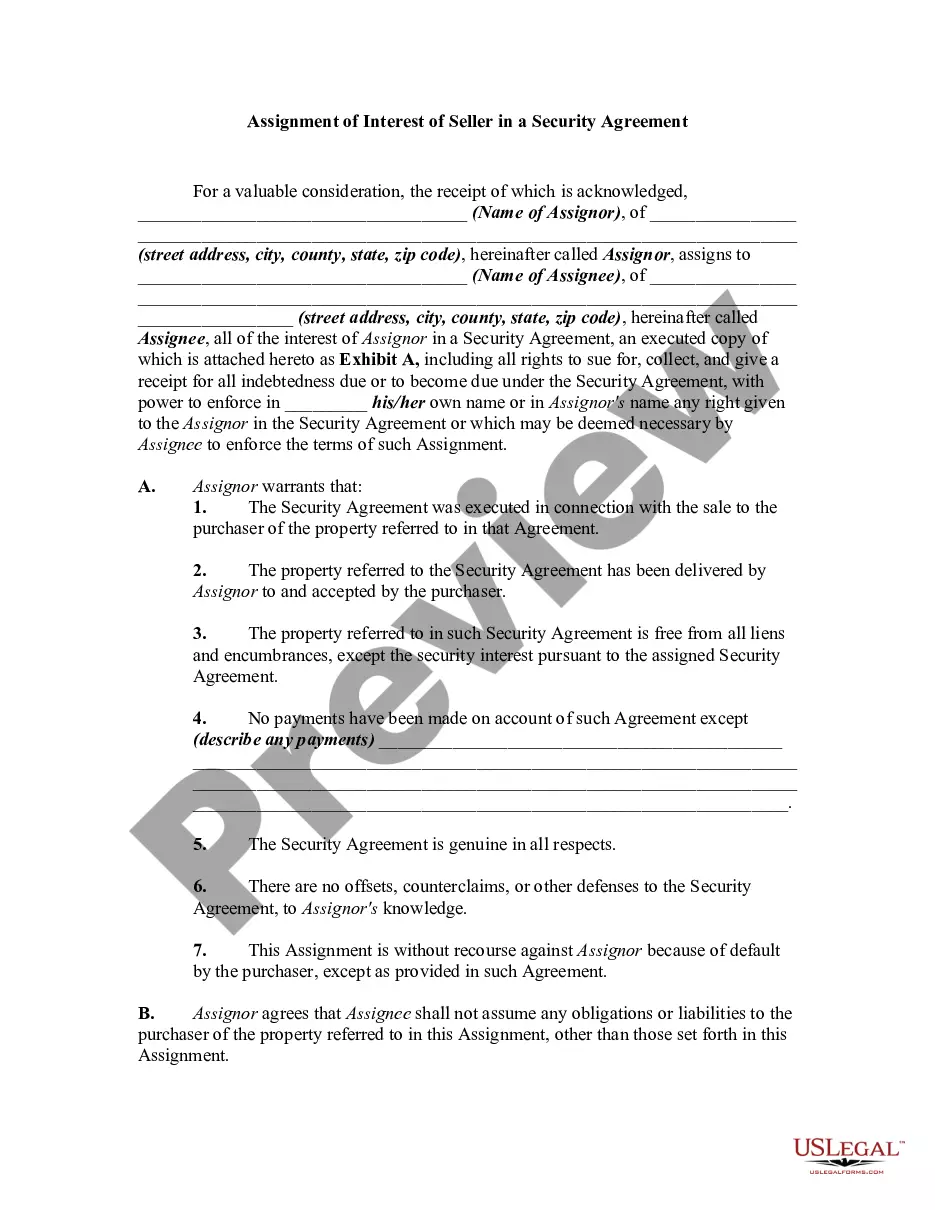
It’s well-known that you cannot become a legal expert instantly, nor can you learn how to swiftly create a Security Interest Form Meaning without a specialized education.
Drafting legal documents is a lengthy process that necessitates particular education and expertise. So why not entrust the creation of the Security Interest Form Meaning to the experts.
With US Legal Forms, one of the most extensive legal document collections, you can find everything from court forms to templates for office communication.
You can revisit your forms from the My documents section at any time. If you are a registered user, you can simply Log In, and find and download the template from the same section.
Regardless of your forms' purpose—whether financial, legal, or personal—our website has everything you need. Give US Legal Forms a try today!
- Identify the document you require by utilizing the search bar at the top of the page.
- Examine it (if this feature is available) and read the supporting description to determine if Security Interest Form Meaning is what you need.
- Restart your search if you require any other template.
- Create a free account and choose a subscription plan to acquire the form.
- Click Buy now. Once the payment is finalized, you can obtain the Security Interest Form Meaning, fill it out, print it, and deliver it either electronically or by mail to the necessary recipients or organizations.
Form popularity
FAQ
One of the most common examples of a security interest is a mortgage: a person borrows money from the bank to buy a house, and they grant a mortgage over the house so that if they default in repaying the loan, the bank can sell the house and apply the proceeds to the outstanding loan.
There are five ways a creditor may perfect a security interest: (1) by filing a financing statement, (2) by taking or retaining possession of the collateral, (3) by taking control of the collateral, (4) by taking control temporarily as specified by the UCC, or (5) by taking control automatically.
A lender can perfect a lien on a borrower's deposit account only by obtaining "control" over the account, which requires one of the following arrangements: (1) the borrower maintains its deposit account directly with the lender; (2) the lender becomes the actual owner of the borrower's deposit accounts with the ...
Security interests for most types of collateral are usually perfected by filing a document simply called a "financing statement." You'll usually file this form with the secretary of state or other public office.
A security interest on a loan is a legal claim on collateral that the borrower provides that allows the lender to repossess the collateral and sell it if the loan goes bad. A security interest lowers the risk for a lender, allowing it to charge lower interest on the loan.