Adverse Possession Washington State Rcw
Description
Get your form ready online
Our built-in tools help you complete, sign, share, and store your documents in one place.
Make edits, fill in missing information, and update formatting in US Legal Forms—just like you would in MS Word.
Download a copy, print it, send it by email, or mail it via USPS—whatever works best for your next step.
Sign and collect signatures with our SignNow integration. Send to multiple recipients, set reminders, and more. Go Premium to unlock E-Sign.
If this form requires notarization, complete it online through a secure video call—no need to meet a notary in person or wait for an appointment.
We protect your documents and personal data by following strict security and privacy standards.

Make edits, fill in missing information, and update formatting in US Legal Forms—just like you would in MS Word.

Download a copy, print it, send it by email, or mail it via USPS—whatever works best for your next step.

Sign and collect signatures with our SignNow integration. Send to multiple recipients, set reminders, and more. Go Premium to unlock E-Sign.

If this form requires notarization, complete it online through a secure video call—no need to meet a notary in person or wait for an appointment.

We protect your documents and personal data by following strict security and privacy standards.
Looking for another form?
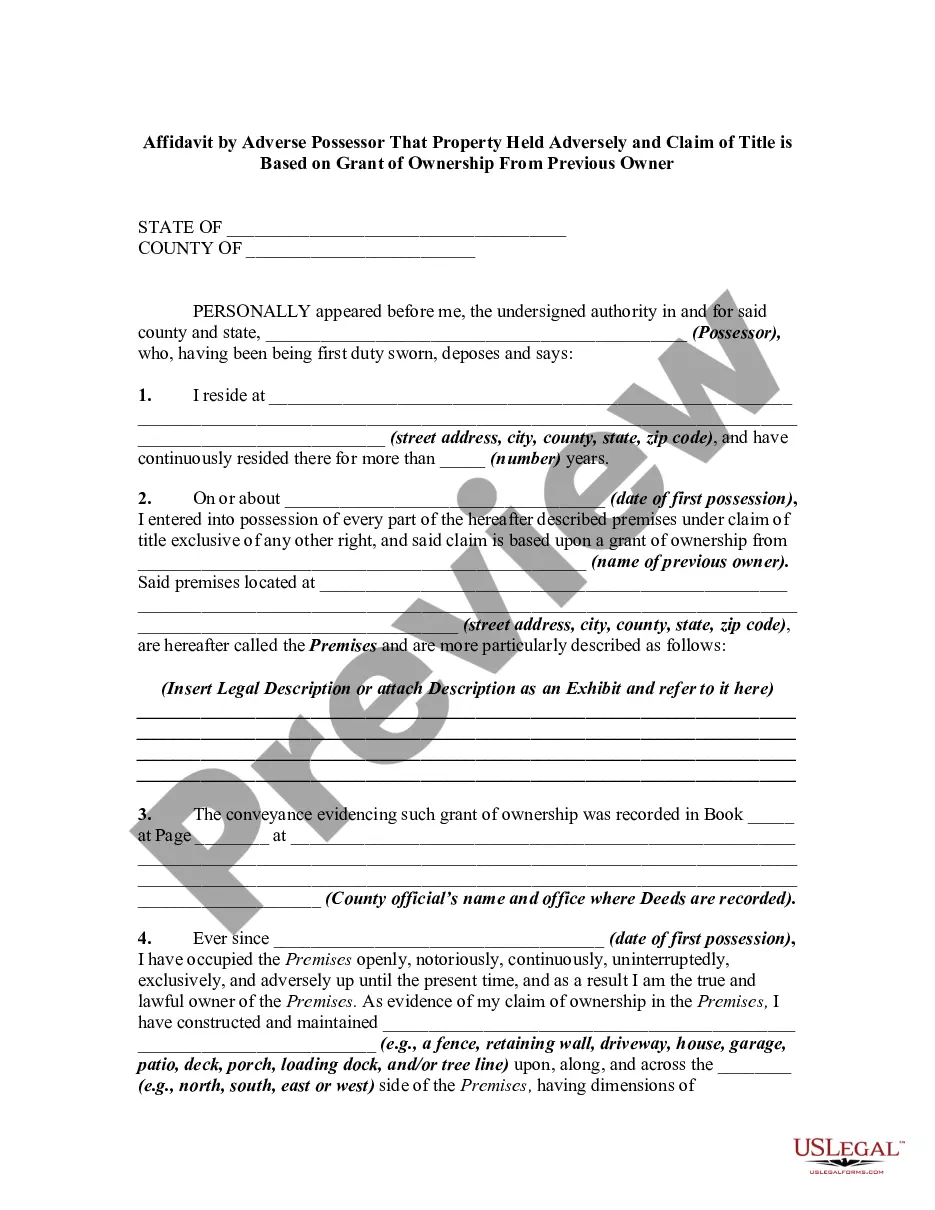
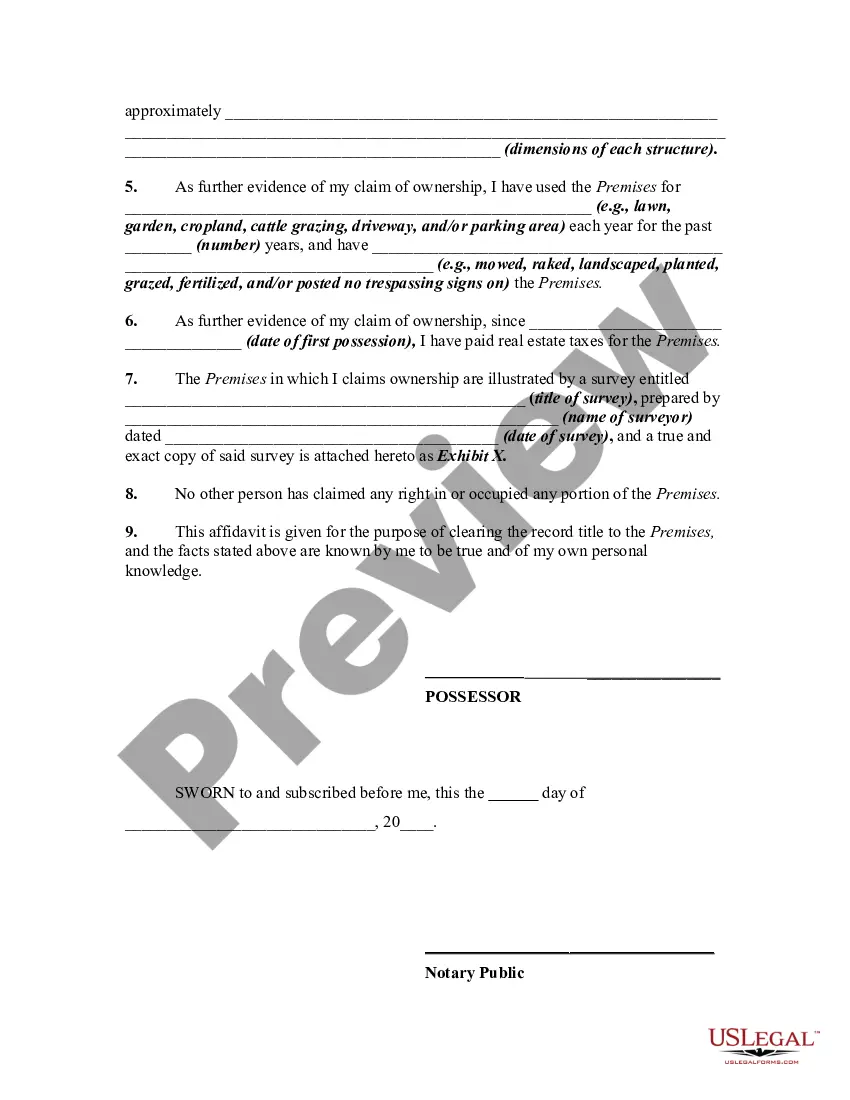
How to fill out Affidavit By Adverse Possessor That Property Held Adversely And Claim Of Title Is Based On Grant Of Ownership From Previous Owner - Squatters Rights?
- If you're a returning user, log in to your account and access your form. Ensure your subscription is current, renewing if necessary.
- For new users, begin by browsing the extensive library. Review the Preview mode and detailed descriptions to select the correct form that complies with Washington State requirements.
- Should you need additional templates, utilize the Search function to find precise forms tailored to your needs, then advance to the subsequent step.
- To purchase the form, click on the Buy Now button and select your desired subscription plan. You will need to create an account to utilize the resources available.
- Complete your transaction by entering your payment details, using either credit card information or a PayPal account.
- Once purchased, download the template directly to your device and locate it in the My Forms section of your profile whenever required.
By following these simple steps, you’ll gain quick access to the forms necessary for filing an adverse possession claim in Washington State.
US Legal Forms simplifies the legal process, offering a robust collection of over 85,000 fillable forms. Start your journey today and ensure your document is both accurate and legally sound.
Form popularity
FAQ
Adverse possession rights can indeed be inherited under Washington state law. If an individual successfully claims adverse possession, their rights to the property can transfer to heirs upon their passing, according to the RCW guidelines. It's essential for heirs to understand the legal implications and ensure that they maintain the claim. Engaging with knowledgeable legal services can help secure inherited rights.
Yes, two or more individuals can jointly claim adverse possession of the same property in Washington state. However, they must satisfy the requirements set forth under the Washington state RCW for adverse possession together. This includes proving continuous, exclusive, and open use of the property. Having a clear understanding of the law can help ensure a successful claim, and platforms like US Legal Forms can provide necessary resources.
In Washington state, adverse possession does not automatically start over with a new owner. The new owner must review the existing claim and determine if the adverse possession criteria established under RCW have been met. If the previous owner allowed the claimant to possess the property continuously, the claim can still stand. Consulting with a legal expert can clarify the nuances of your situation.
To defeat a claim of adverse possession under Washington state RCW, you must establish that the claimant did not meet all legal requirements. This includes demonstrating insufficient use, lack of intent, or showing that you have maintained rightful ownership. You can challenge their occupancy by providing evidence of your own continuous and exclusive use of the property. Proper legal counsel can guide you through this process effectively.
In Washington, the quiet title process begins by filing a lawsuit in the appropriate court, outlining your claims to the property. After filing, you must serve notice to all parties with an interest in the property, allowing them the opportunity to respond. A court hearing follows, where you present evidence supporting your claim. Successfully navigating this process can be complex, and using tools from USLegalForms can simplify your preparation and understanding of the quiet title process.
An example of a quiet title action is when a property owner discovers that their title is contested due to another party’s claim of adverse possession. Suppose someone has lived on the land for years and claims ownership without the formal title. In such cases, the current owner may file a quiet title action to resolve the dispute and clear the title, ensuring their ownership rights are recognized under adverse possession Washington state RCW.
To succeed in a quiet title action in Washington, you must provide clear evidence showing your claim to the property. This includes documentation of your adverse possession, payment of property taxes, and any relevant communication with previous owners. Courts look for proof that your possession has been continuous and exclusive. Utilizing the resources available through USLegalForms can assist you in preparing the necessary documentation effectively.
In Washington, the statutory period for adverse possession, as defined by the RCW, is ten years. This means that if someone openly and continuously occupies a property without permission for at least ten years, they may potentially claim legal ownership of the property. To succeed, the possession must be actual, visible, and hostile to the interests of the true owner. Understanding the nuances of adverse possession in Washington state RCW can help homeowners safeguard their property rights.
Washington state does not specifically have a 7 year fence law as it pertains to property boundaries, but there are laws regarding prescriptive easements and adverse possession that require a minimum of 10 years. Understanding these legal frameworks can help property owners navigate boundary issues effectively. If you believe your situation involves adverse possession Washington state RCW, it's wise to consult a reliable legal service like USLegalForms for guidance.
The 10 year fence law in Washington state pertains to the timeframe for claiming a right to maintain a boundary fence. If property owners maintain a fence for ten years, they may gain prescriptive rights over that boundary line. This law encourages property owners to be proactive about their fence maintenance and boundary clarity. It is vital to keep this timeline in mind, especially when dealing with adverse possession Washington state RCW scenarios.