Adverse Claim In The Philippines
Description

Get your form ready online
Our built-in tools help you complete, sign, share, and store your documents in one place.
Make edits, fill in missing information, and update formatting in US Legal Forms—just like you would in MS Word.
Download a copy, print it, send it by email, or mail it via USPS—whatever works best for your next step.
Sign and collect signatures with our SignNow integration. Send to multiple recipients, set reminders, and more. Go Premium to unlock E-Sign.
If this form requires notarization, complete it online through a secure video call—no need to meet a notary in person or wait for an appointment.
We protect your documents and personal data by following strict security and privacy standards.

Make edits, fill in missing information, and update formatting in US Legal Forms—just like you would in MS Word.

Download a copy, print it, send it by email, or mail it via USPS—whatever works best for your next step.

Sign and collect signatures with our SignNow integration. Send to multiple recipients, set reminders, and more. Go Premium to unlock E-Sign.

If this form requires notarization, complete it online through a secure video call—no need to meet a notary in person or wait for an appointment.

We protect your documents and personal data by following strict security and privacy standards.
Looking for another form?










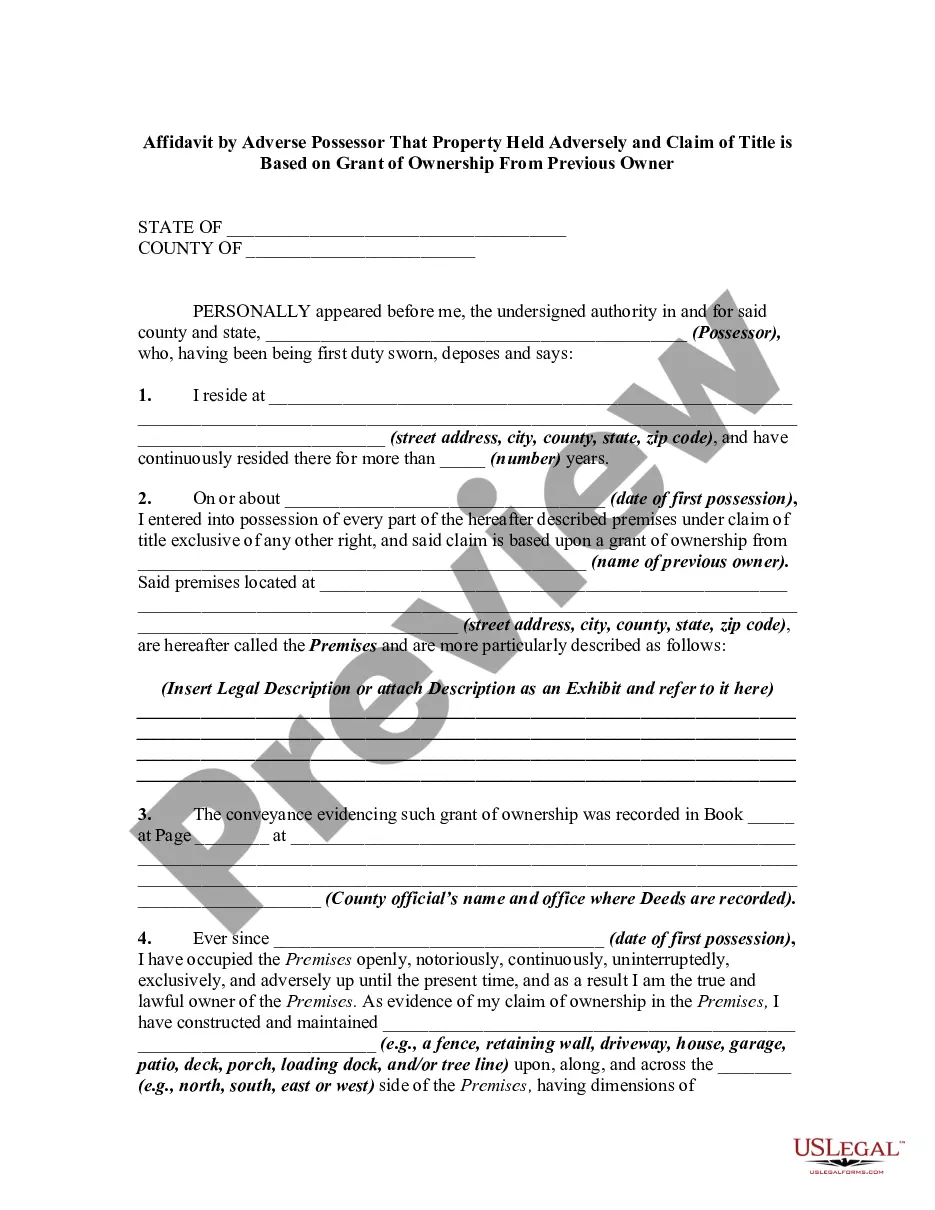
How to fill out Affidavit By Adverse Possessor That Property Held Adversely And Claim Of Title Is Based On Grant Of Ownership From Previous Owner - Squatters Rights?
Acquiring legal documents that comply with national and local regulations is essential, and the web provides numerous choices.
However, what’s the benefit of spending time seeking the properly constructed Adverse Claim In The Philippines sample online when the US Legal Forms digital library has collected such documents in one location.
US Legal Forms is the largest online legal repository with more than 85,000 editable templates prepared by lawyers for any business and personal situation. They are straightforward to navigate with all documents categorized by state and intended use. Our specialists stay updated on legal developments, ensuring your form is always current and compliant when obtaining an Adverse Claim In The Philippines from our platform.
Press Buy Now once you’ve located the appropriate form and choose a subscription plan. Create an account or Log In and process your payment via PayPal or a credit card. Choose the suitable format for your Adverse Claim In The Philippines and download it. All forms you find through US Legal Forms are reusable. To re-download and complete previously purchased documents, access the My documents section in your account. Take advantage of the most comprehensive and user-friendly legal document service!
- Obtaining an Adverse Claim In The Philippines is quick and easy for both existing and new users.
- If you already possess an account with an active subscription, Log In and save the document sample you need in your desired format.
- If you're visiting our site for the first time, follow these steps.
- Examine the template using the Preview feature or through the text outline to ensure it fulfills your requirements.
- If needed, search for another sample using the search functionality at the top of the page.
Form popularity
FAQ
The rule on adverse claims in the Philippines outlines the process for individuals or entities to assert rights over property that is already claimed by another party. An adverse claim provides a formal mechanism to protect one's interest in a property, allowing the claimant to notify the Registry of Deeds about their claim. This is crucial in preventing unauthorized transactions involving the property, as it serves as a public notice. Understanding the rule on adverse claims in the Philippines is essential for anyone dealing with property disputes.
In the Philippines, an adverse claim is typically valid for a period of 30 days, during which the claim must be resolved or pursued further. Failing to take action within this timeframe may result in the loss of the claim’s validity. Therefore, it is crucial to act promptly and consult legal professionals if you find yourself facing such a situation. USLegalForms can assist you with the necessary steps to ensure your claim is handled correctly.
An adverse claim in the Philippines refers to a legal assertion made by an individual that they hold a property interest contrary to the interests of the recorded owner. This generally occurs when someone possesses land without the owner's permission, hoping to eventually obtain legal title. Understanding the implications of an adverse claim can help protect your rights. Resources on USLegalForms can guide you through this process effectively.
To establish an adverse claim in the Philippines, the claimant must possess the property openly, continuously, and without the consent of the owner for a specific duration, typically 10 years. Additionally, the possession must be exclusive and must not be interrupted by the original owner. It is essential to document the claim clearly, as these records can support your position. Our platform, USLegalForms, can assist you in preparing the necessary documentation.
To file an adverse claim in the Philippines, ensure you prepare a statement that describes your claim clearly. You need to submit this statement along with any necessary documentation to the appropriate Registry of Deeds. It’s essential to follow up and ensure the claim is recorded properly. For convenient filing and expert advice, consider leveraging the assistance of USLegalForms to guide you through the necessary steps.
Adverse possession in the Philippines generally requires a continuous, open, and notorious possession of the property for at least ten years. This timeframe not only establishes your claim but also helps you solidify ownership rights over the property. Understanding this process is vital for both property owners and claimants. Resources from USLegalForms can offer critical insights into navigating adverse possession successfully.
An adverse claim in the Philippines remains valid for a period of one year from the date it is filed. After this period, it may be removed if no further action or extension is applied. Therefore, it is important to act promptly if you wish to maintain your claim. For comprehensive guidance on managing these timelines, consider visiting USLegalForms for valuable information.
Filing an adverse claim on a property in the Philippines requires submitting a formal declaration to the Registry of Deeds. You must detail your claim's basis, including any supporting documents that establish your interest in the property. This action puts others on notice regarding your claim. Utilizing platforms like USLegalForms can streamline this process and provide necessary templates.
To remove an adverse claim from your title in the Philippines, you first need to file a petition at the Regional Trial Court. It’s crucial to provide evidence that supports your ownership and disproves the adverse claim. Once the court rules in your favor, you can then proceed to have the title updated. If you need assistance, USLegalForms offers resources to navigate this process smoothly.
The five requirements for adverse possession in the Philippines include open and notorious possession, continuous possession for at least ten years, exclusive possession, actual possession, and the possession being adverse to the true owner. Meeting these conditions can validate a claim to ownership based on prolonged occupation. It's crucial to gather proper documentation to support your claim. USLegalForms can assist in outlining these requirements effectively.