Resultant Excessive Force Formula Triangle
Description
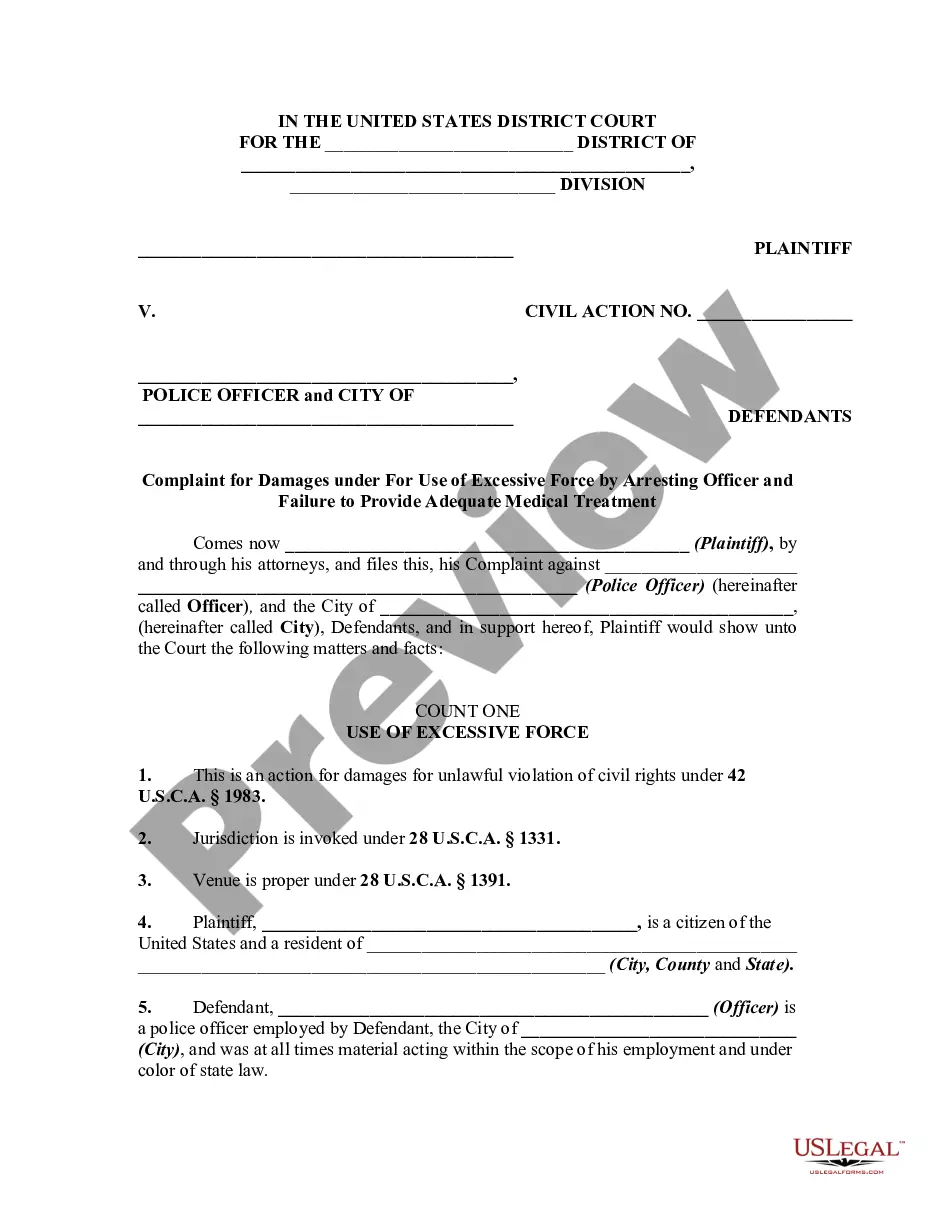
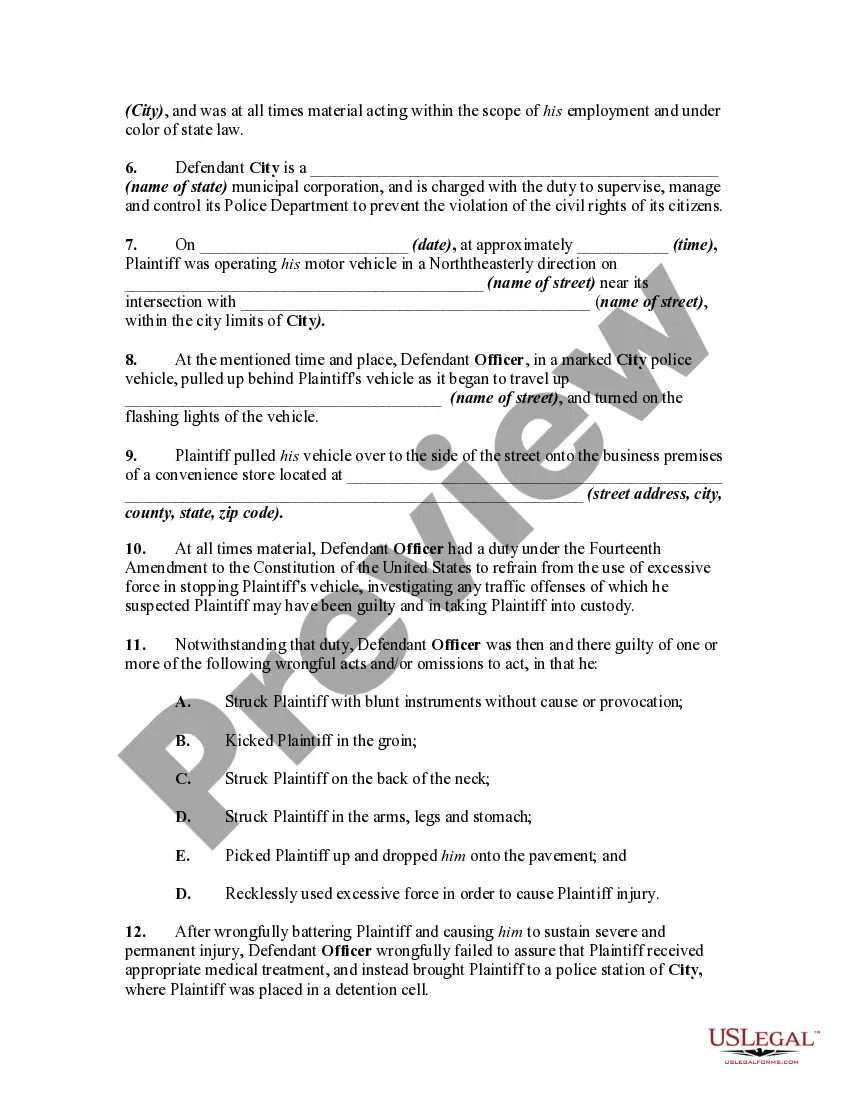
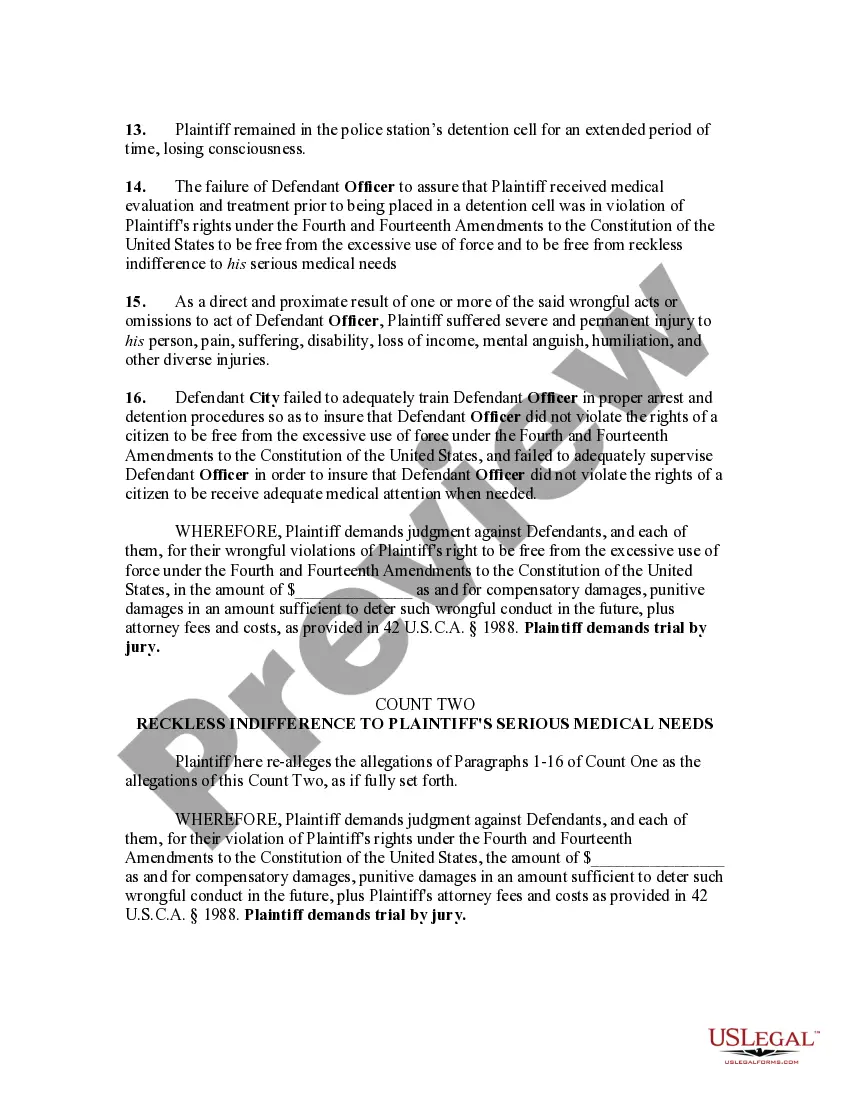
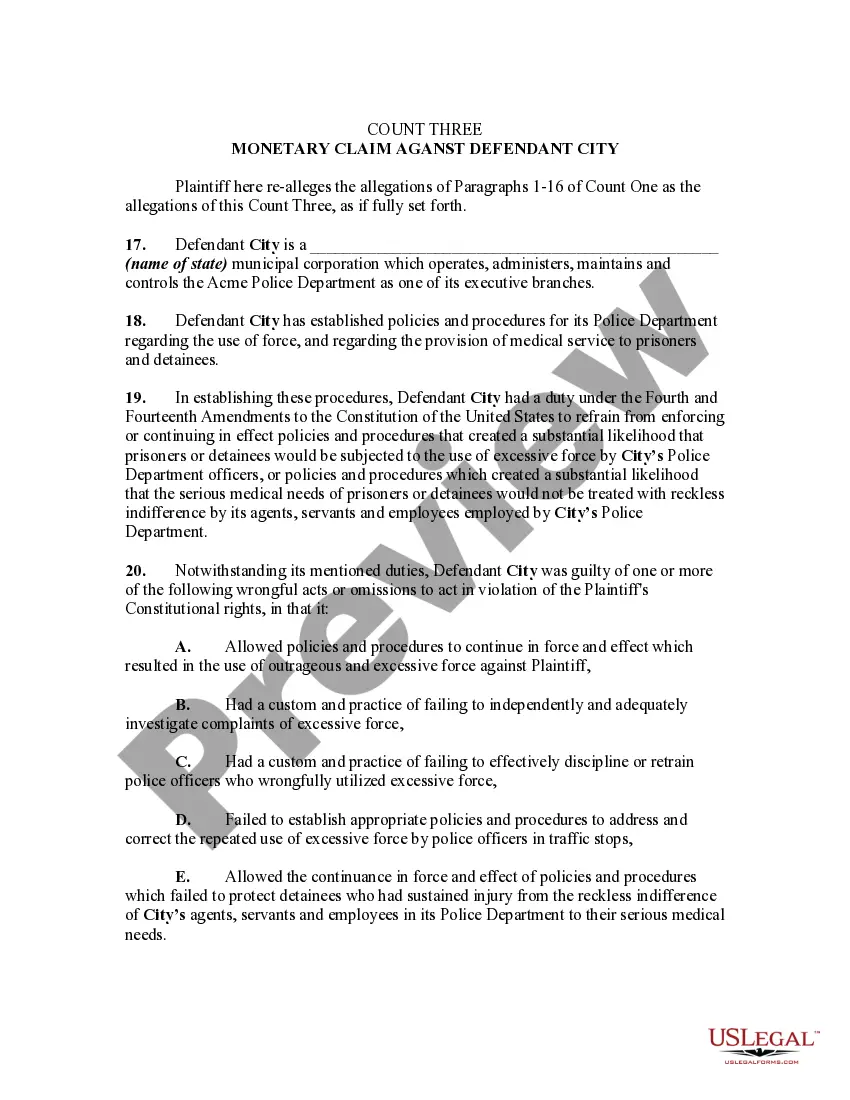





How to fill out Complaint In Federal Court For Damages Resulting From Use Of Excessive Force - Police Brutality - By Arresting Officer And Failure To Provide Adequate Medical Treatment?
The Resultant Excessive Force Formula Triangle you see on this page is a reusable formal template drafted by professional lawyers in accordance with federal and state laws. For more than 25 years, US Legal Forms has provided people, businesses, and legal professionals with more than 85,000 verified, state-specific forms for any business and personal scenario. It’s the fastest, most straightforward and most reliable way to obtain the documents you need, as the service guarantees bank-level data security and anti-malware protection.
Obtaining this Resultant Excessive Force Formula Triangle will take you only a few simple steps:
- Search for the document you need and review it. Look through the file you searched and preview it or check the form description to verify it suits your requirements. If it does not, utilize the search option to find the appropriate one. Click Buy Now when you have located the template you need.
- Sign up and log in. Opt for the pricing plan that suits you and create an account. Use PayPal or a credit card to make a quick payment. If you already have an account, log in and check your subscription to continue.
- Obtain the fillable template. Pick the format you want for your Resultant Excessive Force Formula Triangle (PDF, Word, RTF) and save the sample on your device.
- Fill out and sign the document. Print out the template to complete it by hand. Alternatively, utilize an online multi-functional PDF editor to rapidly and accurately fill out and sign your form with a valid.
- Download your papers one more time. Utilize the same document again anytime needed. Open the My Forms tab in your profile to redownload any previously downloaded forms.
Sign up for US Legal Forms to have verified legal templates for all of life’s scenarios at your disposal.
Form popularity
FAQ
If one force is acting perpendicular to another, the resultant force is determined by using the Pythagorean theorem. The Resultant force formula is given by, FR = F1 + F2 + F3. Where. F1, F2, F3 are the three forces acting in the same direction on an object.
To find the magnitude of the resultant force, you use the equation R = F1 + F2, where F1 and F2 are the magnitudes of the two individual forces. To find the direction of the resultant force, you use the trigonometric functions sine and cosine.
The formula for the resultant force vector is given by Newton's Second law. This law states that the force is equal to mass times acceleration, or F=ma.
Statics: How to find the resultant force using the triangle law - YouTube YouTube Start of suggested clip End of suggested clip So the magnitude of the resultant Force R equals 6.8 kilo Newton to find the measure of angle a weMoreSo the magnitude of the resultant Force R equals 6.8 kilo Newton to find the measure of angle a we can use the sine. Law.
F (R) = F (1)+ F (2) + F (3) ; F (R) = 50+60-20; Hence, the Resultant Force on that object is 90N. (d) One of the force should be in the opposite direction as compared to the other two for zero resultant force.