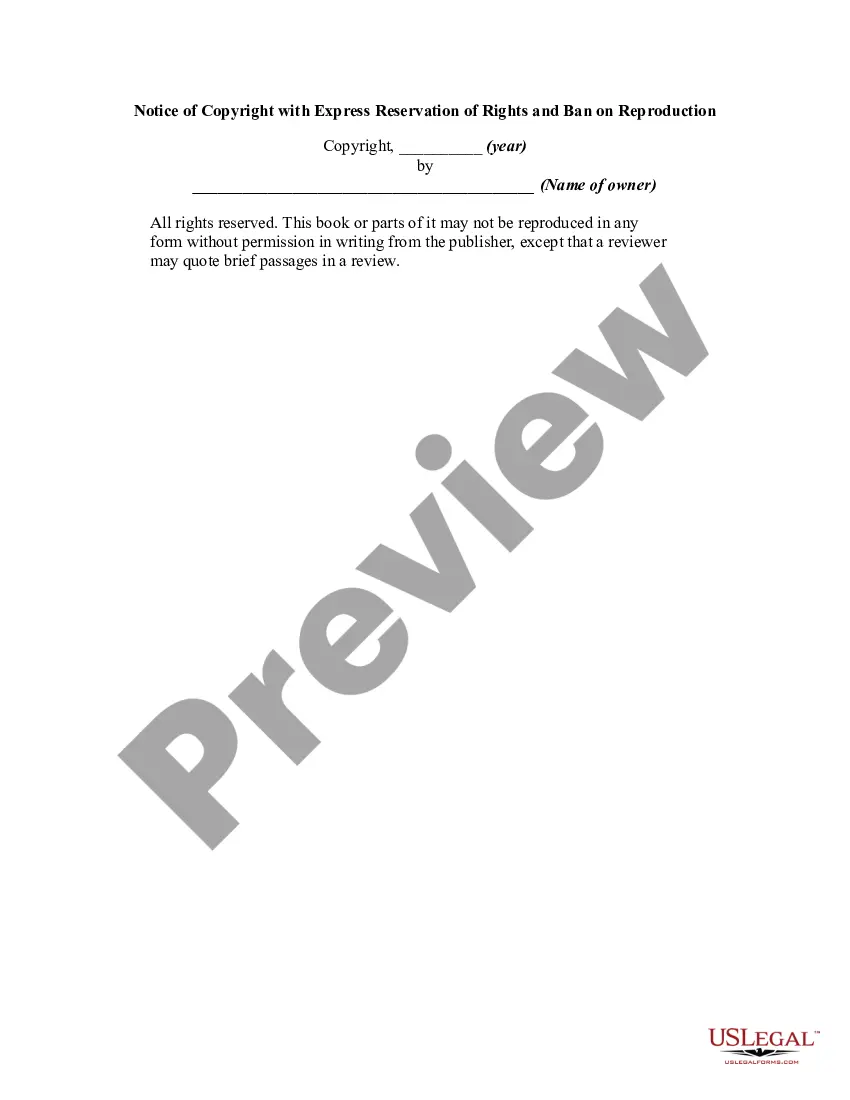
Notice Copyright Sample Without Permission
Description
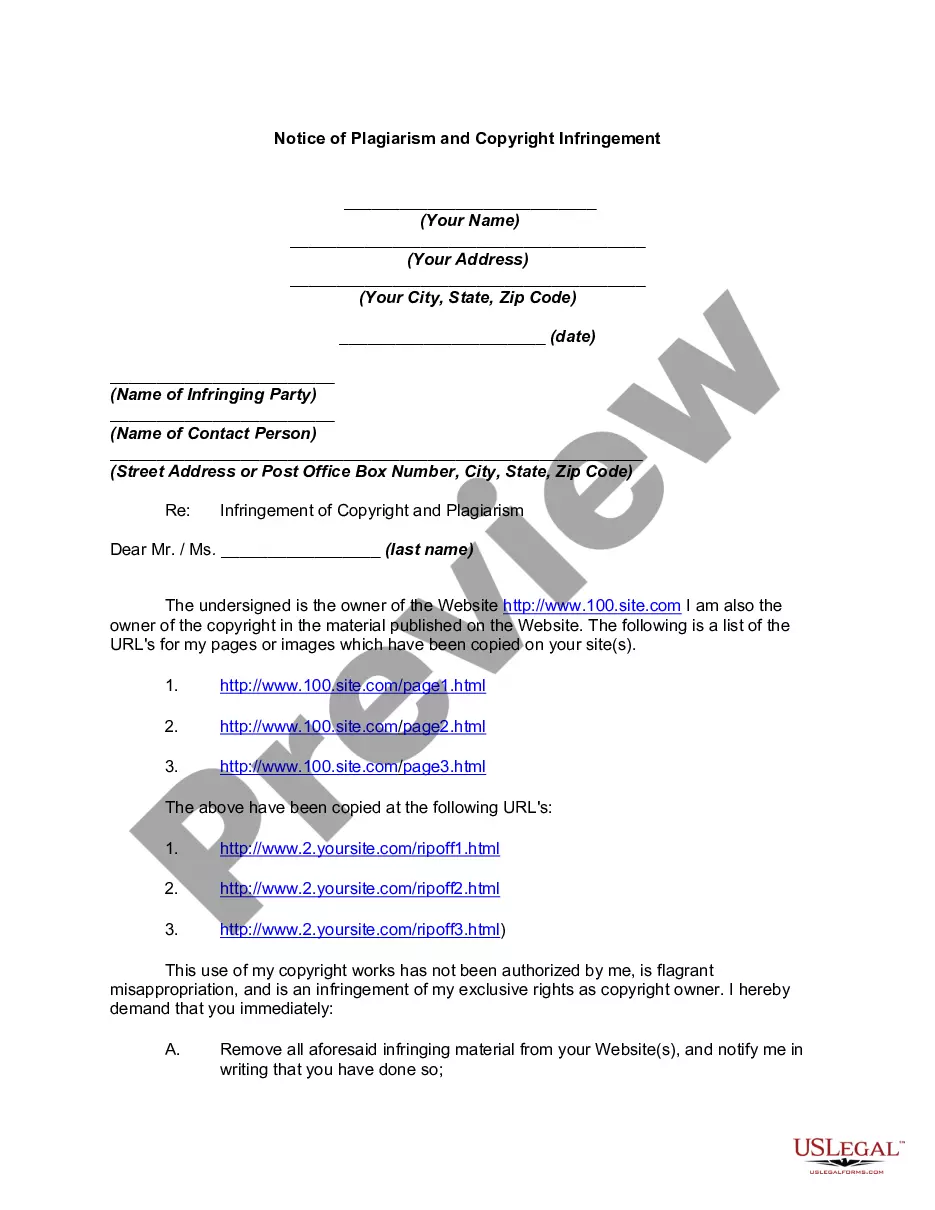
Get your form ready online
Our built-in tools help you complete, sign, share, and store your documents in one place.
Make edits, fill in missing information, and update formatting in US Legal Forms—just like you would in MS Word.
Download a copy, print it, send it by email, or mail it via USPS—whatever works best for your next step.
Sign and collect signatures with our SignNow integration. Send to multiple recipients, set reminders, and more. Go Premium to unlock E-Sign.
If this form requires notarization, complete it online through a secure video call—no need to meet a notary in person or wait for an appointment.
We protect your documents and personal data by following strict security and privacy standards.

Make edits, fill in missing information, and update formatting in US Legal Forms—just like you would in MS Word.

Download a copy, print it, send it by email, or mail it via USPS—whatever works best for your next step.

Sign and collect signatures with our SignNow integration. Send to multiple recipients, set reminders, and more. Go Premium to unlock E-Sign.

If this form requires notarization, complete it online through a secure video call—no need to meet a notary in person or wait for an appointment.

We protect your documents and personal data by following strict security and privacy standards.
Looking for another form?




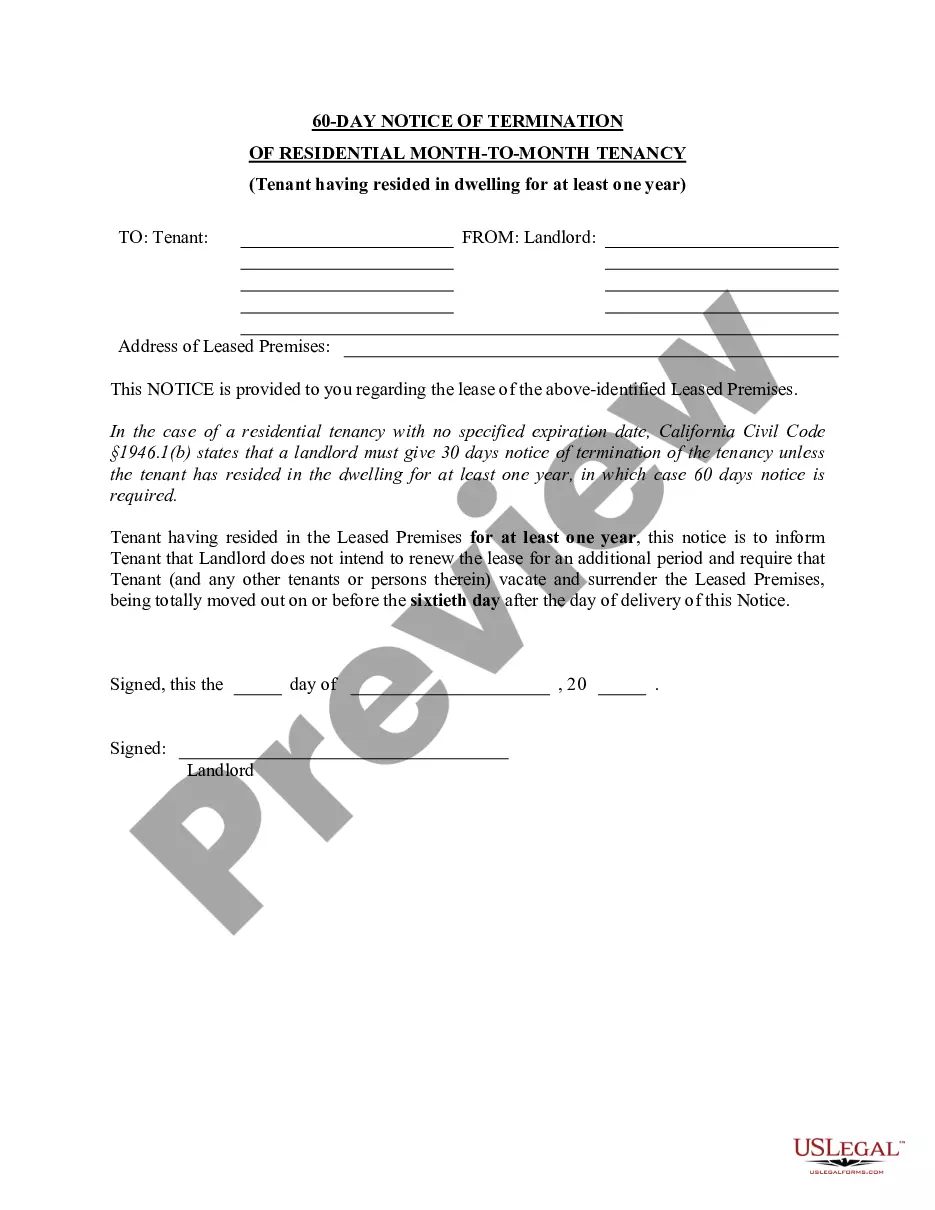
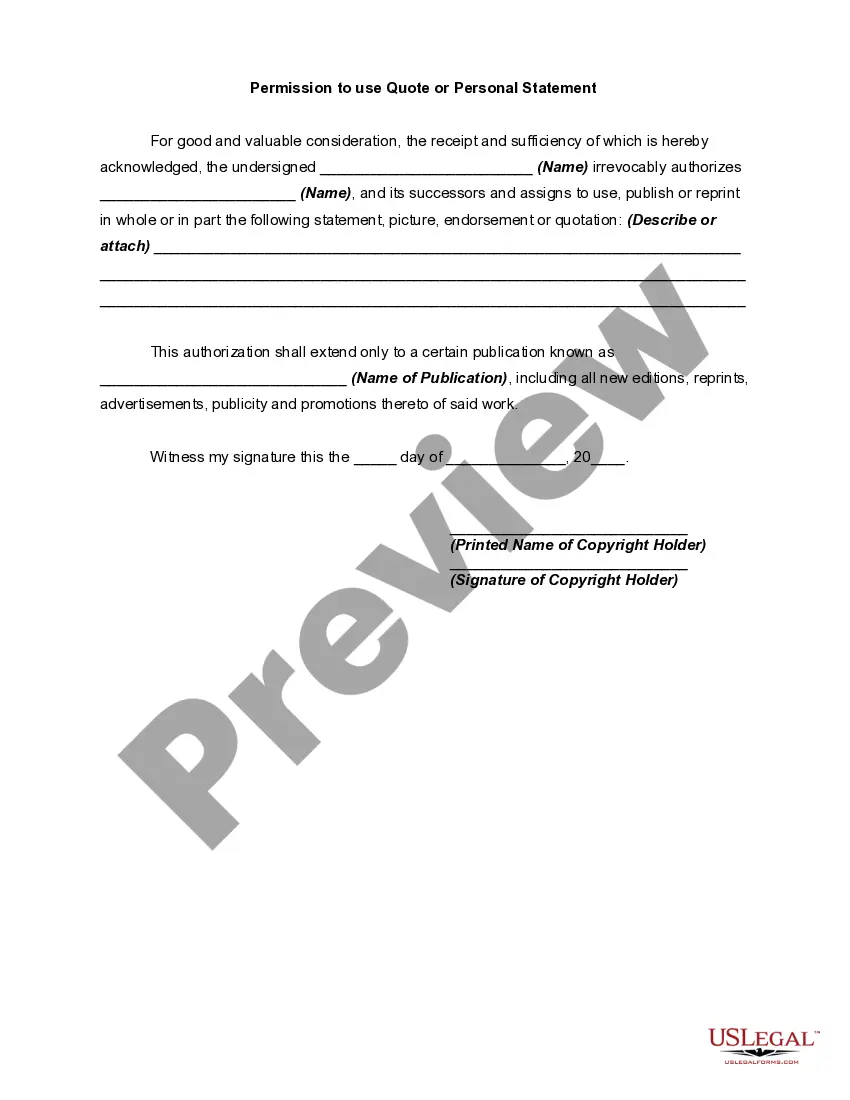
How to fill out Notice Of Copyright With Express Reservation Of Rights And Ban On Reproduction?
Locating a reliable source to obtain the latest and pertinent legal documents is part of the challenge of dealing with bureaucracy.
Finding the appropriate legal documents requires precision and meticulousness, which is why it is essential to acquire samples of Notice Copyright Sample Without Permission exclusively from trustworthy providers, like US Legal Forms. A flawed template will squander your time and hinder your situation.
Once you have the form on your device, you may modify it with the editor or print it out and complete it manually. Remove the inconvenience associated with your legal documentation. Browse the comprehensive US Legal Forms collection where you can discover legal samples, verify their relevance to your circumstances, and download them instantly.
- Utilize the library navigation or search bar to find your sample.
- Review the form’s details to confirm it meets the standards of your state and area.
- Access the form preview, if available, to ensure the template is what you require.
- Continue your search and identify the suitable document if the Notice Copyright Sample Without Permission does not fulfill your requirements.
- If you are certain about the form’s applicability, download it.
- If you are a registered user, click Log in to verify and access your selected templates in My documents.
- If you do not have an account yet, click Buy now to acquire the template.
- Select the pricing plan that aligns with your needs.
- Proceed to the registration to finalize your purchase.
- Complete your purchase by selecting a payment method (credit card or PayPal).
- Choose the file format for downloading Notice Copyright Sample Without Permission.
Form popularity
FAQ
"[The author] assumes no responsibility or liability for any errors or omissions in the content of this site. The information contained in this site is provided on an "as is" basis with no guarantees of completeness, accuracy, usefulness or timeliness..."
How much of someone else's work can I use without getting permission? Under the fair use doctrine of the U.S. copyright statute, it is permissible to use limited portions of a work including quotes, for purposes such as commentary, criticism, news reporting, and scholarly reports.
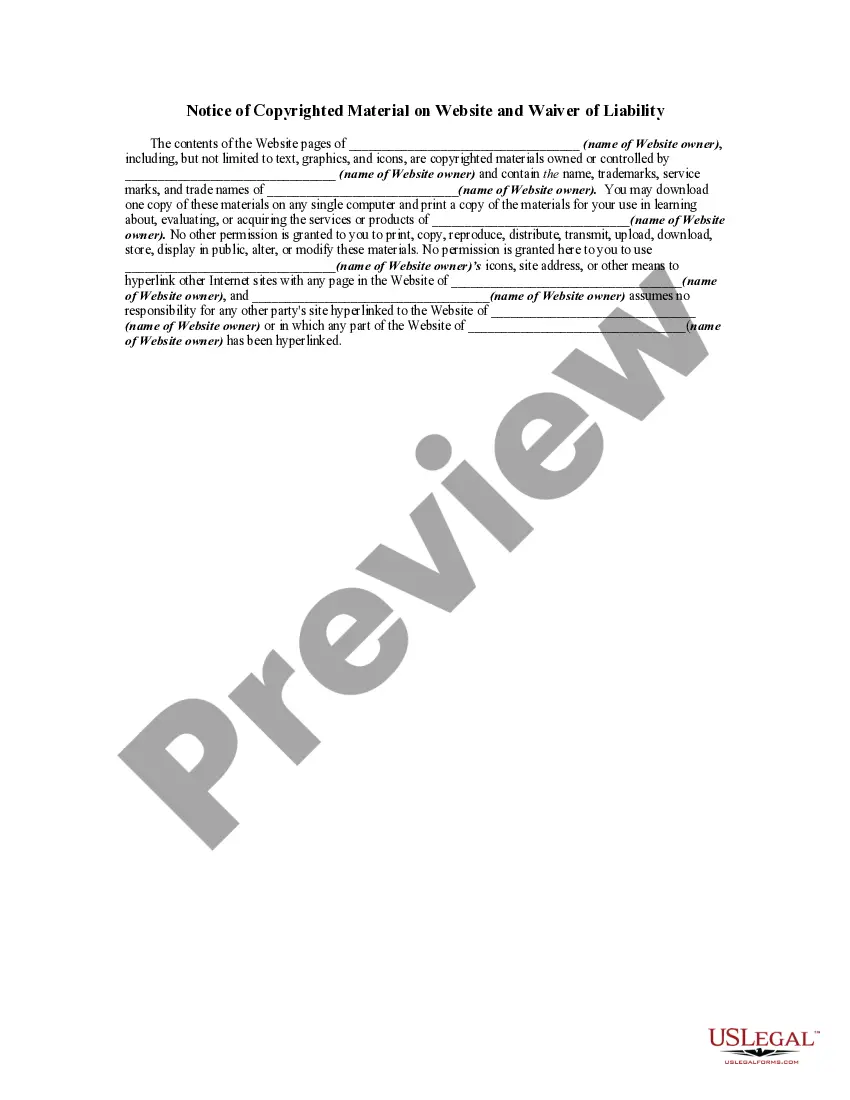
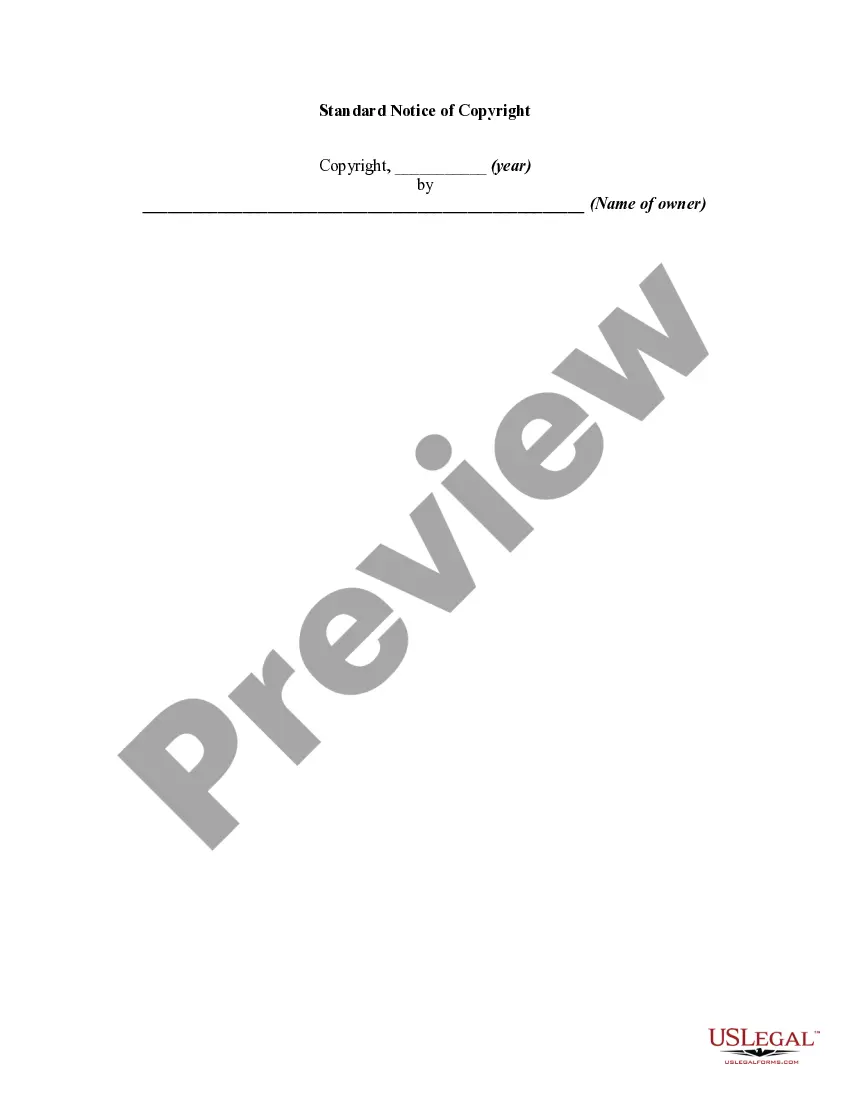
While it is simple, the Copyright Disclaimer does have some distinct, important parts: The copyright symbol © (or a proper substitute) The year of the website's most recent update and publication. The name of the site's owner (either person or company) A statement reserving the rights of the owner (optional)
The copyright notice generally consists of three elements: The symbol © (the letter C in a circle), or the word "Copyright" or the abbreviation "Copr."; The year of first publication of the work; and. The name of the owner of copyright in the work.
Many types of works are eligible for copyright protection, for example: Audiovisual works, such as TV shows, movies, and online videos. Sound recordings and musical compositions. Written works, such as lectures, articles, books, and musical compositions.