Sole Proprietorship For Photography
Description
Get your form ready online
Our built-in tools help you complete, sign, share, and store your documents in one place.
Make edits, fill in missing information, and update formatting in US Legal Forms—just like you would in MS Word.
Download a copy, print it, send it by email, or mail it via USPS—whatever works best for your next step.
Sign and collect signatures with our SignNow integration. Send to multiple recipients, set reminders, and more. Go Premium to unlock E-Sign.
If this form requires notarization, complete it online through a secure video call—no need to meet a notary in person or wait for an appointment.
We protect your documents and personal data by following strict security and privacy standards.

Make edits, fill in missing information, and update formatting in US Legal Forms—just like you would in MS Word.

Download a copy, print it, send it by email, or mail it via USPS—whatever works best for your next step.

Sign and collect signatures with our SignNow integration. Send to multiple recipients, set reminders, and more. Go Premium to unlock E-Sign.

If this form requires notarization, complete it online through a secure video call—no need to meet a notary in person or wait for an appointment.

We protect your documents and personal data by following strict security and privacy standards.
Looking for another form?




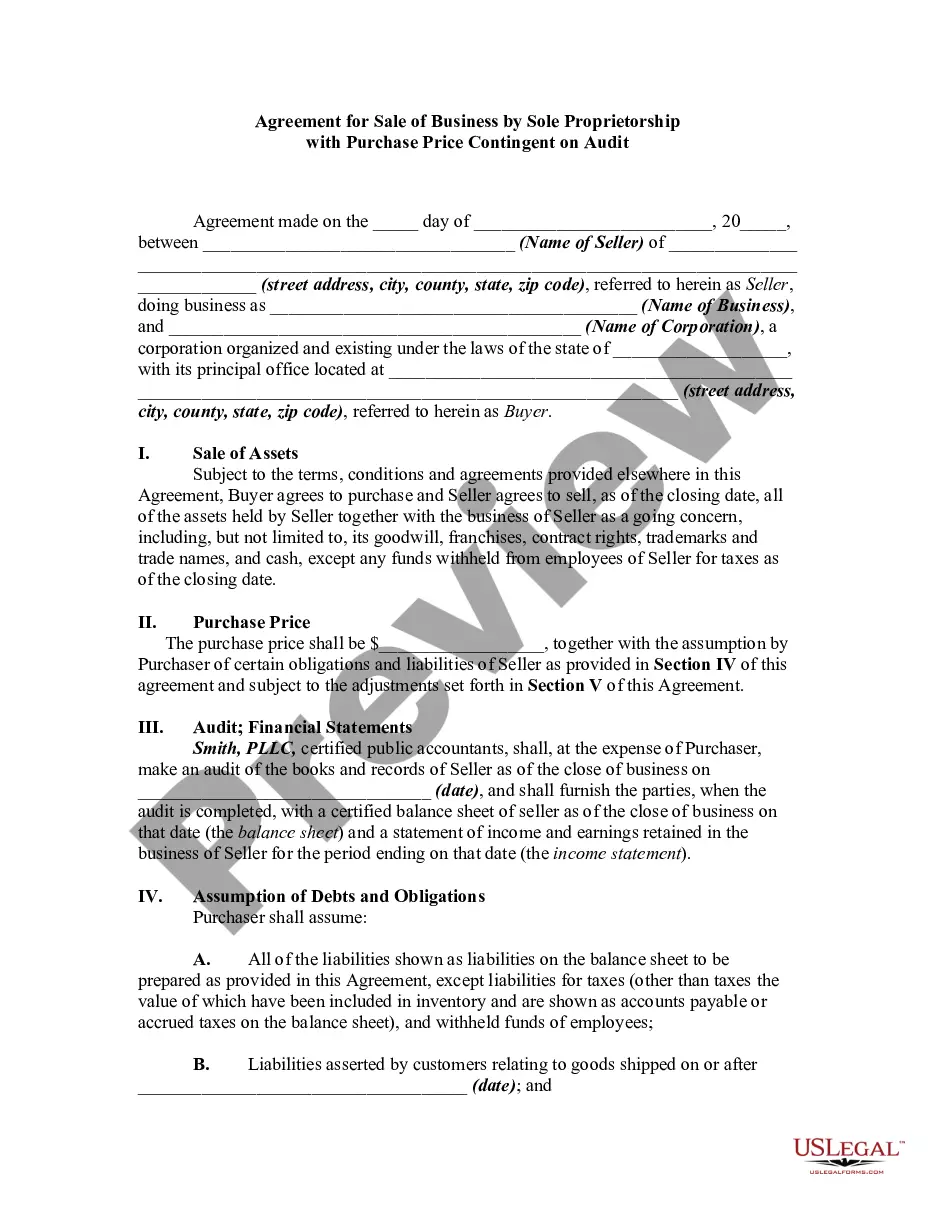
How to fill out Agreement For Sale Of Business By Sole Proprietorship With Purchase Price Contingent On Audit?
- Log in to your US Legal Forms account or create a new one if this is your first visit.
- In preview mode, browse through the extensive library to find the right sole proprietorship form for photography that fits your requirements.
- If the form does not meet your needs, utilize the search function to discover additional templates available in their rich repository.
- Once you've selected your form, click on the Buy Now button and choose the subscription plan that suits you best, while registering an account for full access to available resources.
- Complete your payment through credit card or PayPal to finalize your subscription.
- After payment processing, download the necessary form and save it on your device to proceed with completion. You can also find it in the My Forms section of your profile for future use.
US Legal Forms not only offers a robust collection of documents but also connects you with legal professionals who can assist you in ensuring your forms are completed correctly. This service guarantees that your sole proprietorship for photography is setup properly, reducing stress and focus more on your creative work.
Embrace the ease of setting up your photography business today with US Legal Forms. Visit their website to start your journey!
Form popularity
FAQ
The ideal type of business for photography often starts with a sole proprietorship for photography. This structure allows you to retain complete control and offers simplified tax filings. However, as your business grows and your needs change, you might explore other options like forming an LLC. Always remember to weigh your options and choose a structure that aligns with your long-term business goals.
The best business structure for a photography business largely depends on your personal circumstances and preferences. Many photographers begin as a sole proprietorship for photography because it is easy to set up and requires minimal costs. As your business expands, consider moving to an LLC for added protection and tax benefits. Assess your situation regularly, and don't hesitate to consult with a legal professional to find what suits you best.
Choosing between an LLC and a sole proprietorship for photography depends on your business goals and risk tolerance. A sole proprietorship offers ease of setup and management, while an LLC provides personal liability protection, which can safeguard your assets. If your photography business grows and you face increased risks, transitioning to an LLC might be wise. However, starting as a sole proprietorship can be advantageous for new photographers testing the waters.
When you consider structuring a photography business, starting as a sole proprietorship for photography is a simple and effective option. This structure allows you to operate under your own name or a business name, making it easy to manage. You'll find it straightforward to report your income and expenses on your personal tax return, which simplifies your accounting. Additionally, using a sole proprietorship lets you maintain full control over your creative vision.
To file taxes for your photography business, begin by organizing your income and expenses throughout the year. Use the IRS Schedule C form to report your earnings as a sole proprietorship for photography. If needed, consider software or platforms like uslegalforms to assist with the filing process and ensure you complete your taxes accurately and efficiently.
As a photographer, you can deduct various expenses from your taxable income, including equipment costs, software subscriptions, marketing expenses, and even home office space. Keeping track of these deductions can lower your tax burden significantly. Ensure you document all your expenses to maximize your savings while operating under a sole proprietorship for photography.
Yes, as a photographer, you may receive a 1099 form if you work as an independent contractor or freelance photographer. This form reports your income and is crucial for filing taxes accurately. Since you operate as a sole proprietorship for photography, keeping thorough records will help you manage your income and expenses effectively.
As a photographer working as a sole proprietorship for photography, you typically do not need an EIN unless you have employees. However, having an EIN can simplify various business processes, such as managing taxes and separating personal finances. If you're uncertain, consulting with a professional can help you make the right choice.
You do not need an EIN for your photography business if you operate as a sole proprietorship for photography without any employees. However, obtaining an EIN can be beneficial for easier tax processing, opening a business account, and establishing a professional image. Consider applying for one if you plan to expand your business in the future.
Yes, you can definitely be a photographer without an LLC. Many photographers successfully operate as sole proprietorships for photography, focusing on their craft rather than business structures. This approach is ideal for those just starting or operating on a small scale.