Water Sharing Agreement Formula
Description
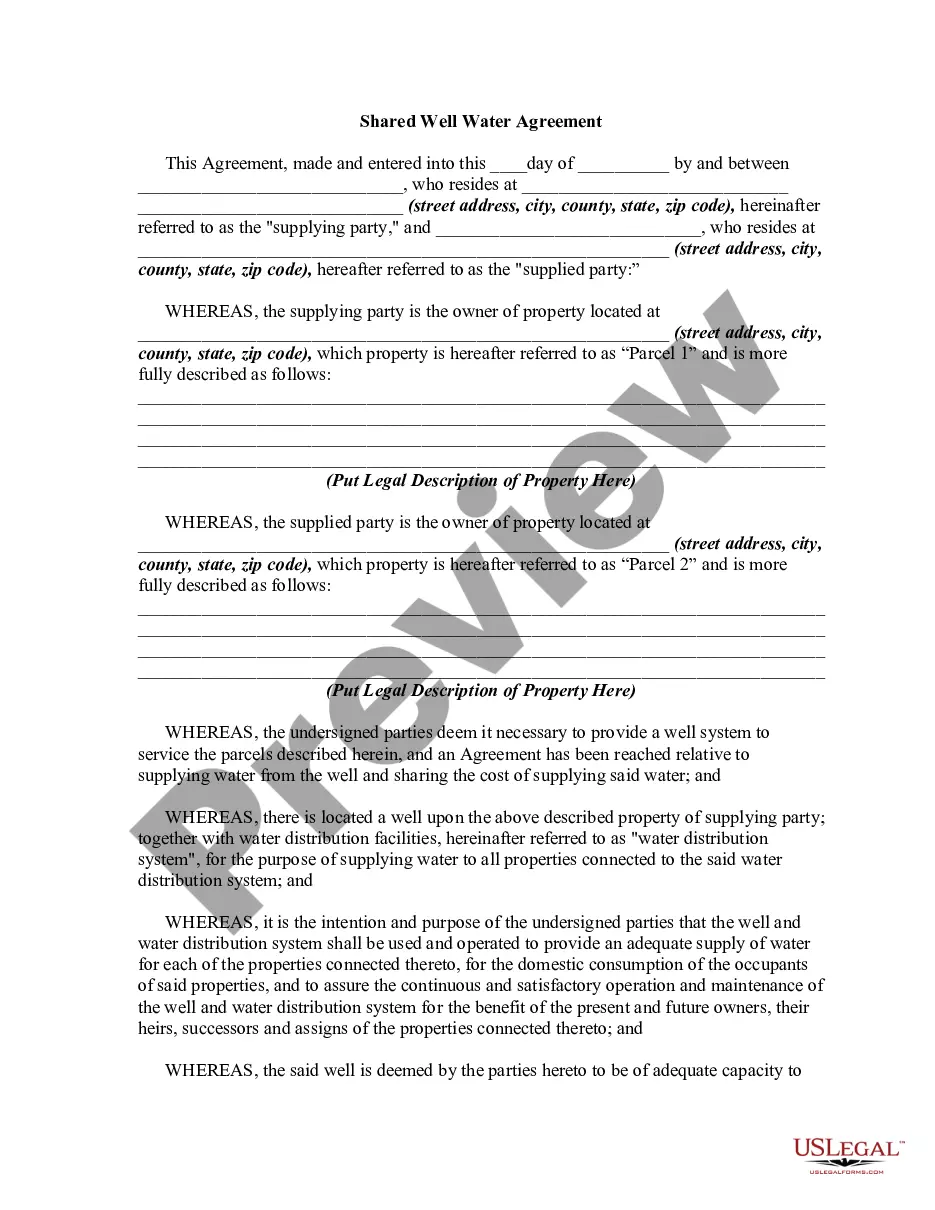
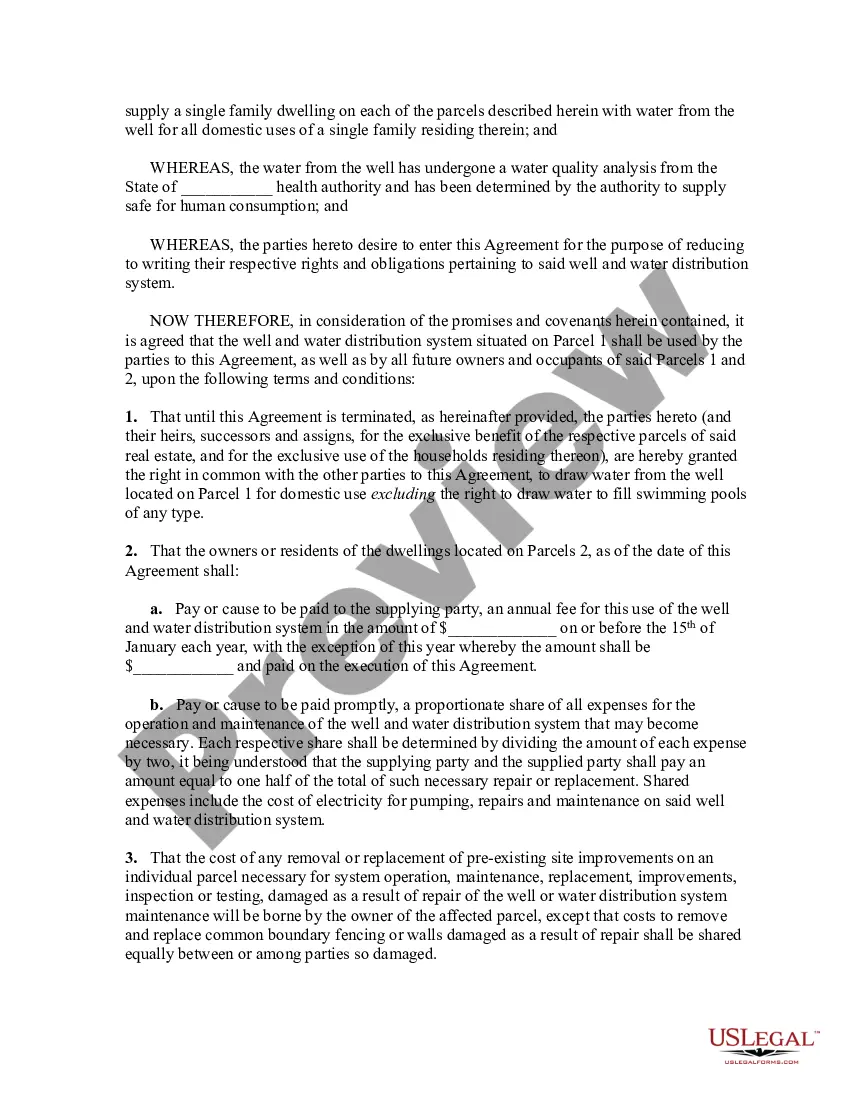
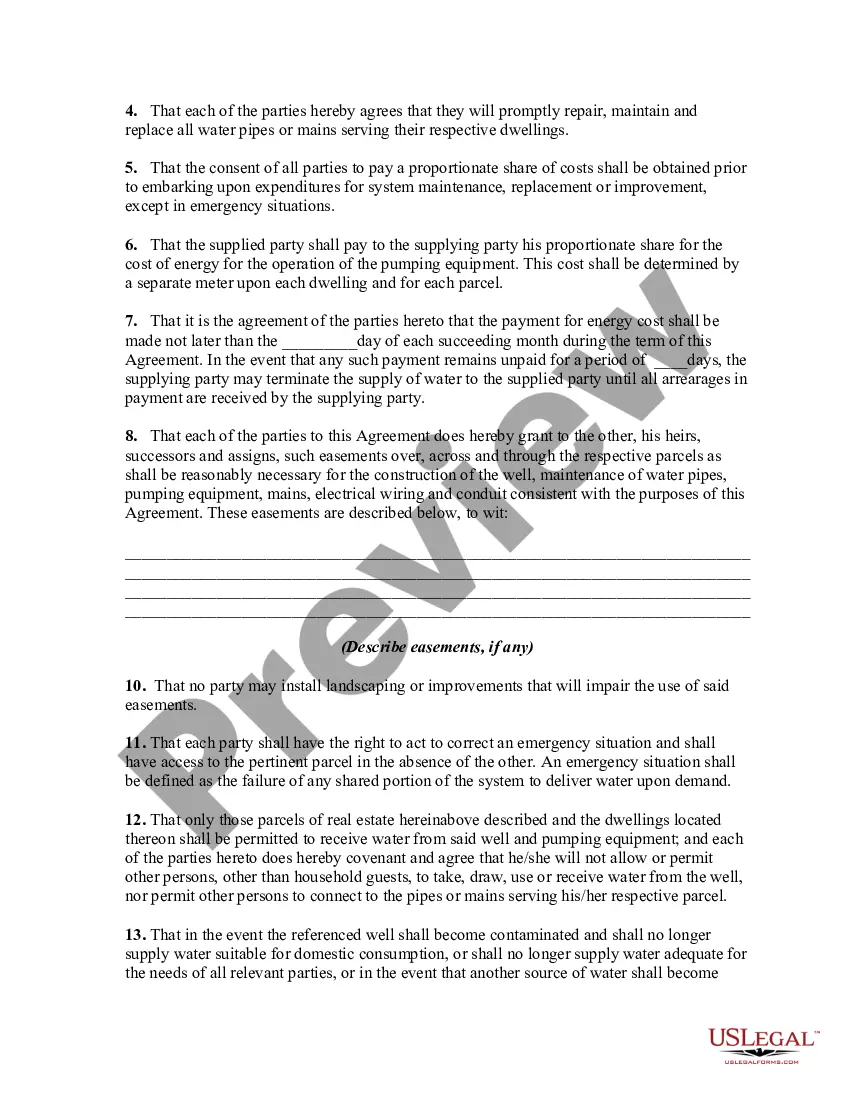
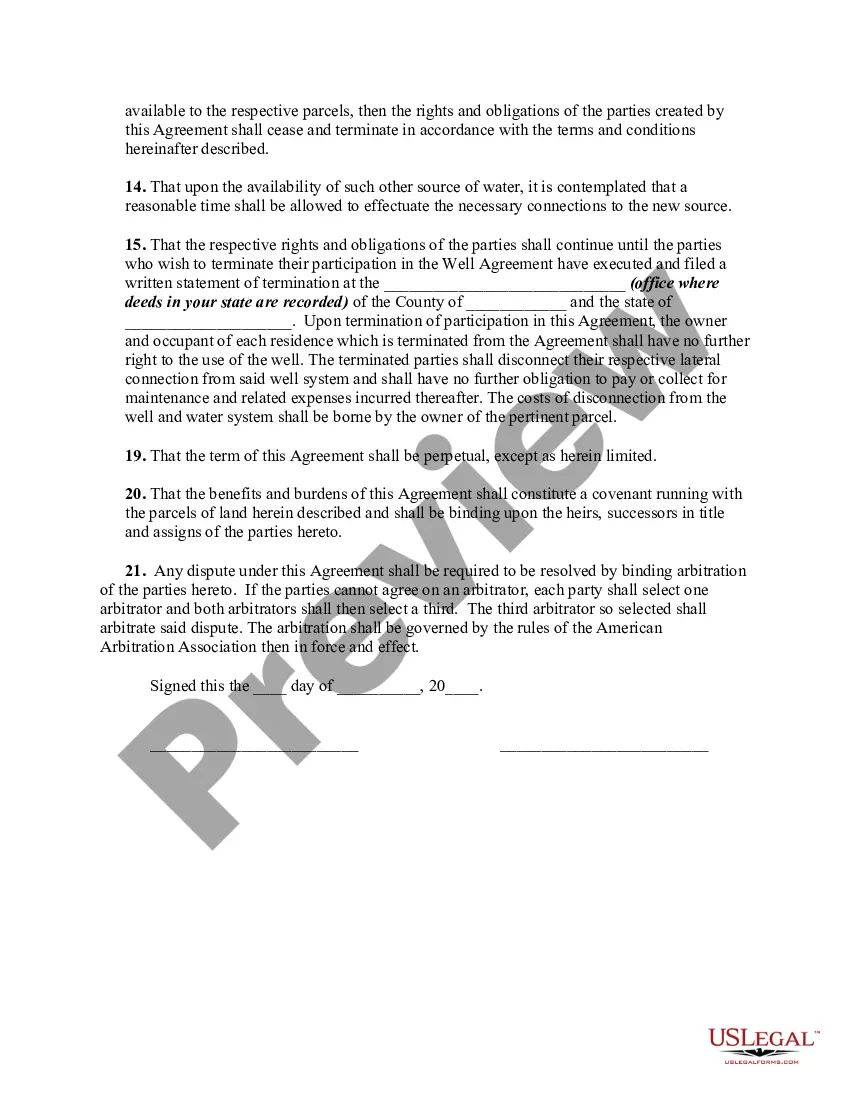
Get your form ready online
Our built-in tools help you complete, sign, share, and store your documents in one place.
Make edits, fill in missing information, and update formatting in US Legal Forms—just like you would in MS Word.
Download a copy, print it, send it by email, or mail it via USPS—whatever works best for your next step.
Sign and collect signatures with our SignNow integration. Send to multiple recipients, set reminders, and more. Go Premium to unlock E-Sign.
If this form requires notarization, complete it online through a secure video call—no need to meet a notary in person or wait for an appointment.
We protect your documents and personal data by following strict security and privacy standards.

Make edits, fill in missing information, and update formatting in US Legal Forms—just like you would in MS Word.

Download a copy, print it, send it by email, or mail it via USPS—whatever works best for your next step.

Sign and collect signatures with our SignNow integration. Send to multiple recipients, set reminders, and more. Go Premium to unlock E-Sign.

If this form requires notarization, complete it online through a secure video call—no need to meet a notary in person or wait for an appointment.

We protect your documents and personal data by following strict security and privacy standards.
Looking for another form?
How to fill out Shared Well Water Agreement?
Locating a reliable resource for acquiring the latest and most pertinent legal templates is a significant part of managing red tape. Identifying the appropriate legal documents requires precision and meticulousness, which highlights the importance of obtaining samples of Water Sharing Agreement Formula exclusively from trustworthy origins, such as US Legal Forms. A flawed template can squander your time and hinder your current situation. With US Legal Forms, your concerns are minimal. You can access and examine all the pertinent details regarding the document’s applicability and significance for your situation and within your state or county.
Consider these outlined steps to complete your Water Sharing Agreement Formula.
Eliminate the inconvenience associated with your legal documents. Explore the extensive US Legal Forms archive to discover legal templates, verify their relevance to your situation, and download them instantly.
- Utilize the catalog navigation or search bar to find your template.
- Examine the form’s details to confirm it meets the requirements of your state and locality.
- Check the form preview, if accessible, to verify that it is indeed the form you are looking for.
- Continue searching and find the appropriate template if the Water Sharing Agreement Formula does not meet your specifications.
- If you are confident in the form’s applicability, download it.
- If you are a registered user, click Log in to validate and access your selected templates in My documents.
- If you haven't created an account yet, click Buy now to obtain the template.
- Choose the pricing option that suits your needs.
- Proceed with registration to complete your purchase.
- Finalize your transaction by selecting a payment method (credit card or PayPal).
- Choose the document format for downloading the Water Sharing Agreement Formula.
- Once you have the form on your device, you may edit it using the editor or print it and fill it out manually.
Form popularity
FAQ
There are two major reservoir projects that provide water supply for the Russian River watershed: Lake Mendocino on the East Fork of the Russian River and Lake Sonoma on Dry Creek.
After nearly a year of intense negotiations, California, Nevada and Arizona reached a historic agreement today to use less water from the overdrafted Colorado River over the next three years. The states agreed to give up 3 million acre-feet of river water through 2026 ? about 13% of the amount they receive.
Russian River stakeholders have developed a voluntary Water Sharing Program ? a locally driven approach for managing water demand to address water shortages. The goal is for participants to have access to water supply as long as possible in the dry season, avoiding or delaying curtailment.
The states took 11 months to reach an agreement: the Colorado River Compact. It divided states in the watershed into an Upper Basin and a Lower Basin, which would each receive 7.5 million acre-feet of water per year.
Provisions Upper Basin, 7.5 million acre·ft/year (293 m³/s) totalColorado51.75%*3.86 million acre·ft/year (150.7 m³/s)California58.70%4.40 million acre·ft/year (172 m³/s)Arizona37.30%2.80 million acre·ft/year (109 m³/s)Nevada4.00%0.30 million acre·ft/year (12 m³/s)6 more rows