Self Employed Injury Form 1040
Description

Get your form ready online
Our built-in tools help you complete, sign, share, and store your documents in one place.
Make edits, fill in missing information, and update formatting in US Legal Forms—just like you would in MS Word.
Download a copy, print it, send it by email, or mail it via USPS—whatever works best for your next step.
Sign and collect signatures with our SignNow integration. Send to multiple recipients, set reminders, and more. Go Premium to unlock E-Sign.
If this form requires notarization, complete it online through a secure video call—no need to meet a notary in person or wait for an appointment.
We protect your documents and personal data by following strict security and privacy standards.

Make edits, fill in missing information, and update formatting in US Legal Forms—just like you would in MS Word.

Download a copy, print it, send it by email, or mail it via USPS—whatever works best for your next step.

Sign and collect signatures with our SignNow integration. Send to multiple recipients, set reminders, and more. Go Premium to unlock E-Sign.

If this form requires notarization, complete it online through a secure video call—no need to meet a notary in person or wait for an appointment.

We protect your documents and personal data by following strict security and privacy standards.
Looking for another form?



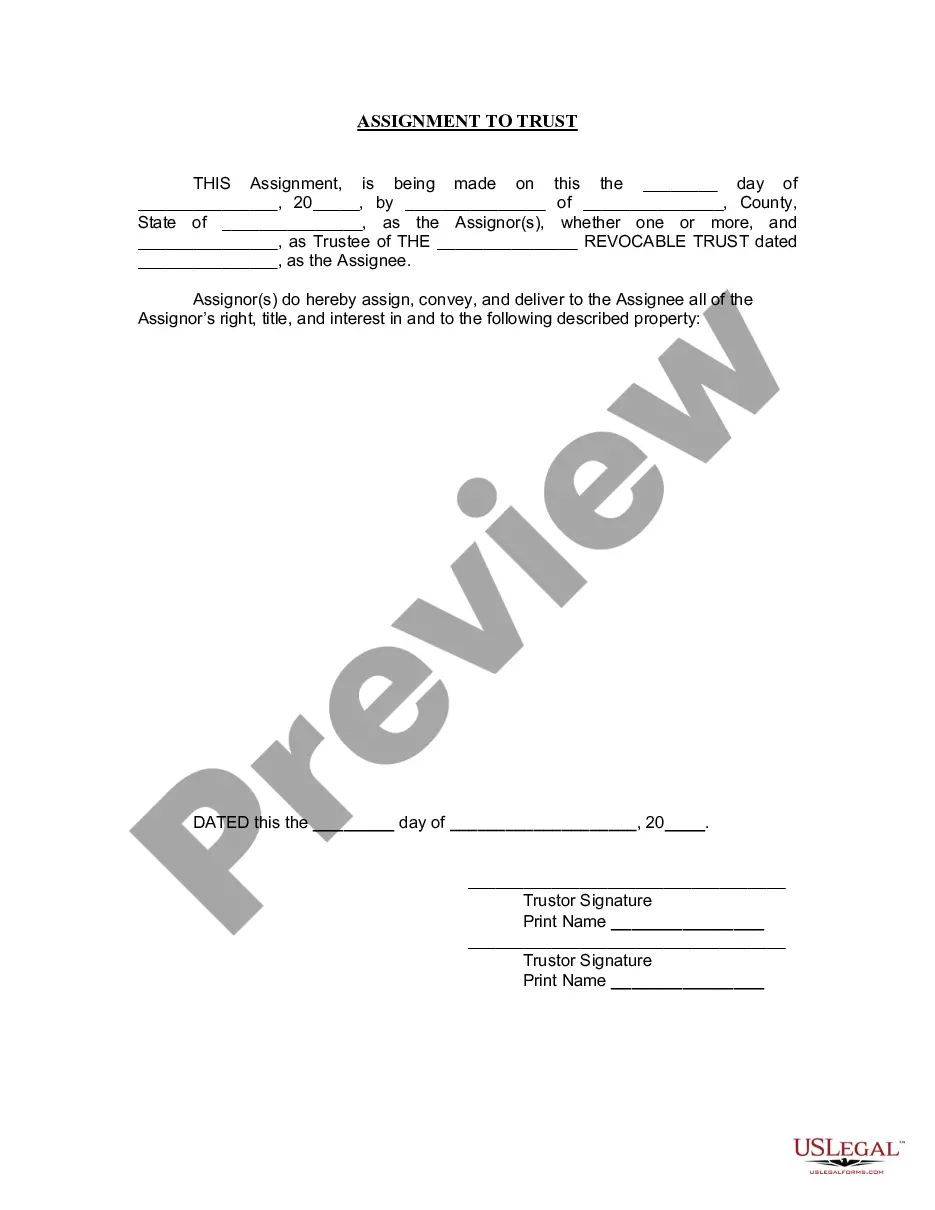






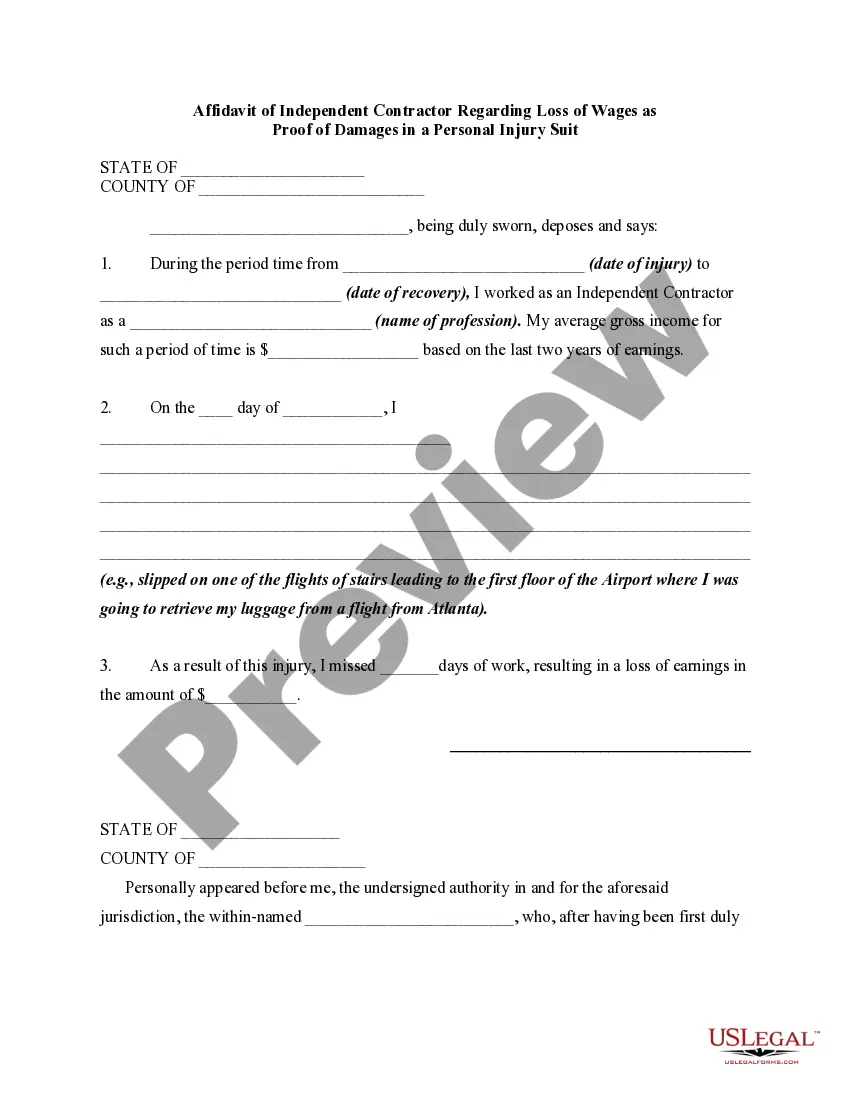
How to fill out Affidavit Of Self-Employed Independent Contractor Regarding Loss Of Wages As Proof Of Damages In Personal Injury Suit?
Whether for commercial reasons or personal matters, everyone must confront legal issues at some stage in their life.
Filling out legal documents requires meticulous care, starting from selecting the appropriate form template.
With a vast US Legal Forms catalog available, you don’t have to waste time searching for the correct template online. Use the library’s user-friendly navigation to find the right form for any situation.
- For instance, if you choose an incorrect version of the Self Employed Injury Form 1040, it will be declined upon submission.
- Thus, it is vital to obtain a reliable source of legal documents such as US Legal Forms.
- If you wish to acquire a Self Employed Injury Form 1040 template, follow these simple steps.
- Locate the template you require using the search bar or catalog browsing.
- Review the form’s description to confirm it aligns with your situation, state, and county.
- Click on the form’s preview to inspect it.
- If it is the incorrect form, return to the search feature to find the Self Employed Injury Form 1040 sample you require.
- Download the template if it suits your needs.
- If you already have a US Legal Forms account, click Log in to access previously saved documents in My documents.
- If you do not possess an account yet, you may download the form by clicking Buy now.
- Choose the correct pricing option.
- Complete the account registration form.
- Select your payment method: either a credit card or PayPal account.
- Choose the file format you prefer and download the Self Employed Injury Form 1040.
- Once it is saved, you can fill out the form using editing software or print it and complete it by hand.
Form popularity
FAQ
There is no W-2 self-employed specific form that you can create. Instead, you must report your self-employment income on Schedule C (Form 1040) to report income or (loss) from any business you operated or profession you practiced as a sole proprietor in which you engaged for profit.
At its most basic, here is how to file self-employment taxes step-by-step. Calculate your income and expenses. That is a list of the money you've made, less the amount you've spent. ... Determine if you have a net profit or loss. Fill out an information return. ... Fill out a 1040 and other self-employment tax forms.
If your expenses are less than your income, the difference is net profit and becomes part of your income on page 1 of Form 1040 or 1040-SR. If your expenses are more than your income, the difference is a net loss. You usually can deduct your loss from gross income on page 1 of Form 1040 or 1040-SR.
Take the final amount recorded in line 4c and enter it in line 6 (unless you also have income as a church employee and received a Form W-2). Line 7 states the maximum amount you can pay Social Security tax on, $142,800. This will be used for calculations in Lines 9-10.
Answer: Independent contractors report their income on Schedule C (Form 1040), Profit or Loss from Business (Sole Proprietorship). Also file Schedule SE (Form 1040), Self-Employment Tax if net earnings from self-employment are $400 or more.