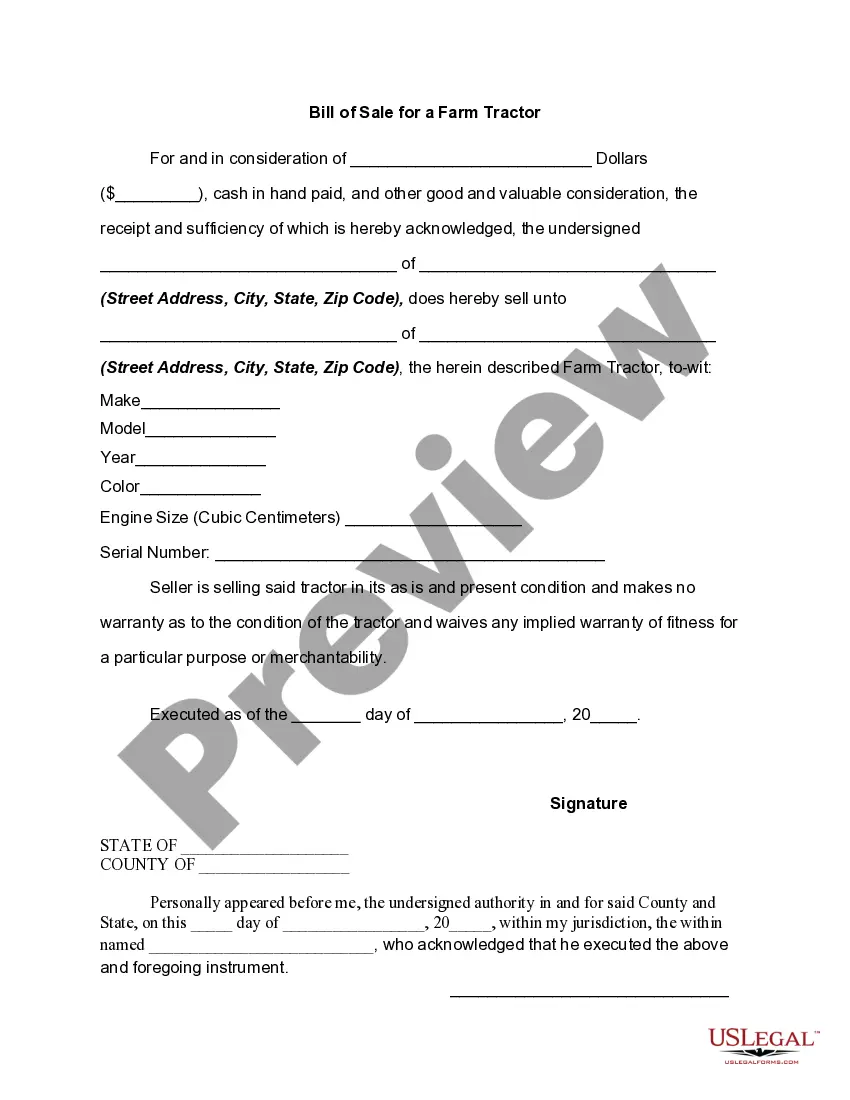
Bill Of Sale For Tractor Format
Description
Get your form ready online
Our built-in tools help you complete, sign, share, and store your documents in one place.
Make edits, fill in missing information, and update formatting in US Legal Forms—just like you would in MS Word.
Download a copy, print it, send it by email, or mail it via USPS—whatever works best for your next step.
Sign and collect signatures with our SignNow integration. Send to multiple recipients, set reminders, and more. Go Premium to unlock E-Sign.
If this form requires notarization, complete it online through a secure video call—no need to meet a notary in person or wait for an appointment.
We protect your documents and personal data by following strict security and privacy standards.

Make edits, fill in missing information, and update formatting in US Legal Forms—just like you would in MS Word.

Download a copy, print it, send it by email, or mail it via USPS—whatever works best for your next step.

Sign and collect signatures with our SignNow integration. Send to multiple recipients, set reminders, and more. Go Premium to unlock E-Sign.

If this form requires notarization, complete it online through a secure video call—no need to meet a notary in person or wait for an appointment.

We protect your documents and personal data by following strict security and privacy standards.
Looking for another form?
How to fill out Bill Of Sale For A Farm Tractor?
The Bill Of Sale For Tractor Format you see on this page is a reusable legal template drafted by professional lawyers in compliance with federal and regional laws and regulations. For more than 25 years, US Legal Forms has provided individuals, organizations, and attorneys with more than 85,000 verified, state-specific forms for any business and personal scenario. It’s the quickest, simplest and most reliable way to obtain the documents you need, as the service guarantees the highest level of data security and anti-malware protection.
Acquiring this Bill Of Sale For Tractor Format will take you just a few simple steps:
- Search for the document you need and review it. Look through the sample you searched and preview it or check the form description to verify it suits your requirements. If it does not, make use of the search option to get the appropriate one. Click Buy Now when you have located the template you need.
- Subscribe and log in. Choose the pricing plan that suits you and create an account. Use PayPal or a credit card to make a quick payment. If you already have an account, log in and check your subscription to proceed.
- Acquire the fillable template. Choose the format you want for your Bill Of Sale For Tractor Format (PDF, Word, RTF) and download the sample on your device.
- Fill out and sign the paperwork. Print out the template to complete it manually. Alternatively, utilize an online multi-functional PDF editor to quickly and precisely fill out and sign your form with a eSignature.
- Download your papers again. Utilize the same document again whenever needed. Open the My Forms tab in your profile to redownload any previously saved forms.
Subscribe to US Legal Forms to have verified legal templates for all of life’s situations at your disposal.
Form popularity
FAQ
Etymology. The word tractor was taken from Latin, being the agent noun of trahere "to pull". The first recorded use of the word meaning "an engine or vehicle for pulling wagons or plows" occurred in 1896, from the earlier term "traction motor" (1859).
Here are a few maintenance tips for tractors to keep it in a good shape: Go through the owner's manual: ... Obtain all the maintenance tools: ... Protect the tractor from rain: ... Check fluids regularly: ... Ensure right air pressure in tires: ... Watch out for the brakes: ... Keep an eye on filters: ... Lubricate often:
You'll just have a receipt or invoice as proof of ownership. Farm tractors used as road tractors to mow the right-of-way or used-for-hire to move commodities over the highway are required to be registered and titled in the United States.
Farm tractors are not titled or registered because they have a lower rate of theft and fraud, compared to motor vehicles. And they don't use roads, bridges and tunnels regularly so there is no need for the government to tax the owner to maintain these networks.
The year was 1892. In a very small village in Clayton county of Northeast Iowa, the very first tractor was created by John Froelich. It had yet to be named the tractor, but it was the first successful gasoline engine that could maneuver forwards and backwards; the most rudimentary functions of modern engines.