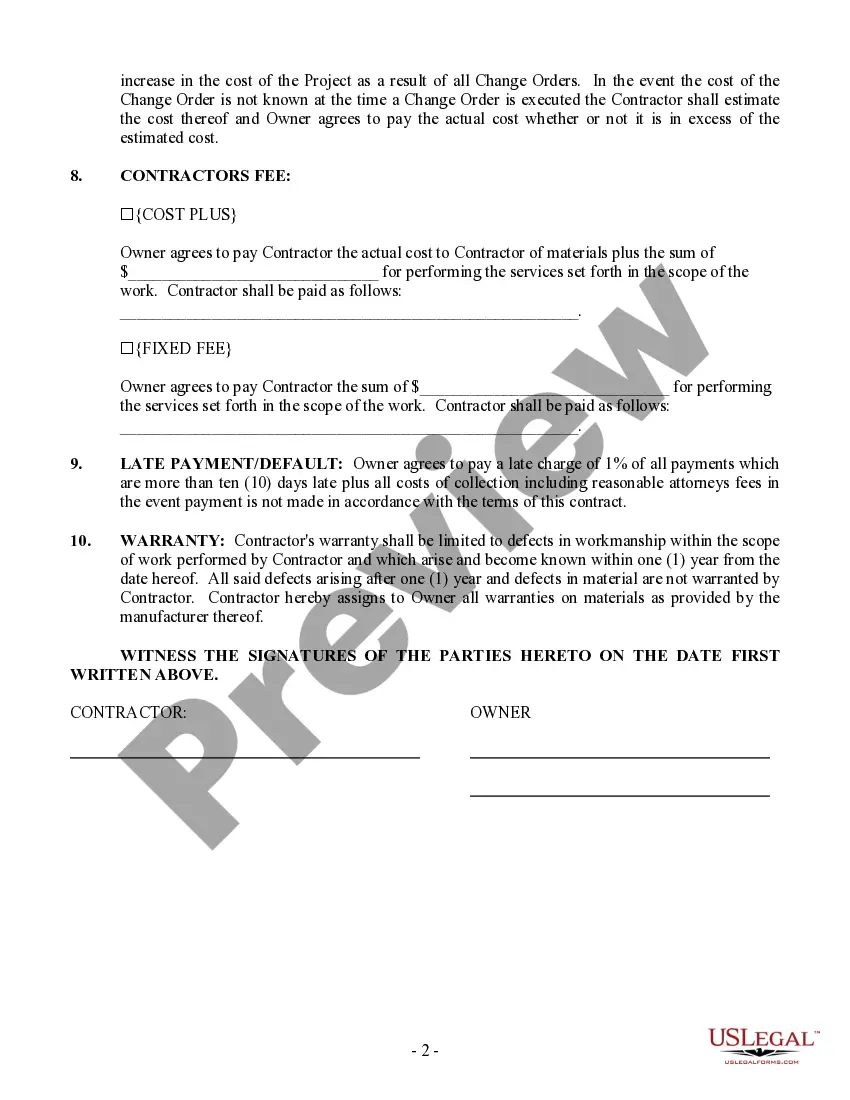
Construction Fee Plus Form With Two Points In Minnesota
Description

Get your form ready online
Our built-in tools help you complete, sign, share, and store your documents in one place.
Make edits, fill in missing information, and update formatting in US Legal Forms—just like you would in MS Word.
Download a copy, print it, send it by email, or mail it via USPS—whatever works best for your next step.
Sign and collect signatures with our SignNow integration. Send to multiple recipients, set reminders, and more. Go Premium to unlock E-Sign.
If this form requires notarization, complete it online through a secure video call—no need to meet a notary in person or wait for an appointment.
We protect your documents and personal data by following strict security and privacy standards.

Make edits, fill in missing information, and update formatting in US Legal Forms—just like you would in MS Word.

Download a copy, print it, send it by email, or mail it via USPS—whatever works best for your next step.

Sign and collect signatures with our SignNow integration. Send to multiple recipients, set reminders, and more. Go Premium to unlock E-Sign.

If this form requires notarization, complete it online through a secure video call—no need to meet a notary in person or wait for an appointment.

We protect your documents and personal data by following strict security and privacy standards.
Looking for another form?






Form popularity
FAQ
Labor to permanently attach an item to real property is construction labor, which is not taxable because it is an im- provement to real property. Usually, the items stay with the building when it is sold to another party. Labor to repair items attached to real property is construction labor.
How to Get a General Contractor License in Minnesota Step 1: Register for the How to Pass the Minnesota Contractor Licensing Exam® Course Step 2: Register for Your Minnesota Residential Contractor Exam. Step 3: Attend How to Pass the Minnesota Contractor Licensing Exam Course. Step 4: Take the Exam.
It is illegal for an employer to classify a worker as an independent contractor if the worker qualifies as an employee. An employer also cannot make a worker an independent contractor by having workers to sign a contract saying that they are independent contractors, when in reality they are employees.
While the state does not have specific “handyman licenses,” most home repair, remodeling, and construction work does need a state-issued contractor's license. This extensive guide will explain all the steps for handymen to legally provide services in Minnesota.
Minnesota's statute of repose prohibits suing a contractor for most construction defects after between 10-12 years after the home is substantially completed. First, the statute provides that a claim can be asserted only for causes of action that “accrue” during the 10 years after the home is substantially completed.
Beyond this, Minnesota's statute of limitations states that defects discovered more than 10 years after the completion of construction can not be litigated, and — more importantly — the customer must pursue litigation no more than two years after the discovery.
A contractor who contracts with any subcontractors or material suppliers to provide labor, skill or materials for the improvement shall upon request provide the subcontractor or material supplier with the name and address of the owner within 10 days of the initial request.
Minnesota's civil statute of limitations sets time limits for filing lawsuits to ensure timely and reliable adjudication. Personal injury and wrongful death claims must be filed within two years, while breaches of contract have a six-year limit.
