Construction Fee Plus Form For Contractor In Minnesota
Description

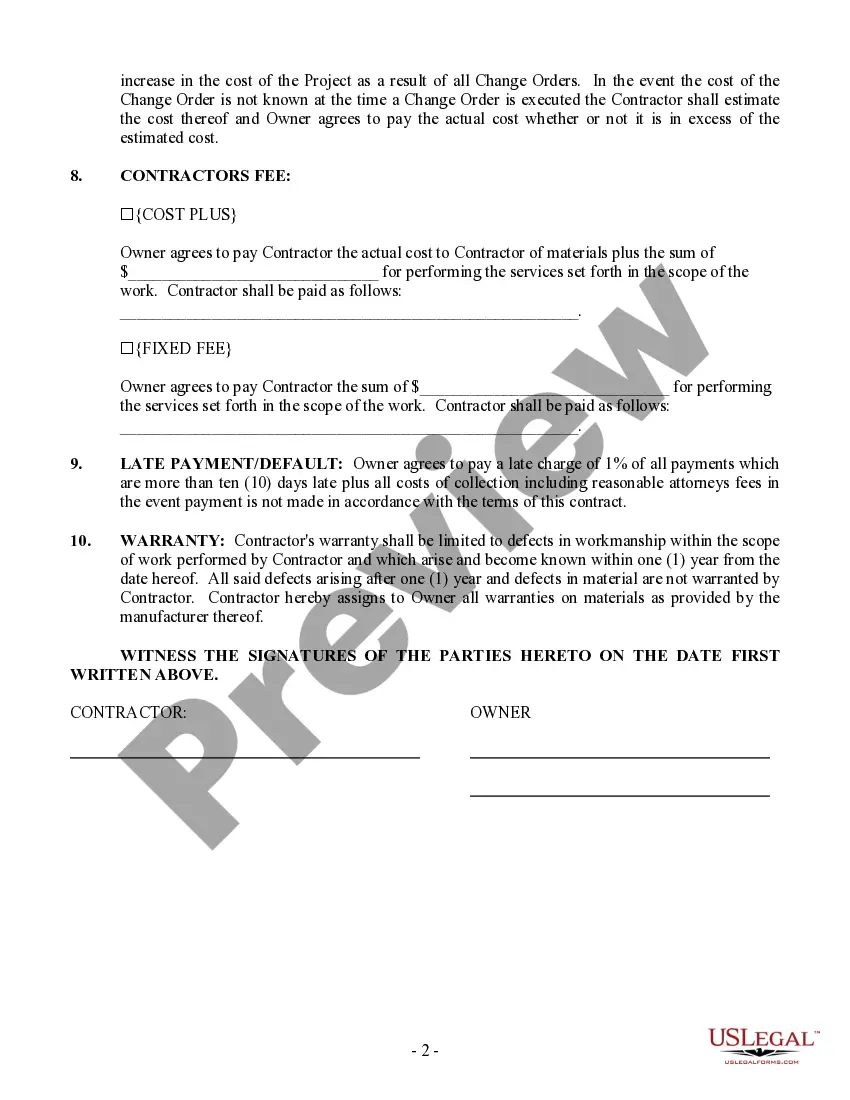
Get your form ready online
Our built-in tools help you complete, sign, share, and store your documents in one place.
Make edits, fill in missing information, and update formatting in US Legal Forms—just like you would in MS Word.
Download a copy, print it, send it by email, or mail it via USPS—whatever works best for your next step.
Sign and collect signatures with our SignNow integration. Send to multiple recipients, set reminders, and more. Go Premium to unlock E-Sign.
If this form requires notarization, complete it online through a secure video call—no need to meet a notary in person or wait for an appointment.
We protect your documents and personal data by following strict security and privacy standards.

Make edits, fill in missing information, and update formatting in US Legal Forms—just like you would in MS Word.

Download a copy, print it, send it by email, or mail it via USPS—whatever works best for your next step.

Sign and collect signatures with our SignNow integration. Send to multiple recipients, set reminders, and more. Go Premium to unlock E-Sign.

If this form requires notarization, complete it online through a secure video call—no need to meet a notary in person or wait for an appointment.

We protect your documents and personal data by following strict security and privacy standards.
Looking for another form?






Form popularity
FAQ
Labor to permanently attach an item to real property is construction labor, which is not taxable because it is an im- provement to real property. Usually, the items stay with the building when it is sold to another party. Labor to repair items attached to real property is construction labor.
Bilateral contracts are agreements in which both parties exchange mutual promises to perform certain obligations, making this type of contract the most common in business transactions.
The (), ConsensusDocs, Design Build Institute of America (DBIA) and Engineers Joint Contract Documents Committee publish the most common forms used in the United States, while international projects often use forms available from the International Federation of Consulting Engineers ( ...
Licenses are required for all residential building contractors and remodelers in Minnesota who contract with a homeowner to construct or improve dwellings by offering more than one special skill.
The 'main contract' is generally that which is awarded by the client (sometimes referred to as the employer) to the general contractor, or main contractor, whose tender has been accepted.
The easiest kind of contractor's license is a Class “B” Contractor's License. This license allows you to do general contracting work. There are also licenses for specialty contracting work called a Class “C” Contractor's License.
Who does not need a contractor license? Residential building contractors whose gross annual receipts from their residential activities are less than $15,000 and have a Certificate of Exemption.
Who does not need a contractor license? Residential building contractors whose gross annual receipts from their residential activities are less than $15,000 and have a Certificate of Exemption.
It's not unusual. If you are not comfortable tell them you are willing to do 50% upon delivery of materials, balance upon completion.
In Minnesota, licensing requirements for contractors vary. Most commercial general contractors don't need a license but must register with the state through the construction contractor registration program. However, if you work with homes, it's a different story.
