Construction Contract Form With Material In Maryland
Description

Get your form ready online
Our built-in tools help you complete, sign, share, and store your documents in one place.
Make edits, fill in missing information, and update formatting in US Legal Forms—just like you would in MS Word.
Download a copy, print it, send it by email, or mail it via USPS—whatever works best for your next step.
Sign and collect signatures with our SignNow integration. Send to multiple recipients, set reminders, and more. Go Premium to unlock E-Sign.
If this form requires notarization, complete it online through a secure video call—no need to meet a notary in person or wait for an appointment.
We protect your documents and personal data by following strict security and privacy standards.

Make edits, fill in missing information, and update formatting in US Legal Forms—just like you would in MS Word.

Download a copy, print it, send it by email, or mail it via USPS—whatever works best for your next step.

Sign and collect signatures with our SignNow integration. Send to multiple recipients, set reminders, and more. Go Premium to unlock E-Sign.

If this form requires notarization, complete it online through a secure video call—no need to meet a notary in person or wait for an appointment.

We protect your documents and personal data by following strict security and privacy standards.
Looking for another form?







Form popularity
FAQ
Obtaining the License Attend licensing workshop (optional). Pass examination administered by PSI Examination prior to applying for license. Register trade name with Assessments and Taxation (410) 767-1330. Demonstrate financial solvency. Provide credit report. Provide certificate of liability insurance.
How To Write A Construction Contract With 7 Steps Step 1: Define the Parties Involved. Step 2: Outline the Scope of Work. Step 3: Establish the Timeline. Step 4: Determine the Payment Terms. Step 5: Include Necessary Legal Clauses. Step 6: Address Change Orders and Modifications. Step 7: Sign and Execute the Contract.
The terms of the contract must be agreed upon mutually. An offer is made, understood by both parties, and accepted. Both parties must agree to the same thing. This is sometimes referred to as “a meeting of the minds.”
A home improvement contract must contain the contractor's name, address, telephone number, and MHIC license number. If a salesperson solicited or sold the home improvement, then the contract must also contain the name and license number of each salesperson.
How to draft a contract in 13 simple steps Start with a contract template. Understand the purpose and requirements. Identify all parties involved. Outline key terms and conditions. Define deliverables and milestones. Establish payment terms. Add termination conditions. Incorporate dispute resolution.
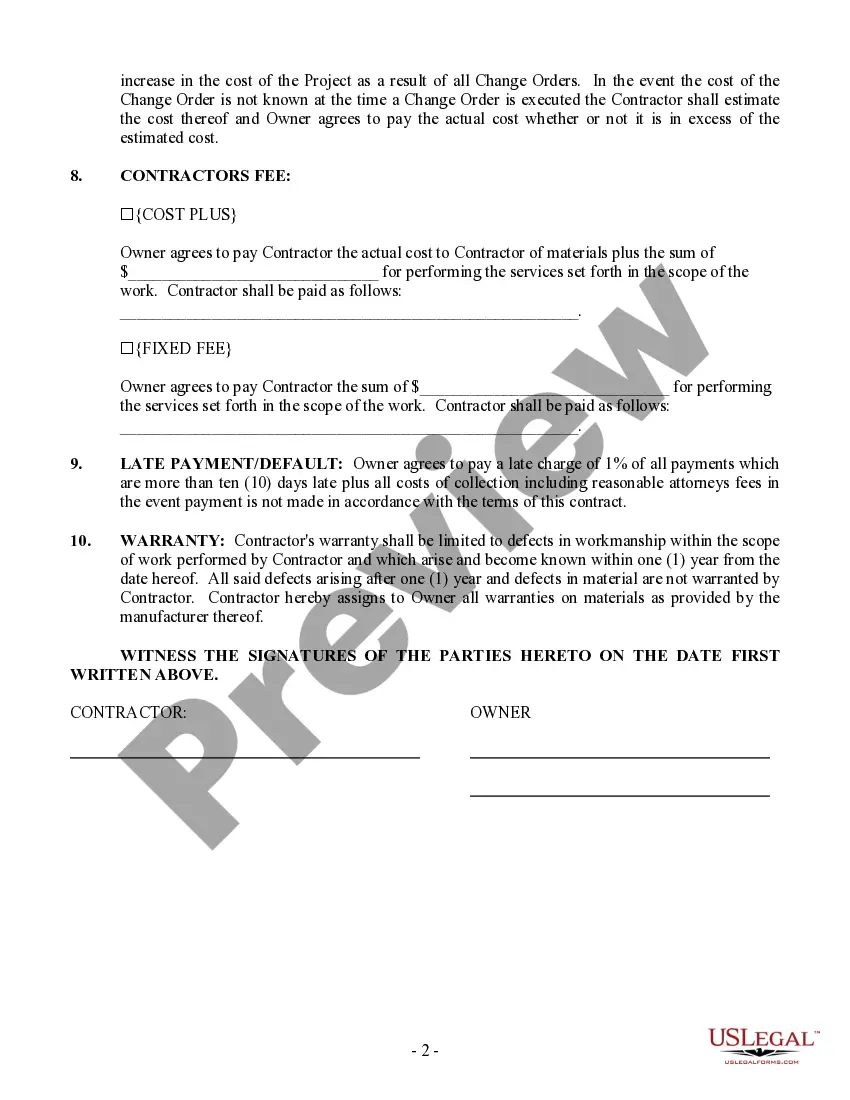
What should I include in a construction contract template? Name and contact information of the project owner. Name and contact information of the contractor. Legal description of the property being worked on. Detailed description of the work to be completed. Completion date and date of final payment.
A contract consists of a legally binding agreement or promise between parties. The agreement must be voluntary and made by competent parties. The promise or agreement must be supported by an exchange of something of value (e.g., goods or services). This exchange must be legal.
Home improvement contractors must be licensed with the Maryland Home Improvement Commission (MHIC). However, it is common for people to take shortcuts or completely avoid this law. The penalties for doing so can be severe, especially if you want to stay in the contracting business in Maryland.