Contract Contractor Building For Rent In Georgia
Description

Get your form ready online
Our built-in tools help you complete, sign, share, and store your documents in one place.
Make edits, fill in missing information, and update formatting in US Legal Forms—just like you would in MS Word.
Download a copy, print it, send it by email, or mail it via USPS—whatever works best for your next step.
Sign and collect signatures with our SignNow integration. Send to multiple recipients, set reminders, and more. Go Premium to unlock E-Sign.
If this form requires notarization, complete it online through a secure video call—no need to meet a notary in person or wait for an appointment.
We protect your documents and personal data by following strict security and privacy standards.

Make edits, fill in missing information, and update formatting in US Legal Forms—just like you would in MS Word.

Download a copy, print it, send it by email, or mail it via USPS—whatever works best for your next step.

Sign and collect signatures with our SignNow integration. Send to multiple recipients, set reminders, and more. Go Premium to unlock E-Sign.

If this form requires notarization, complete it online through a secure video call—no need to meet a notary in person or wait for an appointment.

We protect your documents and personal data by following strict security and privacy standards.
Looking for another form?





Form popularity
FAQ
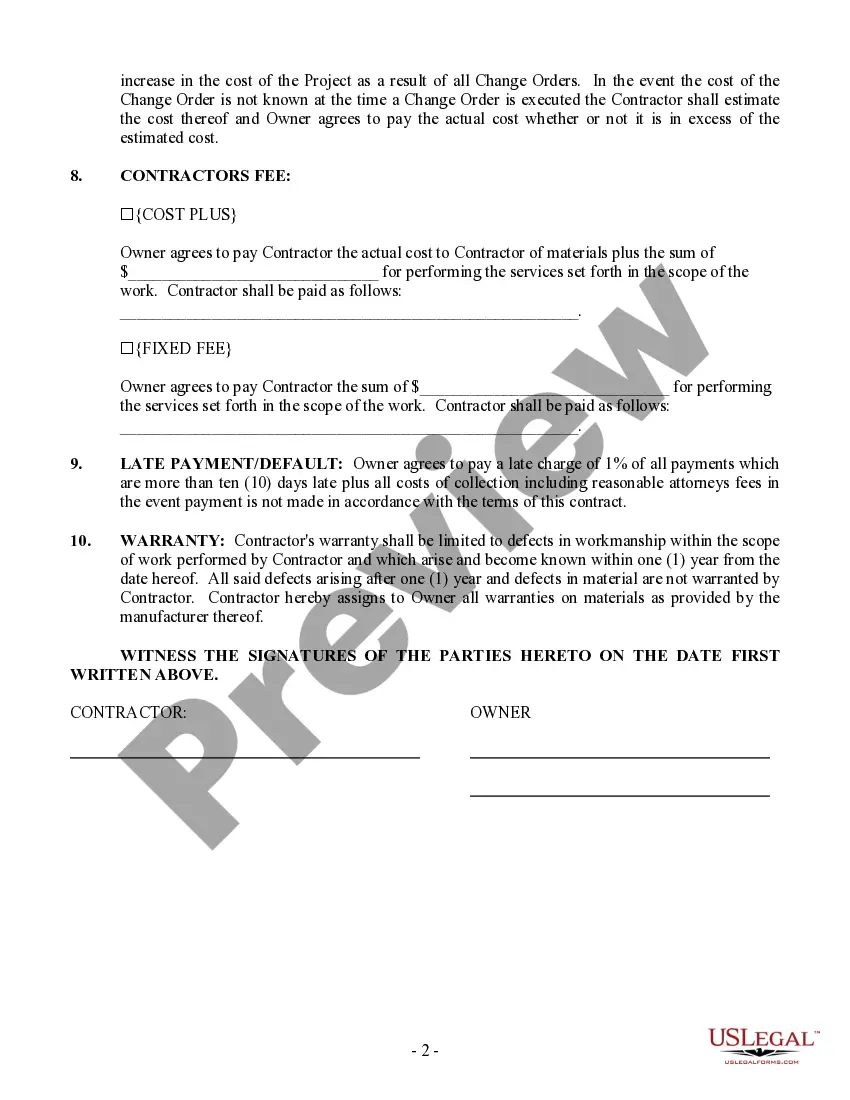
A Georgia independent contractor agreement is a legal document that a company or individual may use to outline the terms and conditions of a job being performed by an independent contractor.
(a) No person, whether an individual or a business organization, shall have the right to engage in the business of residential contracting or commercial general contracting without a current, valid residential contractor license or commercial general contractor license, respectively, issued by the division under this ...
Ing to Georgia handyman laws, you only need a license if any of your work contracts exceed $2,500. Those whose projects exceed this amount must have a contractor license issued by Georgia's State Licensing Board for Residential and General Contractors. The application process involves the following steps.
Is a license required in Georgia for Residential and General contractors? Yes. To perform (or offer to perform) residential or commercial general contractor services for compensation in Georgia, you must be licensed in ance with the laws and rules that regulate this profession.
Subcontractor agrees to be bound to Contractor by the terms of the Prime Contract and the other Subcontract Documents and to assume toward Contractor all the obligations and responsibilities that Contractor by those documents assumes toward the Owner.
Georgia primarily differentiates between employees and independent contractors based on the level of control a business has over a worker's tasks and how they're performed. Contractors typically: Decide on their own work hours. Use their own tools or resources.
Below are eight important points to consider including in an independent contractor agreement. Define a Scope of Work. Set a Timeline for the Project. Specify Payment Terms. State Desired Results and Agree on Performance Measurement. Detail Insurance Requirements. Include a Statement of Independent Contractor Relationship.
To draft a contract from scratch, start by identifying the parties involved and clearly outlining the agreement. Include consideration (what is exchanged), define the terms and conditions, ensure all parties are legally competent, and finalise it with signatures. These essential elements make the contract enforceable.
To write a simple contract, title it clearly, identify all parties and specify terms (services or payments). Include an offer, acceptance, consideration, and intent. Add a signature and date for enforceability. Written contracts reduce disputes and offer better legal security than verbal ones.
