Cost Plus Construction Contracts With Exempt Entities
Description

Get your form ready online
Our built-in tools help you complete, sign, share, and store your documents in one place.
Make edits, fill in missing information, and update formatting in US Legal Forms—just like you would in MS Word.
Download a copy, print it, send it by email, or mail it via USPS—whatever works best for your next step.
Sign and collect signatures with our SignNow integration. Send to multiple recipients, set reminders, and more. Go Premium to unlock E-Sign.
If this form requires notarization, complete it online through a secure video call—no need to meet a notary in person or wait for an appointment.
We protect your documents and personal data by following strict security and privacy standards.

Make edits, fill in missing information, and update formatting in US Legal Forms—just like you would in MS Word.

Download a copy, print it, send it by email, or mail it via USPS—whatever works best for your next step.

Sign and collect signatures with our SignNow integration. Send to multiple recipients, set reminders, and more. Go Premium to unlock E-Sign.

If this form requires notarization, complete it online through a secure video call—no need to meet a notary in person or wait for an appointment.

We protect your documents and personal data by following strict security and privacy standards.
Looking for another form?




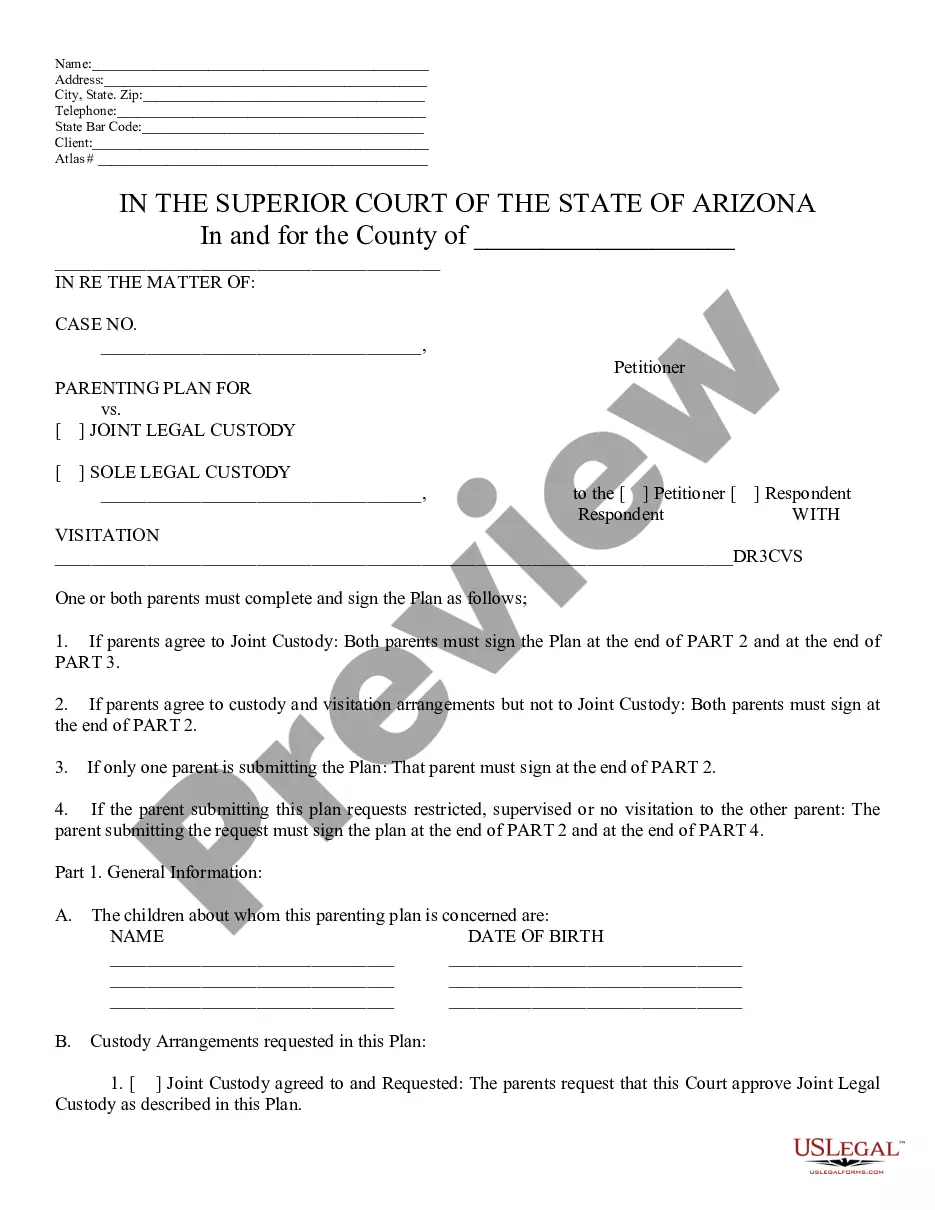

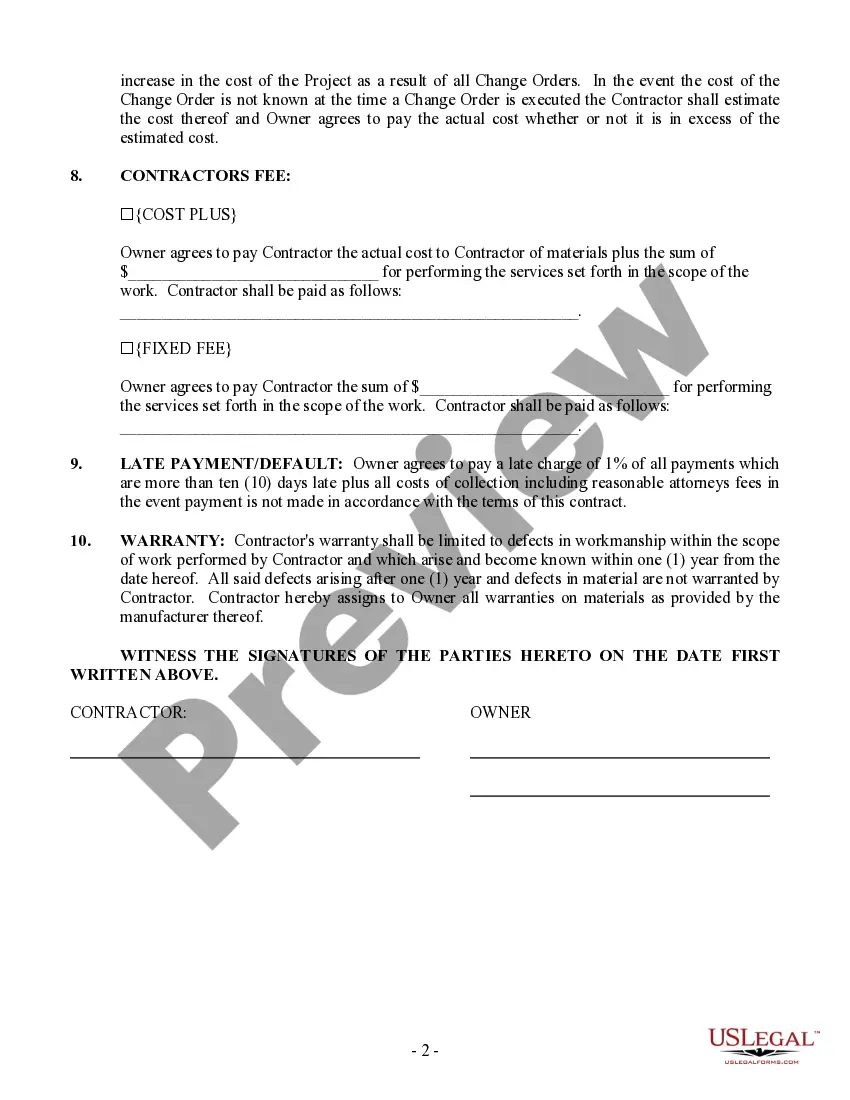
How to fill out Construction Contract For Home - Fixed Fee Or Cost Plus?
Managing legal documents can be exasperating, even for the most seasoned professionals.
When you're in search of Cost Plus Construction Contracts With Exempt Entities and lack the time to dedicate to locating the suitable and updated version, the process can be taxing.
For existing subscribers, Log In to your US Legal Forms account, search for the document, and obtain it.
Examine your My documents section to see the documents you've previously saved and manage your folders as desired.
Leverage the US Legal Forms web library, supported by 25 years of expertise and reliability. Streamline your daily document management into a seamless and user-friendly experience today.
- Confirm that this is the correct document by reviewing it and reading its description.
- Make certain the sample is validated in your state or county.
- Select Buy Now when you are prepared.
- Choose a subscription option.
- Select the format you prefer, then Download, complete, eSign, print, and dispatch your document.
- Utilize cutting-edge tools to complete and manage your Cost Plus Construction Contracts With Exempt Entities.
- Access a comprehensive database of articles, guides, and resources pertinent to your circumstances and requirements.
- Save energy and time searching for the documents you desire, and use US Legal Forms’ sophisticated search and Preview feature to acquire Cost Plus Construction Contracts With Exempt Entities.
Form popularity
FAQ
Yes, certain construction companies can be tax exempt, particularly if they work for exempt entities, such as government agencies or nonprofit organizations. This tax exemption often applies to the income generated from projects directly related to these exempt entities. Utilizing cost plus construction contracts with exempt entities can help ensure compliance and optimize financial management. For specific guidance, consider using USLegalForms to find templates that cater to your needs.
Exclusions in a construction contract refer to specific items or conditions that are not covered under the terms of the agreement. Understanding these exclusions is crucial for parties involved in cost plus construction contracts with exempt entities, as they can impact project scope and budget. Clearly defining exclusions helps avoid misunderstandings and potential disputes later on. For comprehensive insights into these contracts, consider exploring US Legal Forms, which offers resources tailored to guide you through the complexities.
A: As an example, a cost-plus contract may establish that the total estimated cost of a building project is $10 million plus a fixed fee of $1.5 million, roughly 15% of the total cost, as the contractor's profit. So the total expense to the buyer would be approximately $11.5 million ?the cost plus the fee.
The disadvantage to a contractor is that it doesn't cover the time needed to fix the project if something doesn't go as planned and takes more time. The disadvantage to the buyer is that it's hard to budget with this type of contract as the cost increases the more materials are needed.
plus contract is a construction agreement that requires reimbursement for project costs as well as a markup that covers the contractor's overhead and profit. In other words, the name is a shorthand way of remembering what the contract covers: project costs plus contractor markup.
Lastly, it's important to note that cost-plus contracts do not cover costs associated with a contractor's mistakes or negligence ? though they may cover situations related to estimating errors.
In a cost-plus contract, one party agrees to reimburse the contracting party for expenses plus a specified profit proportional to the full value of the contract.