Confidential Disclosure Agreement With In Philadelphia
Description

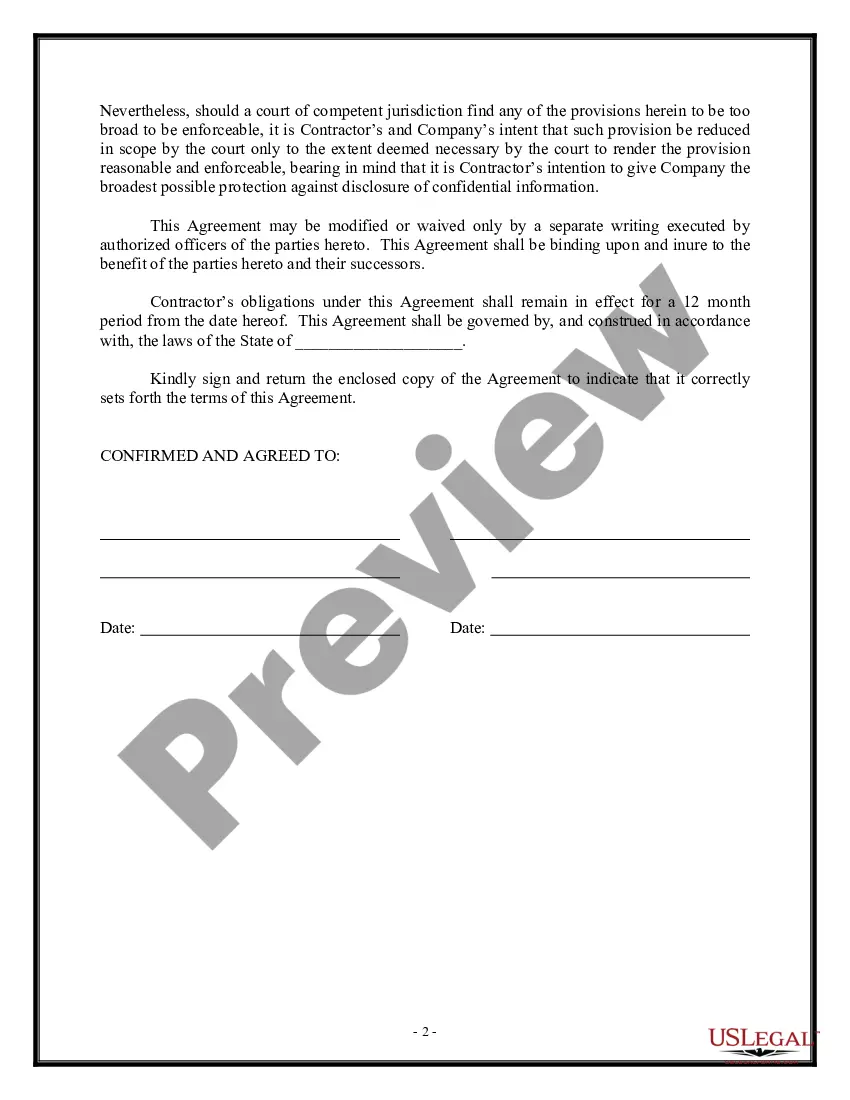
Get your form ready online
Our built-in tools help you complete, sign, share, and store your documents in one place.
Make edits, fill in missing information, and update formatting in US Legal Forms—just like you would in MS Word.
Download a copy, print it, send it by email, or mail it via USPS—whatever works best for your next step.
Sign and collect signatures with our SignNow integration. Send to multiple recipients, set reminders, and more. Go Premium to unlock E-Sign.
If this form requires notarization, complete it online through a secure video call—no need to meet a notary in person or wait for an appointment.
We protect your documents and personal data by following strict security and privacy standards.

Make edits, fill in missing information, and update formatting in US Legal Forms—just like you would in MS Word.

Download a copy, print it, send it by email, or mail it via USPS—whatever works best for your next step.

Sign and collect signatures with our SignNow integration. Send to multiple recipients, set reminders, and more. Go Premium to unlock E-Sign.

If this form requires notarization, complete it online through a secure video call—no need to meet a notary in person or wait for an appointment.

We protect your documents and personal data by following strict security and privacy standards.
Looking for another form?








Form popularity
FAQ
Whereas confidentiality agreements are typically devised in employment or personal situations to protect sensitive information, NDAs are often used in business and legal settings to protect trade secrets, client lists, and financial data.
Definition: An NDA allows a party to communicate nonpublic information to another. A CDA allows multiple parties to handle information with utmost secrecy.
What is the difference between a DPA and a NDA? A DPA (Data Processing Agreement) outlines terms for data processing, focusing on ensuring data protection and privacy compliance. An NDA (Non-Disclosure Agreement) is a contract where parties agree not to disclose confidential information they've shared with each other.
This is sometimes referred to as a “consent,” an “authorization to release,” a “release of information,” or “authorization for disclosure.” The person who signs the release must give informed consent for the information to be disclosed.
A Confidential Disclosure Agreement (CDA), also referred to as non-disclosure agreement (NDA) or secrecy agreement, is a legal agreement between a minimum of two parties which outlines information the parties wish to share with one another for certain evaluation purposes, but wish to restrict from wider use and ...
A Confidential Disclosure Agreement (CDA), also referred to as non-disclosure agreement (NDA) or secrecy agreement, is a legal agreement between a minimum of two parties which outlines information the parties wish to share with one another for certain evaluation purposes, but wish to restrict from wider use and ...
Filing of Documents Under Seal. A document authorized to be filed under seal by an existing court order shall be filed on paper accompanied by the court order authorizing it to be filed under seal and submitted in a sealed envelope marked with the case number, case caption and the words “sealed document.”
Filing under seal is a procedure allowing sensitive or confidential information to be filed with a court without becoming a matter of public record.
Sealing court documents refers to the process of restricting access to specific legal documents or court records, making them confidential and not accessible to the public or unauthorized individuals.
Under common law, documents that were signed under seal were considered more reliable and therefore given greater deference and protection under the law primarily in the form of a longer statute of limitations — much longer. In some states, the statute of limitations for contracts signed under seal is 20 years.
