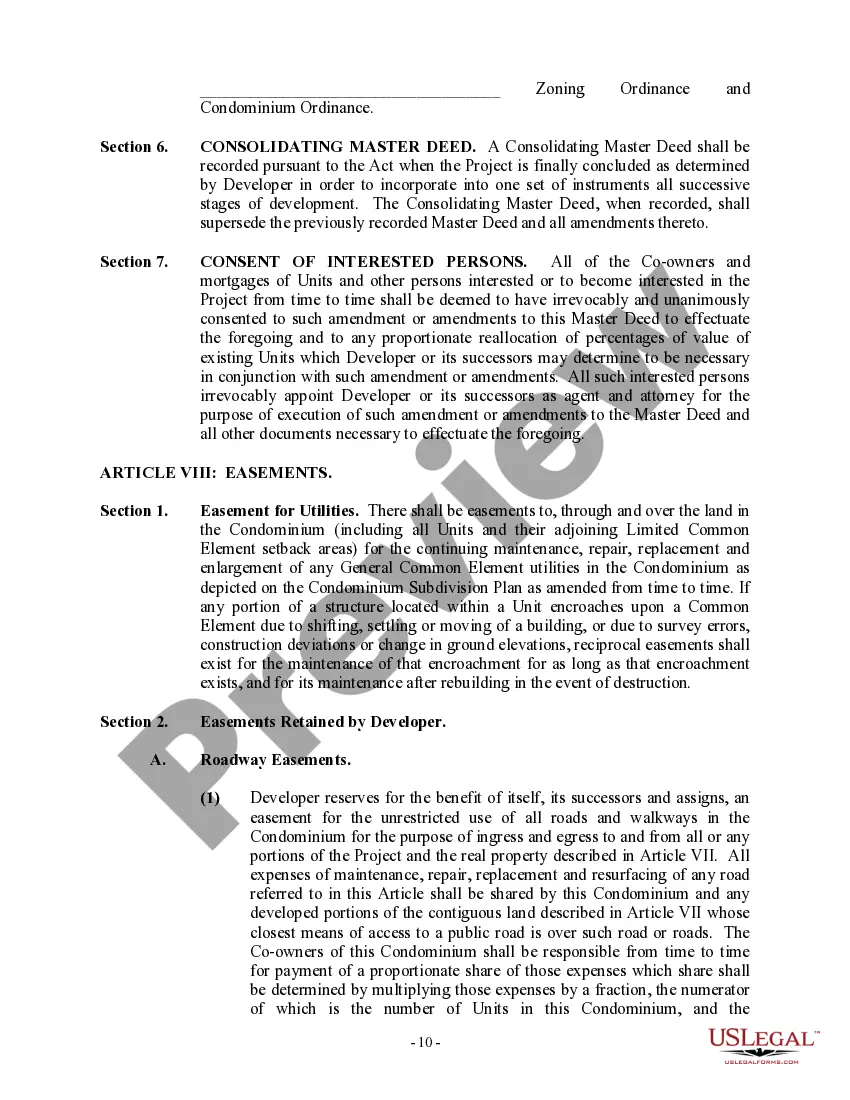
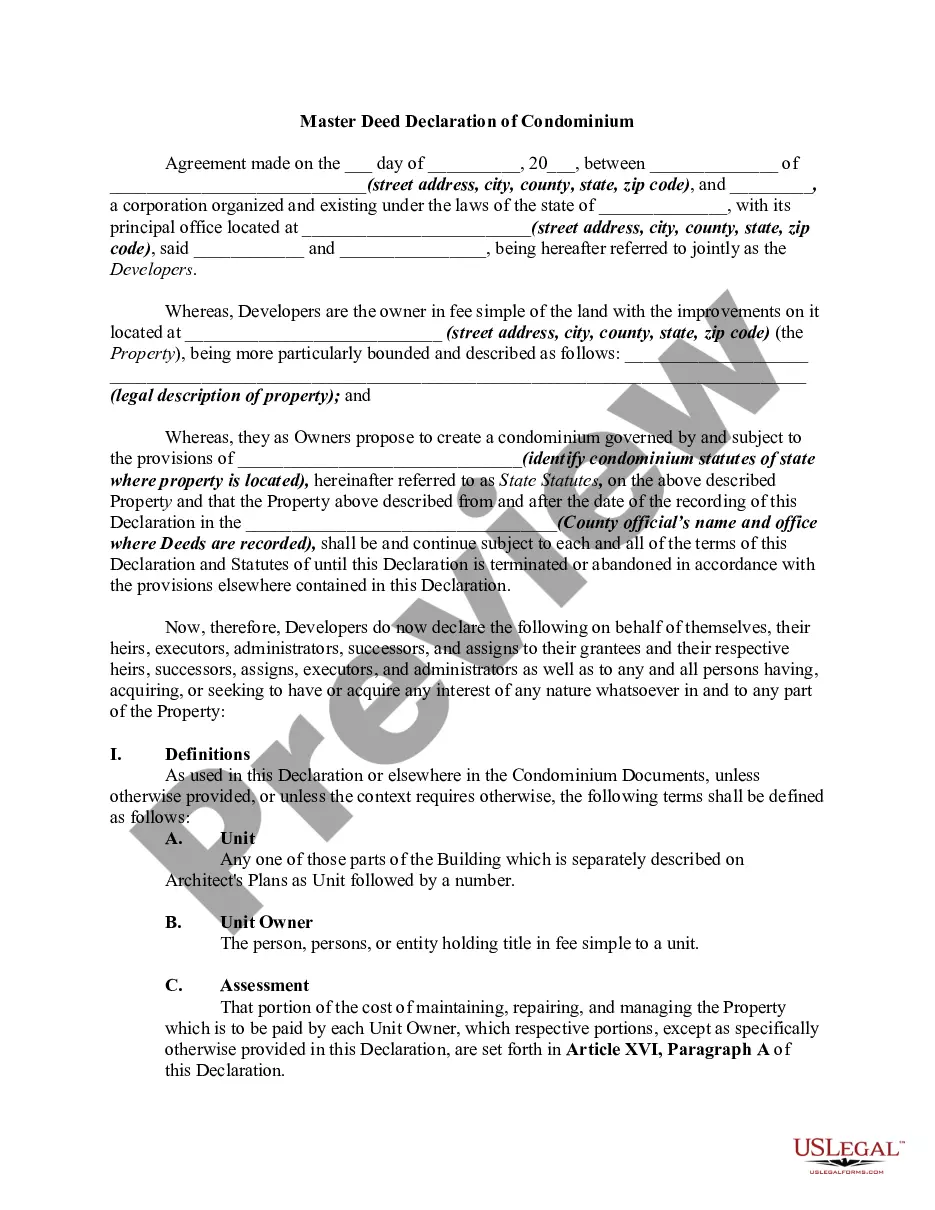
Condo Master Deed And Bylaws In San Antonio
Description



Get your form ready online
Our built-in tools help you complete, sign, share, and store your documents in one place.
Make edits, fill in missing information, and update formatting in US Legal Forms—just like you would in MS Word.
Download a copy, print it, send it by email, or mail it via USPS—whatever works best for your next step.
Sign and collect signatures with our SignNow integration. Send to multiple recipients, set reminders, and more. Go Premium to unlock E-Sign.
If this form requires notarization, complete it online through a secure video call—no need to meet a notary in person or wait for an appointment.
We protect your documents and personal data by following strict security and privacy standards.

Make edits, fill in missing information, and update formatting in US Legal Forms—just like you would in MS Word.

Download a copy, print it, send it by email, or mail it via USPS—whatever works best for your next step.

Sign and collect signatures with our SignNow integration. Send to multiple recipients, set reminders, and more. Go Premium to unlock E-Sign.

If this form requires notarization, complete it online through a secure video call—no need to meet a notary in person or wait for an appointment.

We protect your documents and personal data by following strict security and privacy standards.
Looking for another form?








Form popularity
FAQ
Texas law places limits on HOA power, including restrictions on their ability to prohibit certain types of construction like solar panels and rules against unreasonable fines or foreclosure practices. The exact limitations are outlined in state statutes, which are intended to protect homeowners' rights.
Once you buy a home that's part of an HOA, you automatically become a member of the HOA. HOA rules are legally binding, and you must adhere to all rules and regulations in the governing document. Yes, there are bylaws that you may not like, but there are no HOA loopholes.
The local law supersedes the rules and regulations of the HOA, meaning that HOAs must ensure they are operating under the law.
The best way to strategize on short-term rental restrictions is to speak to a board member. At the same time, you can consult the CC&Rs' (Covenants, conditions, and restrictions) advice. Knowing the potential risks of getting around HOA's restrictions is important. And we highly recommend doing it the legal way.
House Bill 614 guarantees your right to a hearing before the HOA board to contest the violation or the proposed fine. This ensures a fair and transparent process where you can voice your concerns and advocate for your interests.
No, there is not a way to ``leave the HOA'' without moving. The HOA covenants are tied to the property permanently.
The Texas Uniform inium Act contains a provision which states that unless a declaration provides otherwise, a inium building may be terminated and sold if 100% of the owners agree. It also allows unit owners associations to adopt a rule allowing for a lower threshold of 80% of the votes.
For Texas associations, state laws are the only dedicatory instrument that outranks your Covenants, Conditions, and Restrictions (CC&Rs, your association's “Boss Doc”).
In 2021, the Texas Senate passed Bill 1588, which placed restrictions on HOA authority over fencing. This legislation ensures that if you own a property, your HOA cannot categorically deny you the right to a fence installation.
Effective January 1, 2024. A property owners' association must adopt an enforcement policy regarding levying of fines. The policy must be made available to the property owners.
