Educational Assistance Employees For Hard Work In Nevada
Description

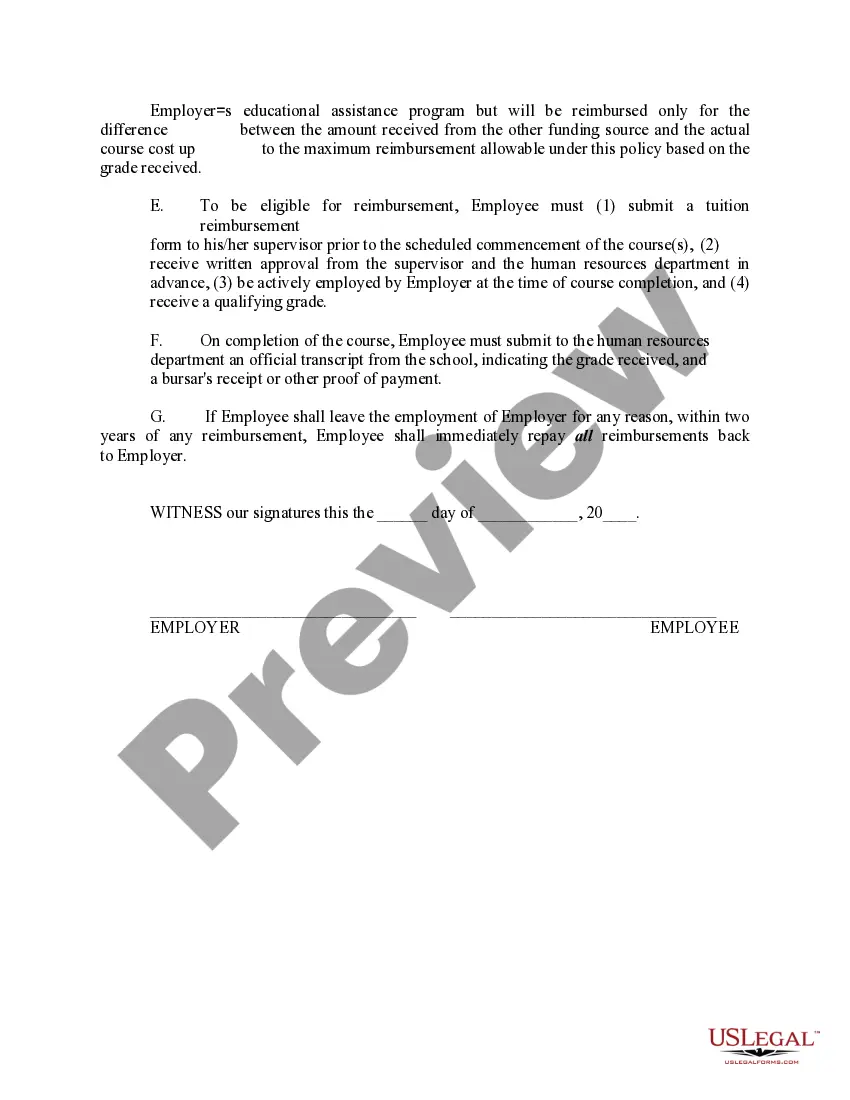
Get your form ready online
Our built-in tools help you complete, sign, share, and store your documents in one place.
Make edits, fill in missing information, and update formatting in US Legal Forms—just like you would in MS Word.
Download a copy, print it, send it by email, or mail it via USPS—whatever works best for your next step.
Sign and collect signatures with our SignNow integration. Send to multiple recipients, set reminders, and more. Go Premium to unlock E-Sign.
If this form requires notarization, complete it online through a secure video call—no need to meet a notary in person or wait for an appointment.
We protect your documents and personal data by following strict security and privacy standards.

Make edits, fill in missing information, and update formatting in US Legal Forms—just like you would in MS Word.

Download a copy, print it, send it by email, or mail it via USPS—whatever works best for your next step.

Sign and collect signatures with our SignNow integration. Send to multiple recipients, set reminders, and more. Go Premium to unlock E-Sign.

If this form requires notarization, complete it online through a secure video call—no need to meet a notary in person or wait for an appointment.

We protect your documents and personal data by following strict security and privacy standards.
Looking for another form?










Form popularity
FAQ
The SNAP program is administered by the Nevada Department of Welfare and Social Services (DWSS). SNAP eligibility involves four elements: (1) low income and few assets, (2) citizenship or qualified alien status, (3) a Social Security Card, and (4) working or looking for work.
Nevada: Financial Assistance Resources for Families Child Care Financial Assistance. Temporary Assistance for Needy Families (TANF) ... Children's Health Insurance Program (CHIP) ... Women, Infants, and Children (WIC) ... Supplemental Nutritional Assistance Program (SNAP formerly Food Stamps) ... Low Income Energy Assistance Program.
Employment Security Division CEP is an employer-funded training and re-employment program that provides job seekers with training designed to improve earning potential and increase job skills required in today's workplace.
By definition, a “low-income” family typically earns 80 percent or less of the median family income for an area. For example, a family of four in Clark County can earn no more than $67,700 to be considered a low-income family.
NEON is Nevada's employment and training program whose purpose is to reduce or eliminate dependency on public assistance by providing employment services, education, training and support services to TANF NEON recipients. NEON participation is mandatory for most cases with a work-eligible individual in the home.
As with most states, however, Nevada law does not define a “full-time” employee. However, full-time employment is generally regarded as 30 to 40 hours per week.
Students registered for at least 12 hours are considered full-time.
Nevada has no legal standard defining full-time employment by weekly hours. Employers determine this, but the IRS considers 30 hours a week full-time for benefits, making 32 hours often considered full-time.
The 4/10 Rule and Alternative Work Schedules This written agreement clearly outlines the schedule and ensures compliance with Nevada's overtime laws. If an employee works beyond 10 hours in a single day under the 4/10 schedule, the extra hours must be compensated at 1.5 times their regular hourly rate.
