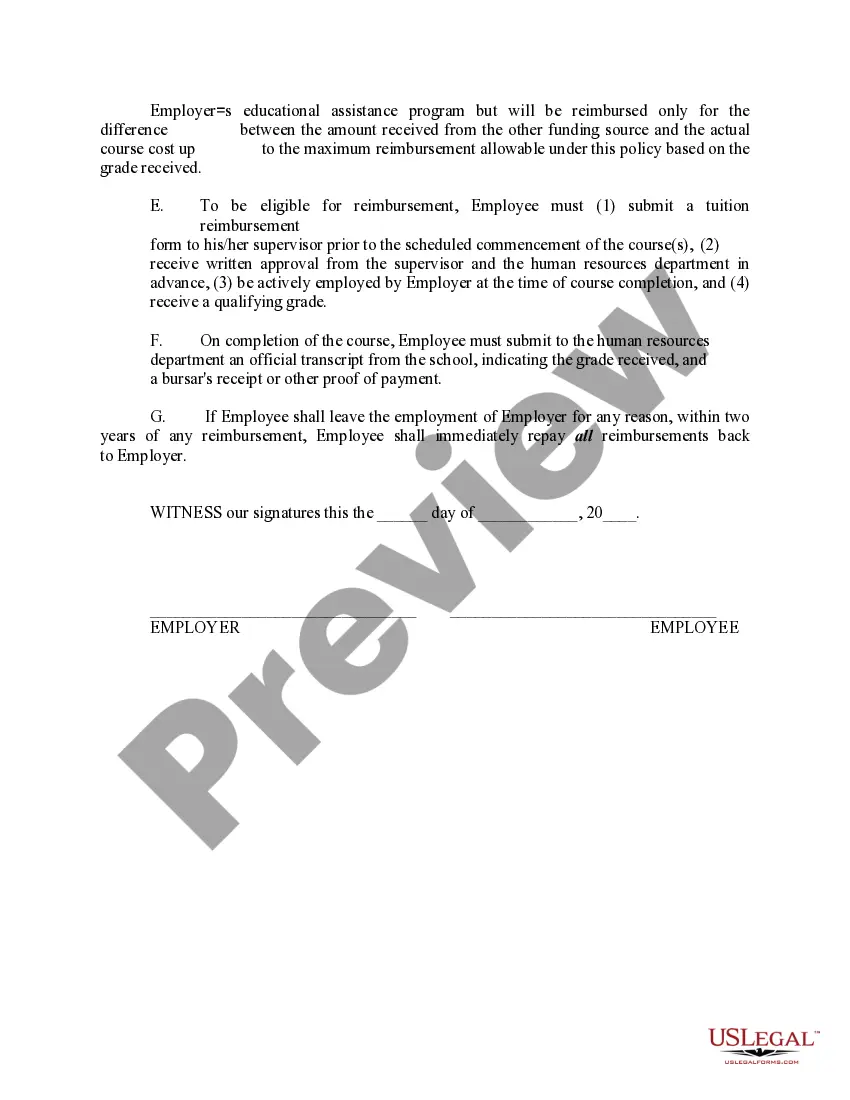
Educational Assistance Programs Employee With Non Work-related Problems In Minnesota
Description

Get your form ready online
Our built-in tools help you complete, sign, share, and store your documents in one place.
Make edits, fill in missing information, and update formatting in US Legal Forms—just like you would in MS Word.
Download a copy, print it, send it by email, or mail it via USPS—whatever works best for your next step.
Sign and collect signatures with our SignNow integration. Send to multiple recipients, set reminders, and more. Go Premium to unlock E-Sign.
If this form requires notarization, complete it online through a secure video call—no need to meet a notary in person or wait for an appointment.
We protect your documents and personal data by following strict security and privacy standards.

Make edits, fill in missing information, and update formatting in US Legal Forms—just like you would in MS Word.

Download a copy, print it, send it by email, or mail it via USPS—whatever works best for your next step.

Sign and collect signatures with our SignNow integration. Send to multiple recipients, set reminders, and more. Go Premium to unlock E-Sign.

If this form requires notarization, complete it online through a secure video call—no need to meet a notary in person or wait for an appointment.

We protect your documents and personal data by following strict security and privacy standards.
Looking for another form?









Form popularity
FAQ
Similar to federal law, state law provides that contributions made to a qualified tuition program are not deductible.
Vacation leave - Full-time employees receive between 13 and 29 days per year, depending on length of service. Part-time employees receive vacation leave based on hours worked. receive sick leave based on hours worked.
Lifestyle Benefits are part of the state's Employee Assistance Program. An EAP is a confidential program that helps employees and the people they live with work through various life challenges that may adversely affect job performance, health, and personal well-being.
The best emergency action plans include employees in the planning process, specify what employees should do during an emergency, and ensure that employees receive proper training for emergencies.
A mandatory referral is made only when an employer is at the corrective action or work. performance stage, where discipline or dismissal of the employee is likely, and there are. mitigating circumstances that motivate company management to provide an opportunity for. the employee to resolve the problem.
Employee assistance programs can help employees with personal problems that affect their job performance. EAPs can identify and address a wide range of health, financial, and social issues, including mental and/or substance use disorders.
The Employee Assistance Program (EAP) provides assessment, short-term counseling, referral, management consultation, and coaching services to federal employees, and is available 24 hours a day, 365 days a year.
In extreme cases, such as workplace violence threats or suicidal thoughts, employers may consider a mandatory referral to an EAP.
(a) "Holiday" includes New Year's Day, January 1; Martin Luther King's Birthday, the third Monday in January; Washington's and Lincoln's Birthday, the third Monday in February; Memorial Day, the last Monday in May; Juneteenth, June 19; Independence Day, July 4; Labor Day, the first Monday in September; Indigenous ...
Vacation leave - Full-time employees receive between 13 and 29 days per year, depending on length of service. Part-time employees receive vacation leave based on hours worked. receive sick leave based on hours worked.
