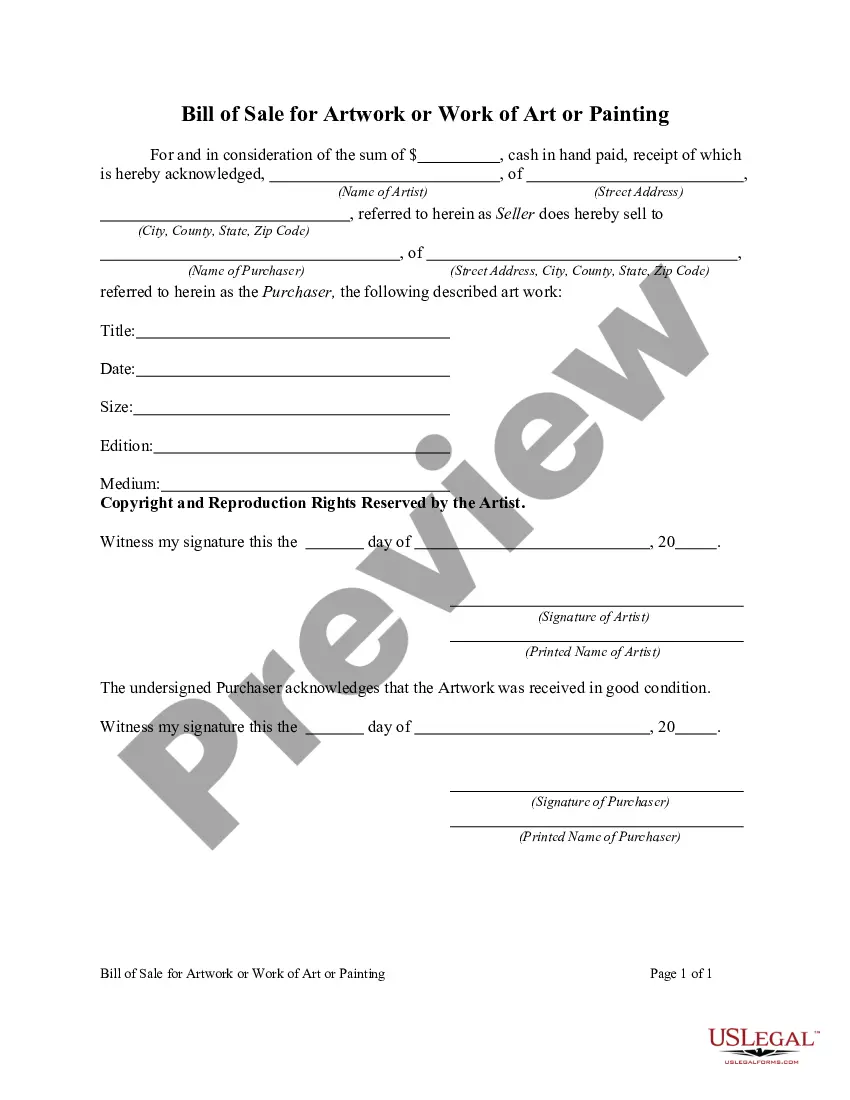
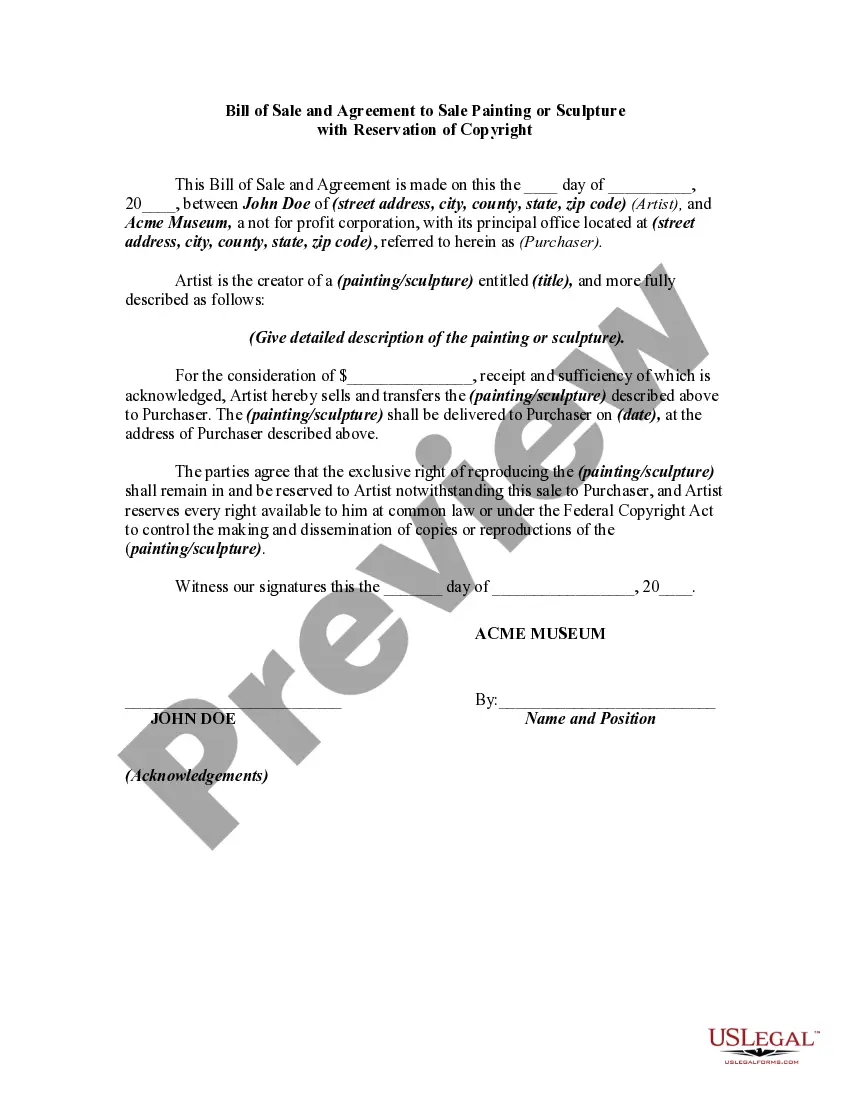
Bill Sale Art Sample For Composition Scheme In Riverside
Description

Get your form ready online
Our built-in tools help you complete, sign, share, and store your documents in one place.
Make edits, fill in missing information, and update formatting in US Legal Forms—just like you would in MS Word.
Download a copy, print it, send it by email, or mail it via USPS—whatever works best for your next step.
Sign and collect signatures with our SignNow integration. Send to multiple recipients, set reminders, and more. Go Premium to unlock E-Sign.
If this form requires notarization, complete it online through a secure video call—no need to meet a notary in person or wait for an appointment.
We protect your documents and personal data by following strict security and privacy standards.

Make edits, fill in missing information, and update formatting in US Legal Forms—just like you would in MS Word.

Download a copy, print it, send it by email, or mail it via USPS—whatever works best for your next step.

Sign and collect signatures with our SignNow integration. Send to multiple recipients, set reminders, and more. Go Premium to unlock E-Sign.

If this form requires notarization, complete it online through a secure video call—no need to meet a notary in person or wait for an appointment.

We protect your documents and personal data by following strict security and privacy standards.
Looking for another form?









Form popularity
FAQ
It's the way multiple elements of an artwork are combined. It can be broken down into eight elements: unity, balance, movement, rhythm, focus, contrast, pattern, and proportion. What's important is that every artwork has a composition, no matter whether it conveys any meaning or has a defined subject matter.
The four main types of composition writing are description, narration, exposition, and argumentation. A descriptive composition relates details of a person or a place. In a composition of narration, a writer tells a chronology of events as a first-person narrative.
The "Tunnel" Composition All the elements if the foreground are positioned in such a way as to lead the eyes of the viewer to the background of the painting, where the focus of interest is.
1. Payne lists 15 principal forms/stems of composition: Steelyard, The Balance Scale, Circle, S or Compound Curve, Pyramid, The Cross, The Radiating Line, Ell or Rectangular, Suspended Steelyard, Three Spot, Grouped Mass, Diagonal Line, The Tunnel, The Silhouette, The Pattern.
A notable example is Piet Mondrian's “Composition with Red, Blue, and Yellow.” In this work, Mondrian uses simple geometric shapes, arranging squares and rectangles in a balanced grid. These shapes and the primary colors of red, blue, and yellow create balance, harmony, and order.
Ready to Exhibit Your Art? Here Are Steps You Can Take Try a home show and invite your friends. Connect with a local business and see if they might be interested in hanging your work in their establishment. Get together with a few other artists and rent a space for your exhibition. Enter juried exhibitions.
The steelyard composition is formed of a large mass that is counterbalanced on a theoretical fulcrum by a smaller mass further away from the centre. The area of interest would be near the fulcrum or main weight but sometimes the main weight itself could be the main point of interest, for example, a group of trees.
The composition—the way in which a painting is composed and the way in which the painting's elements work together to form a coherent whole—is key to the success of a work of art in conveying its message and visually "hanging together." The composition is an important part of the foundation of the paintings we find so ...
Verbal description should include standard information, the artists name, the title of the work, key dates, mediums, dimensions, nationality of the artist, giving the viewer/buyer, quick, relevant, facts that they can easily recall.
Use Frames Choose the Right Frame: Select frames that complement your art without overshadowing it. Use Mats: Adding a mat around your print can give it a polished look and draw attention to the artwork. Display in a Grid: Arrange framed prints in a grid pattern on the wall to create a cohesive and organized display.