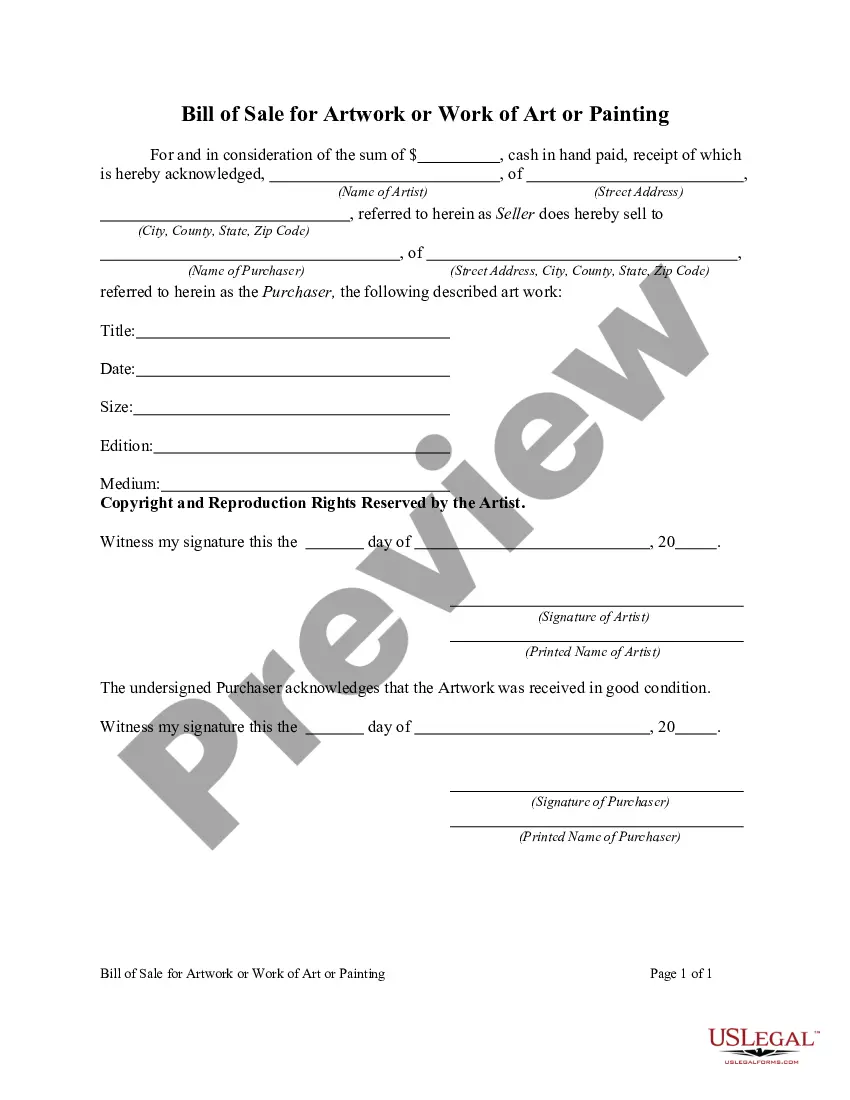
Bill Sale Art Sample Without Permission In Harris
Description
Get your form ready online
Our built-in tools help you complete, sign, share, and store your documents in one place.
Make edits, fill in missing information, and update formatting in US Legal Forms—just like you would in MS Word.
Download a copy, print it, send it by email, or mail it via USPS—whatever works best for your next step.
Sign and collect signatures with our SignNow integration. Send to multiple recipients, set reminders, and more. Go Premium to unlock E-Sign.
If this form requires notarization, complete it online through a secure video call—no need to meet a notary in person or wait for an appointment.
We protect your documents and personal data by following strict security and privacy standards.

Make edits, fill in missing information, and update formatting in US Legal Forms—just like you would in MS Word.

Download a copy, print it, send it by email, or mail it via USPS—whatever works best for your next step.

Sign and collect signatures with our SignNow integration. Send to multiple recipients, set reminders, and more. Go Premium to unlock E-Sign.

If this form requires notarization, complete it online through a secure video call—no need to meet a notary in person or wait for an appointment.

We protect your documents and personal data by following strict security and privacy standards.
Looking for another form?



Form popularity
FAQ
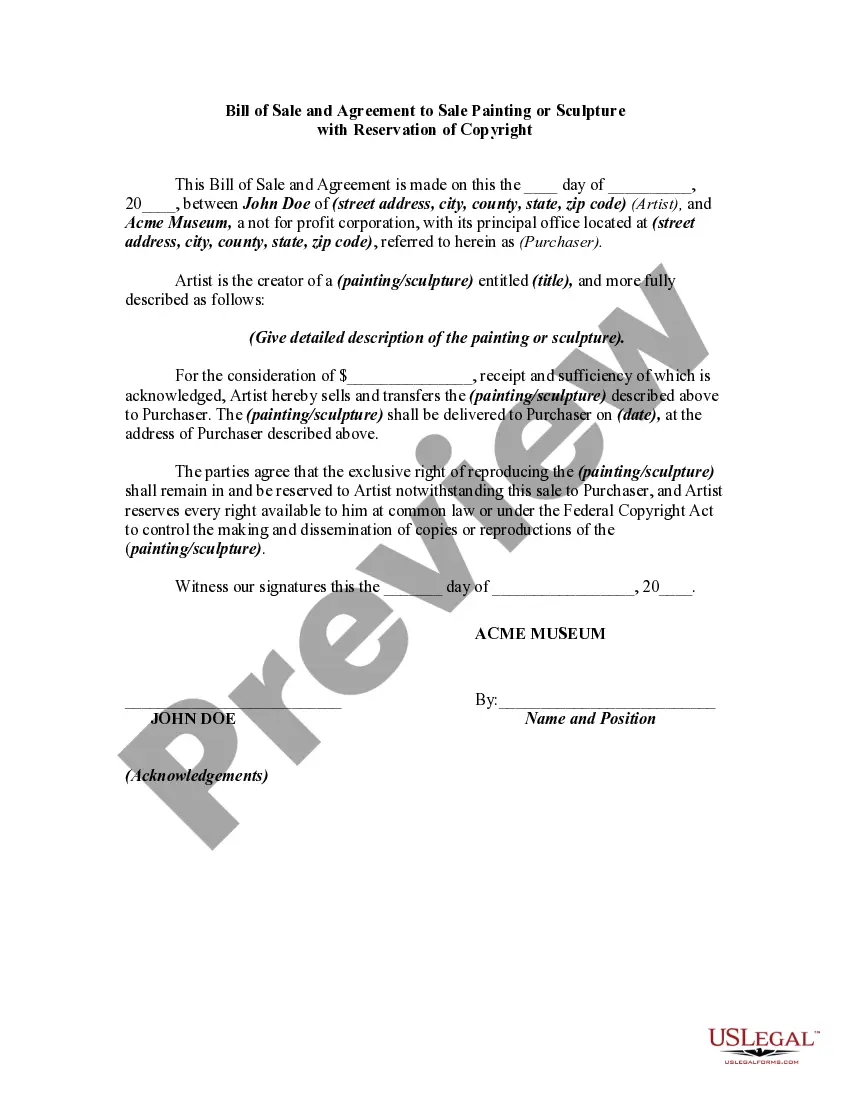
The original artist owns his or her physical painting until it is sold, and the original artist retains the exclusive right to make reproductions of his artwork, even after the original is sold. This copyright covers recreations, duplications, reprintings, and any other form of “copying” you can think of.
Artist's Bill of Sale Date of sale and invoice number. Invoice numbers can be used as a unique reference ID and will prove very helpful should you need to quickly find the documentation later. Artist's contact information. Buyer's contact information. Artwork sold. Subtotal. Taxes. Other charges. Total.
In other words, although the client may “own” the work of art, the artist who created the work owns the copyright, including all ways in which that artwork is represented (photos, video, ads, logos, branding), other than in situ (on-site documentation photos).
It is your right to pursue legal action if your work is used unlawfully without your permission and not under a statutory exception or limitation like fair use. However, if your work is a U.S. work, you do need to register it with the Copyright Office before bringing an infringement lawsuit in federal court.
If you are selling any artwork yourself, it is a legal requirement to have a business license. It allows you to file for a DBA (Doing Business As) so that you can operate under the business name of your choice. You can also operate a business under your own name.
When an artist creates a painting, the artist owns both the copyright in the artwork, and the physical artwork. Ownership of the copyright is an intellectual property right. Ownership of the physical artwork is a personal property right. A sale of the physical artwork does not transfer the copyrights in the artwork.
The artist retains all rights under the Copyright Act of 1976 (17 USC Section 101) as the sole author of the work for the duration of the copyright. The duration of copyright in the United States is currently the life of the author, plus 70 years.
Copyright ownership is separate from ownership of an original artwork. If the work is uncommissioned, then the artist owns the copyright automatically even if the original is sold. The copyright may be sold or assigned as a separate undertaking. Only the copyright holder has the right to reproduce the work.
Art theft, sometimes called artnapping, is the stealing of paintings, sculptures, or other forms of visual art from galleries, museums or other public and private locations.
You cannot take someone's photo and draw straight from it, especially if it has copyright. That is seen as intellectual theft and the creator can sue you for it!