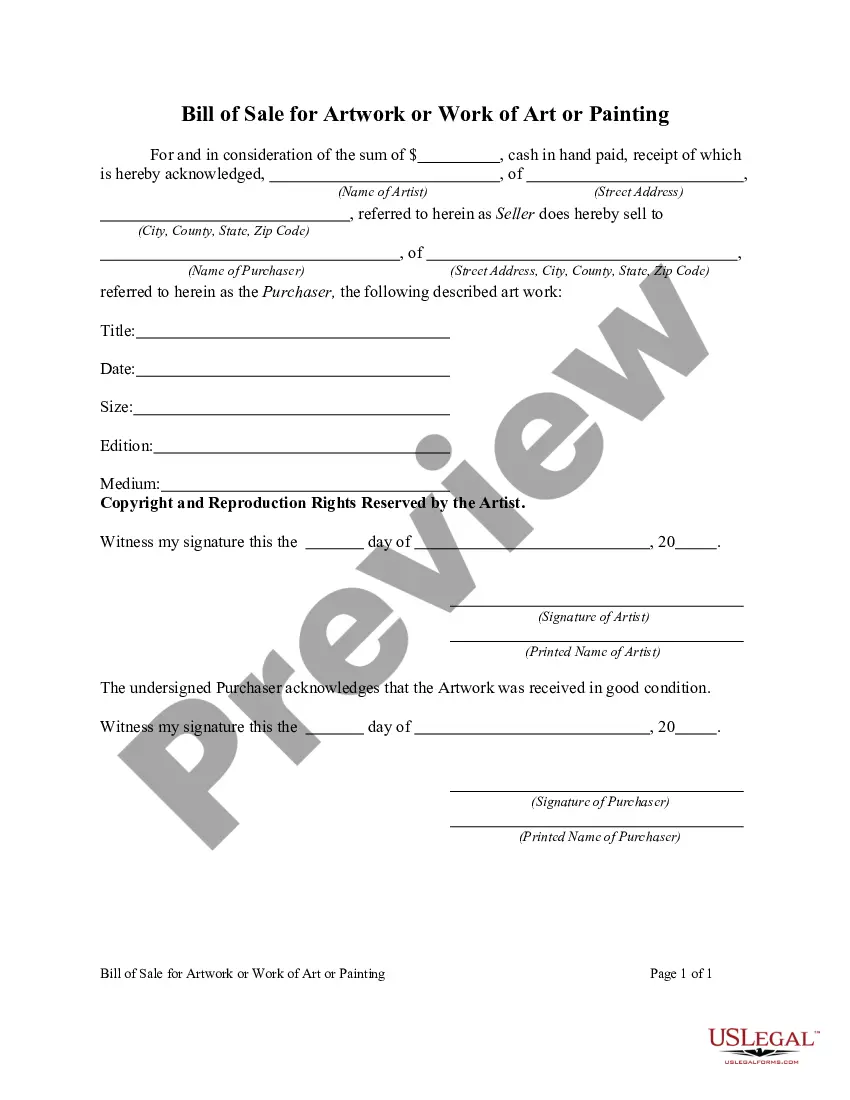
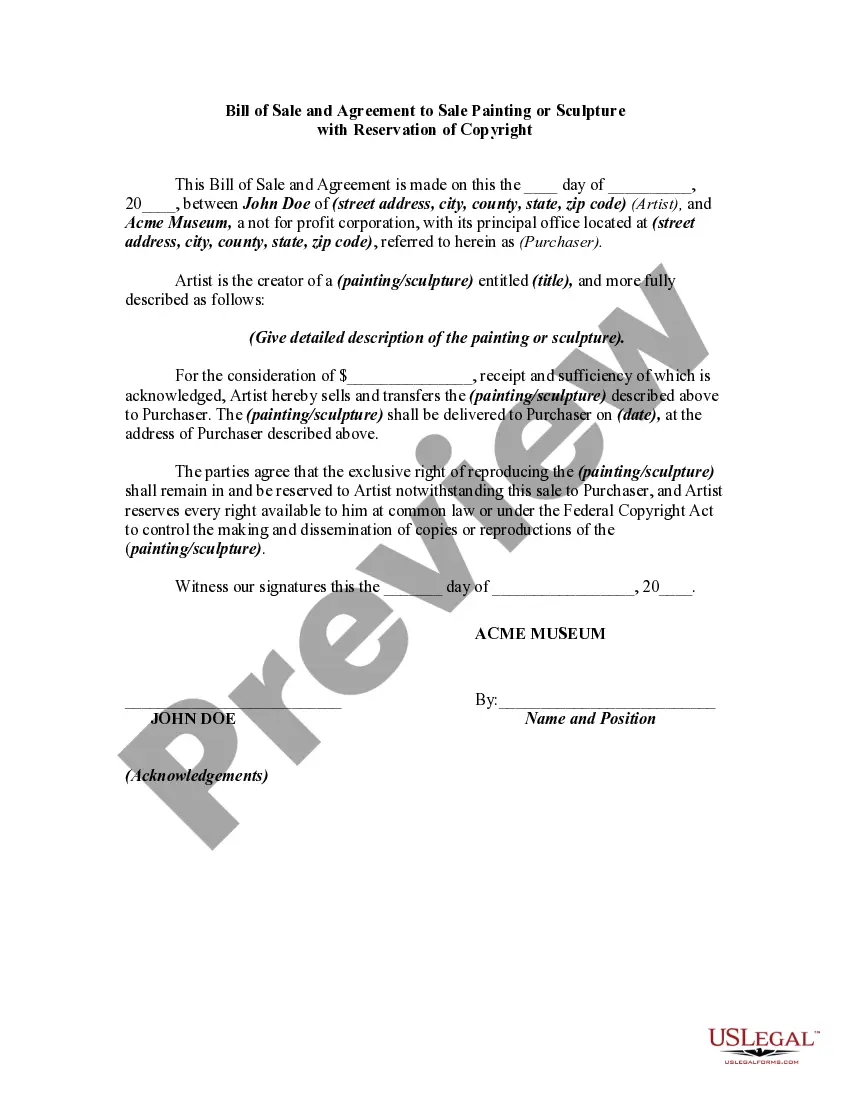
Bill Sale Art Sample Format In Collin
Description

Get your form ready online
Our built-in tools help you complete, sign, share, and store your documents in one place.
Make edits, fill in missing information, and update formatting in US Legal Forms—just like you would in MS Word.
Download a copy, print it, send it by email, or mail it via USPS—whatever works best for your next step.
Sign and collect signatures with our SignNow integration. Send to multiple recipients, set reminders, and more. Go Premium to unlock E-Sign.
If this form requires notarization, complete it online through a secure video call—no need to meet a notary in person or wait for an appointment.
We protect your documents and personal data by following strict security and privacy standards.

Make edits, fill in missing information, and update formatting in US Legal Forms—just like you would in MS Word.

Download a copy, print it, send it by email, or mail it via USPS—whatever works best for your next step.

Sign and collect signatures with our SignNow integration. Send to multiple recipients, set reminders, and more. Go Premium to unlock E-Sign.

If this form requires notarization, complete it online through a secure video call—no need to meet a notary in person or wait for an appointment.

We protect your documents and personal data by following strict security and privacy standards.
Looking for another form?










Form popularity
FAQ
Billy Collins' most famous poems include: "The Afterlife" (1990) "The Art of Drowning" (1991) "The Best Cigarette" (1995) "The Birds of America" (1996) "Introduction to Poetry" (1996) "Aristotle" (1998) "The Revenant" (2003) "The Breather" (2008)
``Dubbed 'the most popular poet in America' by Bruce Weber in the New York Times, Billy Collins is famous for conversational, witty poems that welcome readers with humor but often slip into quirky, tender or profound observation on the everyday, reading and writing, and poetry itself'' (``Billy Collins'').
Though Collins published throughout the 1980s, it was his fourth book, Questions about Angels (1991), that propelled him into the literary spotlight. The collection was selected by poet Ed Hirsch for the 1990 National Poetry Series.
"The Art of Drowning" contains four stanzas: two quintains (five-line stanzas) and two sestets (six-line stanzas). Apart from that, the poem doesn't follow any particular form.
In June 2001, Billy Collins was appointed United States Poet Laureate 2001–2003.
Summary. 'The Art of Drowning' by Billy Collins speaks humorously on near-death experiences and the idea that one's life could be contained in a “flash”. The poem begins with the speaker asking why and how the idea of life flashing before one's eyes came into being.
Use Frames Choose the Right Frame: Select frames that complement your art without overshadowing it. Use Mats: Adding a mat around your print can give it a polished look and draw attention to the artwork. Display in a Grid: Arrange framed prints in a grid pattern on the wall to create a cohesive and organized display.
Start with a blank Google Doc or Word document. Enter your name or business name and contact information on the top left, then add your company logo if you have one on the top right. Add your buyer's name and contact information. To the right of this, add the invoice number, invoice data, and payment due date.
On your invoice, you should include: Your details. Your business name and address. Your buyer's details. Your buyer's name and address. Information about the artwork. Separate line items for each product or service delivered. Information about the payment terms. Your hourly rate, if relevant.
When filling out an artist invoice, include your business name and contact information, the client's details, a description of the artwork or service provided, and the associated costs. Make sure to specify payment terms, due dates, and any additional charges such as taxes or shipping, if applicable.