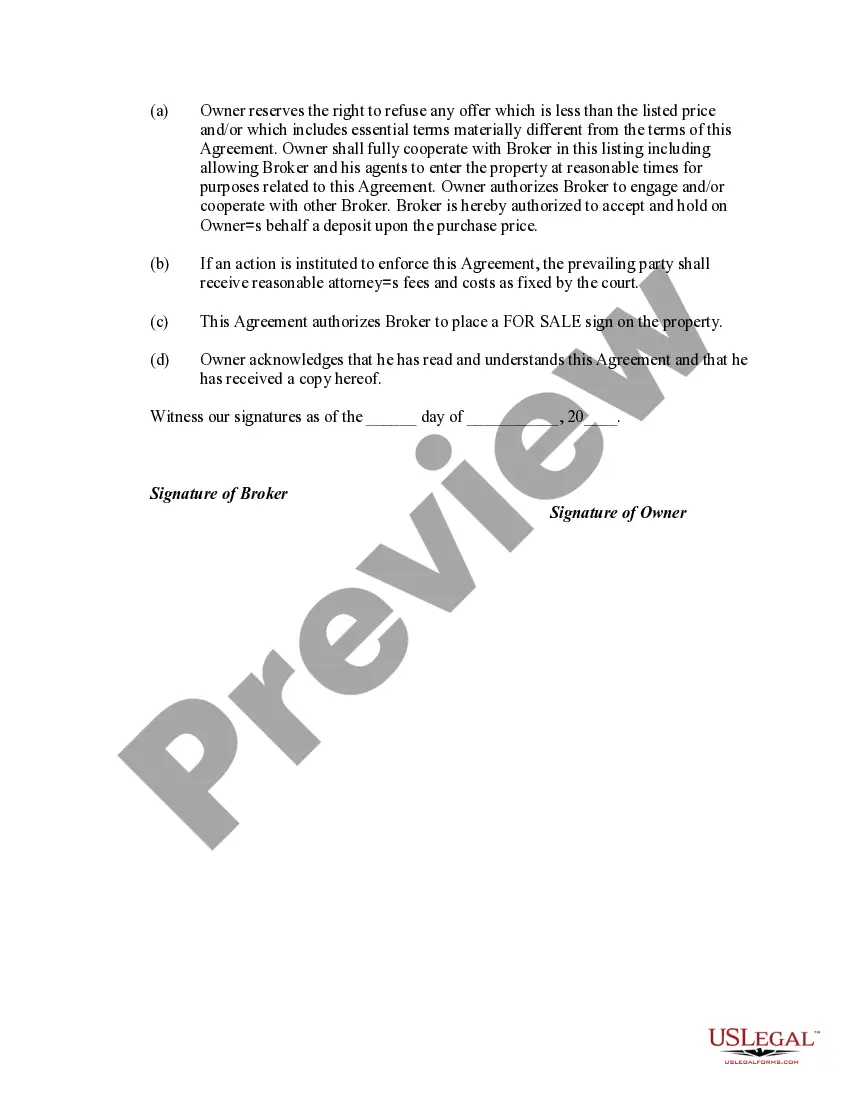
Listing Agreement For Debt Securities In Ohio
Description


Get your form ready online
Our built-in tools help you complete, sign, share, and store your documents in one place.
Make edits, fill in missing information, and update formatting in US Legal Forms—just like you would in MS Word.
Download a copy, print it, send it by email, or mail it via USPS—whatever works best for your next step.
Sign and collect signatures with our SignNow integration. Send to multiple recipients, set reminders, and more. Go Premium to unlock E-Sign.
If this form requires notarization, complete it online through a secure video call—no need to meet a notary in person or wait for an appointment.
We protect your documents and personal data by following strict security and privacy standards.

Make edits, fill in missing information, and update formatting in US Legal Forms—just like you would in MS Word.

Download a copy, print it, send it by email, or mail it via USPS—whatever works best for your next step.

Sign and collect signatures with our SignNow integration. Send to multiple recipients, set reminders, and more. Go Premium to unlock E-Sign.

If this form requires notarization, complete it online through a secure video call—no need to meet a notary in person or wait for an appointment.

We protect your documents and personal data by following strict security and privacy standards.
Looking for another form?






Form popularity
FAQ
There are four common types of listings: open listings, exclusive right-to-sell listings, exclusive agency listings, and net listings. Open listing agreement. An open listing is a non-exclusive contract. Exclusive right to sell listing agreement. Exclusive agency listing agreement. Net listing agreement.
There are several different types of listing contracts, but very few of them are used. The "Exclusive Right to Sell" is the most common, but there is the "open listing," the "exclusive agency listing," and the "one-time show."
1. Exclusive Right to Sell Listing. As the most commonly used listing agreement, the Exclusive Right to Sell Listing's name pretty much says it all. With an Exclusive Right to Sell Listing Agreement, the real estate agent or broker has total control over the transaction.
The most common is the Exclusive Right to Sell or Lease Listing Agreement. The means there is an agency agreement between the seller and the broker, granting the broker the exclusive right to represent the seller in the sale or lease of the seller's property.
The term “blue sky” derives from the characterization of baseless and broad speculative investment schemes which such laws targeted.
Ohio's blue sky laws, found in Chapter 1707 of the Ohio Revised Code, cover various aspects of securities regulation, including exemptions, registration, and the burden of proof in securities-related legal actions.
To be admitted to trading, Debt Securities must be eligible for electronic settlement. For listing and admission to trading, listing particulars, as applicable must be submitted to the Exchange and published.
(Learn how and when to remove this message) A blue sky law is a state law in the United States that regulates the offering and sale of securities to protect the public from fraud.
Blue sky laws are state-level, anti-fraud regulations that require issuers of securities to be registered and to disclose details of their offerings. Blue sky laws create liability for issuers, allowing legal authorities and investors to bring action against them for failing to live up to the laws' provisions.
This means the buyer's agent represents solely you — not the seller — in the transaction. These agreements are often exclusive, which means that you will not hire another agent to represent you while you shop for a home.
