Letter Settlement Estate Sample Withholding Tax In San Antonio
Description


Get your form ready online
Our built-in tools help you complete, sign, share, and store your documents in one place.
Make edits, fill in missing information, and update formatting in US Legal Forms—just like you would in MS Word.
Download a copy, print it, send it by email, or mail it via USPS—whatever works best for your next step.
Sign and collect signatures with our SignNow integration. Send to multiple recipients, set reminders, and more. Go Premium to unlock E-Sign.
If this form requires notarization, complete it online through a secure video call—no need to meet a notary in person or wait for an appointment.
We protect your documents and personal data by following strict security and privacy standards.
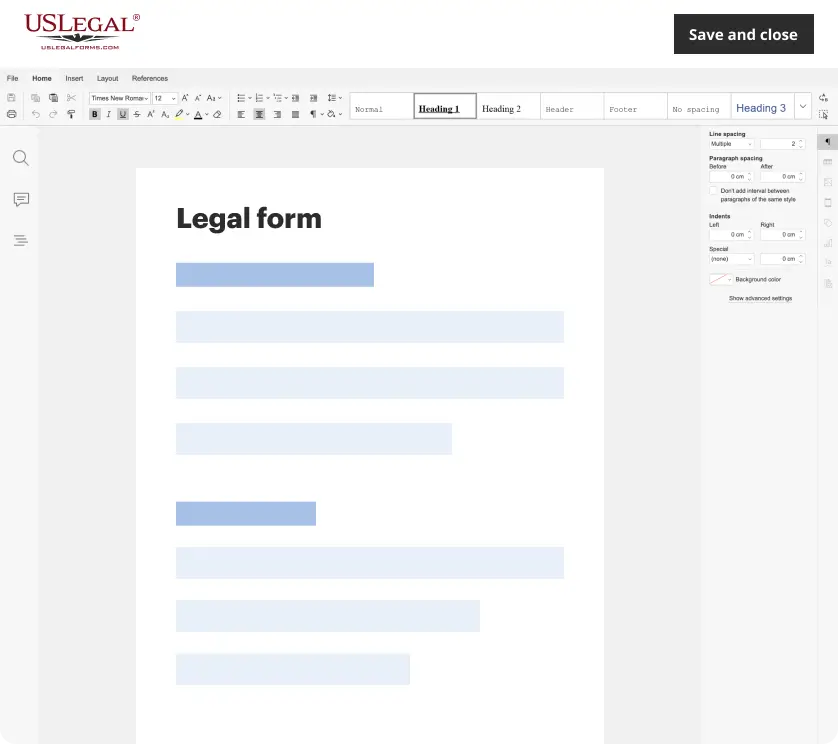
Make edits, fill in missing information, and update formatting in US Legal Forms—just like you would in MS Word.
Download a copy, print it, send it by email, or mail it via USPS—whatever works best for your next step.
Sign and collect signatures with our SignNow integration. Send to multiple recipients, set reminders, and more. Go Premium to unlock E-Sign.

If this form requires notarization, complete it online through a secure video call—no need to meet a notary in person or wait for an appointment.
We protect your documents and personal data by following strict security and privacy standards.
Looking for another form?







Form popularity
FAQ
If you are trying to locate, download, or print Texas tax forms, you can do so on the Texas Comptroller Website, at .
Alaska, Florida, Nevada, New Hampshire, South Dakota, Tennessee, Texas, Washington, and Wyoming do not have state income tax. Most other states require employees to complete the W-4 for state taxes, unless the state imposes a flat income tax rate.
The employee's request is made on a W-4 Form . An amended W-4 filed by an employee must be put into effect no later than the beginning of the first payroll period ending on or after the 30th day after the form is filed with the employer.
Each individual has a lifetime exemption from both estate tax and gift tax (see below). This exemption is the value of assets you can give away, throughout your life and after your death, without being subject to federal estate tax. For 2025, this exemption is $13.99 million per person (up from $13.61 million in 2024).
Texas has no state or local income tax withholding. In general, workers are covered by the unemployment law of the state in which the work is performed. Please be advised that all Washington State Community and Technical Colleges have selected the Reimbursable method for Washington unemployment insurance.
Ing to the Comptroller, there is no provision for the cessation of property taxes at any stage. However, there is a Texas property tax exemption for people over the age of 65, which offers temporary tax relief for seniors. At the age of 65, seniors can apply for an exemption from Texas property taxes.
Texas Tax Code - TAX § 151.0101. “Taxable Services” (17) a sale by a transmission and distribution utility, as defined in Section 31.002, Utilities Code, of transmission or delivery of service directly to an electricity end-use customer whose consumption of electricity is subject to taxation under this chapter.
The tax is nearly always computed as the fair market value of the property, multiplied by an assessment ratio, multiplied by a tax rate, and is generally an obligation of the owner of the property. Values are determined by local officials, and may be disputed by property owners.
Estate and gift tax rates currently range from 18% - 40%. The rates are the same whether you are a US citizen, US domiciliary, or non-US domiciliary. Applicable credit amounts are available against gift tax and estate tax for US citizens and domiciliaries, equivalent to $12,060,000 of value in 2022.

