Letter Of Agreement With In Wayne
Description

Get your form ready online
Our built-in tools help you complete, sign, share, and store your documents in one place.
Make edits, fill in missing information, and update formatting in US Legal Forms—just like you would in MS Word.
Download a copy, print it, send it by email, or mail it via USPS—whatever works best for your next step.
Sign and collect signatures with our SignNow integration. Send to multiple recipients, set reminders, and more. Go Premium to unlock E-Sign.
If this form requires notarization, complete it online through a secure video call—no need to meet a notary in person or wait for an appointment.
We protect your documents and personal data by following strict security and privacy standards.

Make edits, fill in missing information, and update formatting in US Legal Forms—just like you would in MS Word.

Download a copy, print it, send it by email, or mail it via USPS—whatever works best for your next step.

Sign and collect signatures with our SignNow integration. Send to multiple recipients, set reminders, and more. Go Premium to unlock E-Sign.

If this form requires notarization, complete it online through a secure video call—no need to meet a notary in person or wait for an appointment.

We protect your documents and personal data by following strict security and privacy standards.
Looking for another form?








Form popularity
FAQ
How to write an agreement letter Title your document. Provide your personal information and the date. Include the recipient's information. Address the recipient and write your introductory paragraph. Write a detailed body. Conclude your letter with a paragraph, closing remarks, and a signature. Sign your letter.
How to write an agreement letter Title your document. Provide your personal information and the date. Include the recipient's information. Address the recipient and write your introductory paragraph. Write a detailed body. Conclude your letter with a paragraph, closing remarks, and a signature. Sign your letter.
To write a simple contract, title it clearly, identify all parties and specify terms (services or payments). Include an offer, acceptance, consideration, and intent. Add a signature and date for enforceability. Written contracts reduce disputes and offer better legal security than verbal ones.
Just like wills, there is generally no requirement that a contract be notarized in order to be legally binding. However, if a party who signed a business agreement decides to dispute that agreement in court, a notarized contract can help a great deal.
A contract is a formal, legally binding agreement made between two parties with a common interest in mind. This creates “mutual obligations that are enforceable by law.”
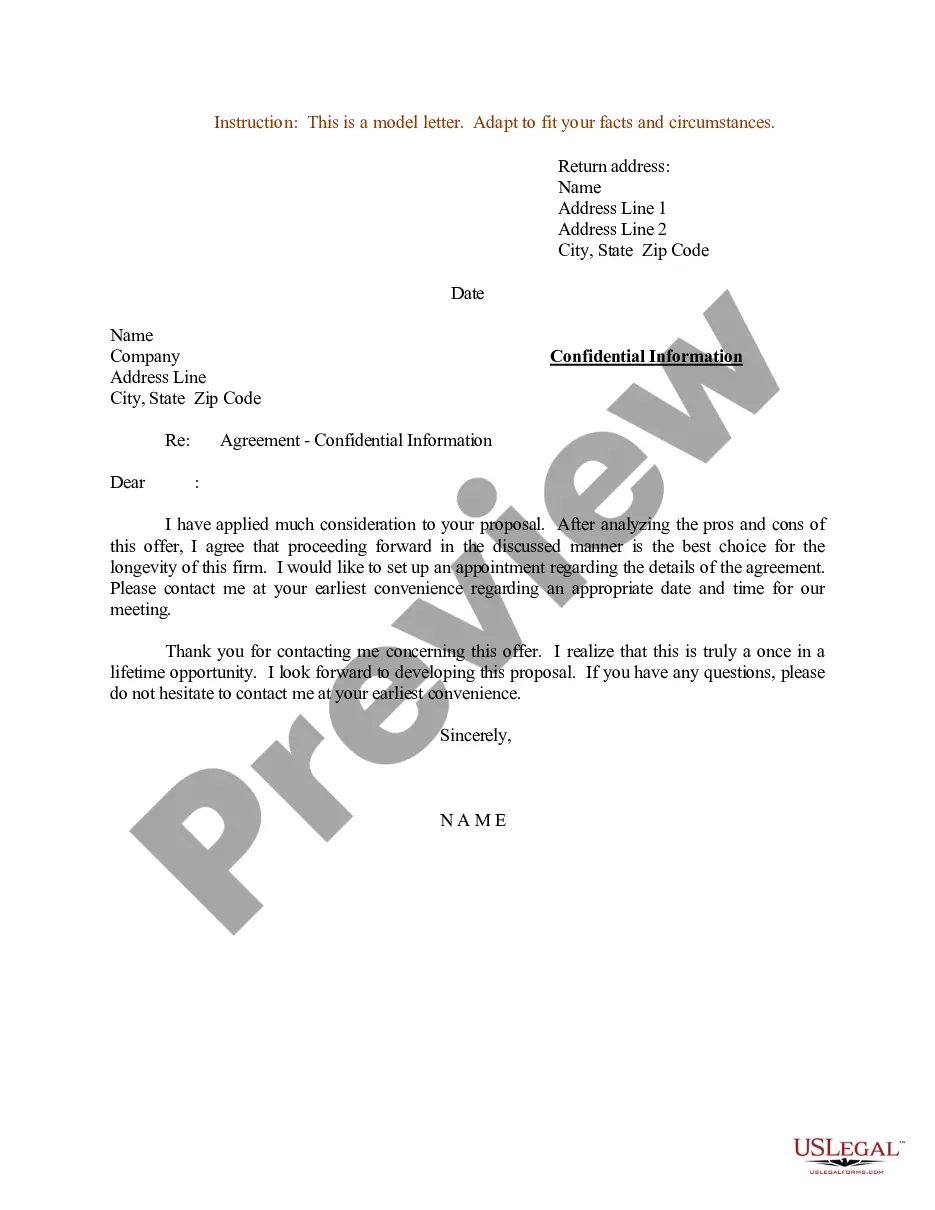
A letter of agreement is a document you can use for business, professional, or commercial purposes to outline the terms and conditions of an agreement. This document gains effect when all relevant parties sign their names to demonstrate their agreement to the terms.
An agreement letter is a type of contract document that outlines the terms and conditions of a working relationship between two parties in a written record. If you want to understand more about contracts, such as those between employers and employees, understanding agreement letters can be a helpful step.
An agreement is a promise or arrangement between two or more parties to do, or not do, something. It's usually informal and sometimes unwritten (but not always). Some examples of agreements include a letter of intent, or a confidentiality agreement that precedes a commercial discussion.
Here are some other names for the letter of agreement: 1. Memorandum of Understanding (MOU): This is a term often used in government contracts. An MOU is similar to a letter of agreement in that it outlines the terms and conditions of a partnership or agreement, but it is not legally binding.
A LoA is a letter drafted by one party to another party. It doesn't matter which party drafts the letter, only that it's signed by both parties. Upon signature, the letter becomes binding on both parties. This is now a valid contract.

