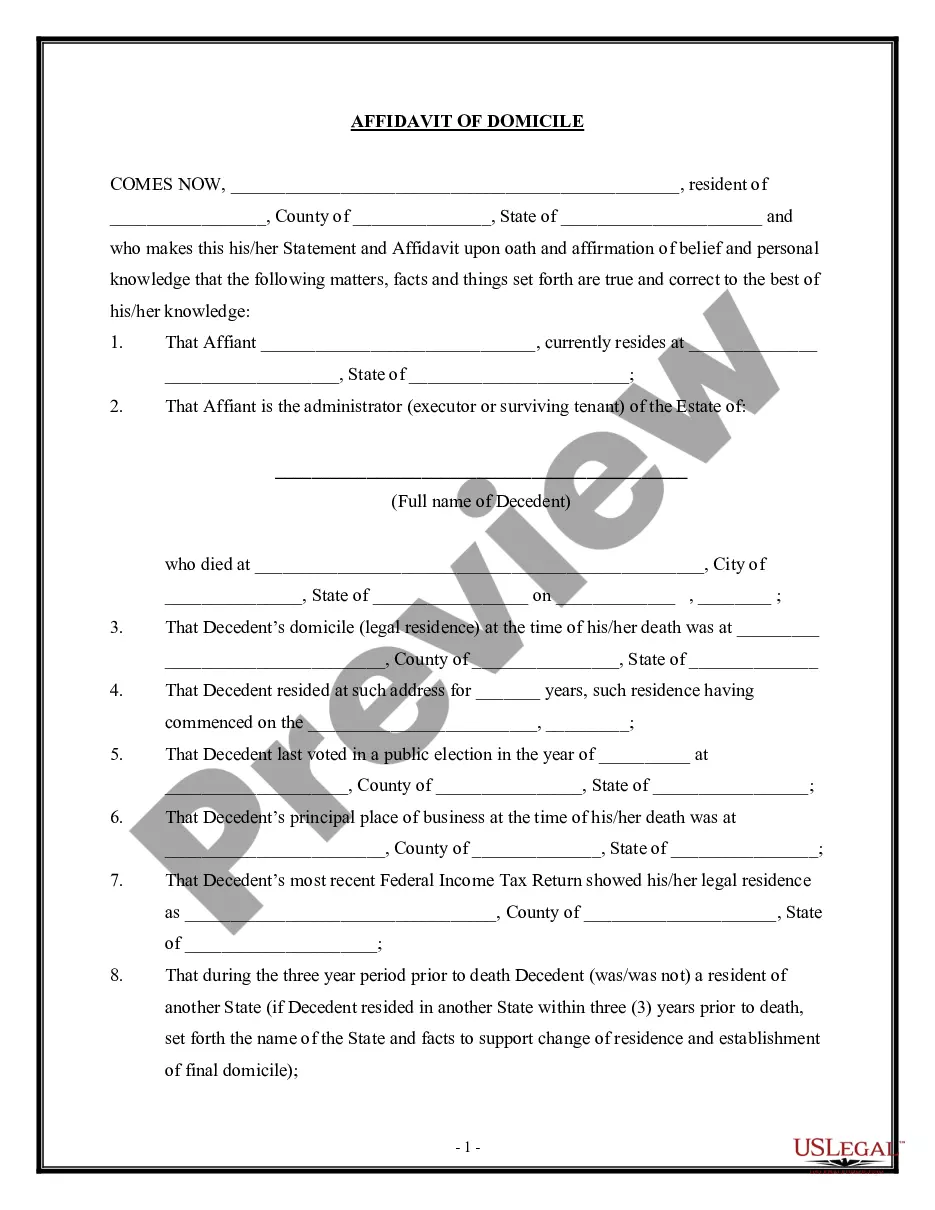
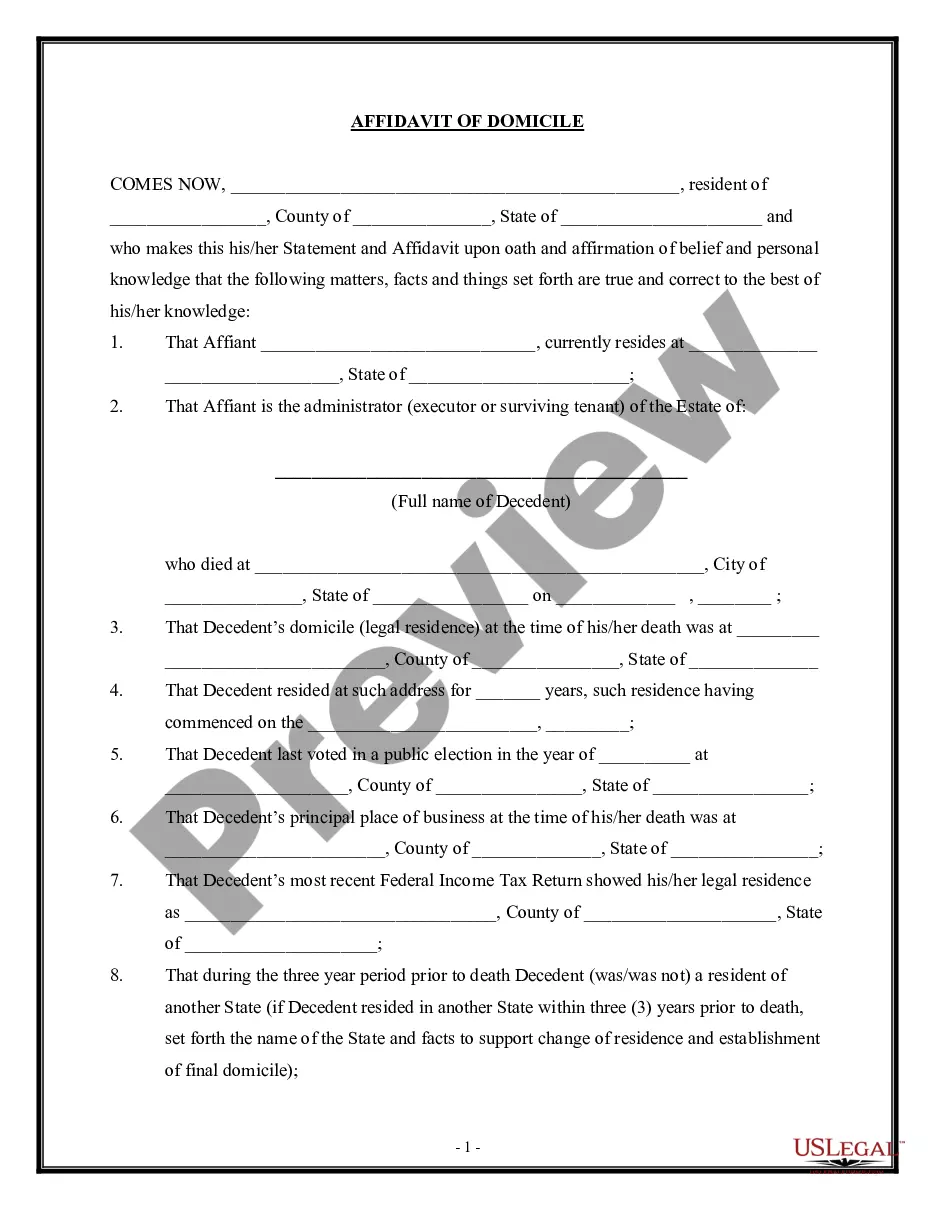
Proof Of U.s. Domicile Sample In Chicago
Description
Get your form ready online
Our built-in tools help you complete, sign, share, and store your documents in one place.
Make edits, fill in missing information, and update formatting in US Legal Forms—just like you would in MS Word.
Download a copy, print it, send it by email, or mail it via USPS—whatever works best for your next step.
Sign and collect signatures with our SignNow integration. Send to multiple recipients, set reminders, and more. Go Premium to unlock E-Sign.
If this form requires notarization, complete it online through a secure video call—no need to meet a notary in person or wait for an appointment.
We protect your documents and personal data by following strict security and privacy standards.

Make edits, fill in missing information, and update formatting in US Legal Forms—just like you would in MS Word.

Download a copy, print it, send it by email, or mail it via USPS—whatever works best for your next step.

Sign and collect signatures with our SignNow integration. Send to multiple recipients, set reminders, and more. Go Premium to unlock E-Sign.

If this form requires notarization, complete it online through a secure video call—no need to meet a notary in person or wait for an appointment.

We protect your documents and personal data by following strict security and privacy standards.
Looking for another form?









Form popularity
FAQ
“Country of residence” refers to the country where a person currently lives and intends to stay for an extended period. For visa holders and immigrants in the USA, this is often the United States, especially if they have a long-term visa or permanent residency status.
A voting record in the United States. Records of paying U.S. state or local taxes. Having property in the United States. Maintaining bank or investment accounts in the United States.
Examples of proof that a sponsor's trip abroad is temporary and that he or she has maintained a domicile in the United States may include: A voting record in the United States. Records of paying U.S. state or local taxes. Having property in the United States.
Individuals arriving on immigrant visas become LPRs when they arrive in the United States. After residing in the United States for five years (or three years in some circumstances), LPRs are eligible to apply for U.S. citizenship.
If you are living outside the United States, you will need to prove that you have significant ties to the U.S., or that you plan to re-establish domicile. Under some circumstances, if you've been living abroad but have been working for certain U.S. organizations, you may still be eligible to claim U.S. domicile.
Your domicile is the state of your permanent home, or the state you consider your home whenever you are. elsewhere. Your domicile is an important place. It is, for example, the place that usually has the power to tax. your income or dissolve your marriage or distribute your property upon your death.
Domicile of choice can be achieved by intention and residence. This means that if an individual is living in a country and leaves it with the intention to return, then they will not have a domicile in the country they went to; instead, their domicile of origin will remain.
Domicile refers to 'a country that a person views as their permanent home'. Domicile status is usually established at birth, a child effectively inherits their domicile status, usually from their father.
Domicile refers to someone's true, principal, and permanent home. In other words, the place where a person has physically lived, regards as home, and intends to return even if currently residing elsewhere.

