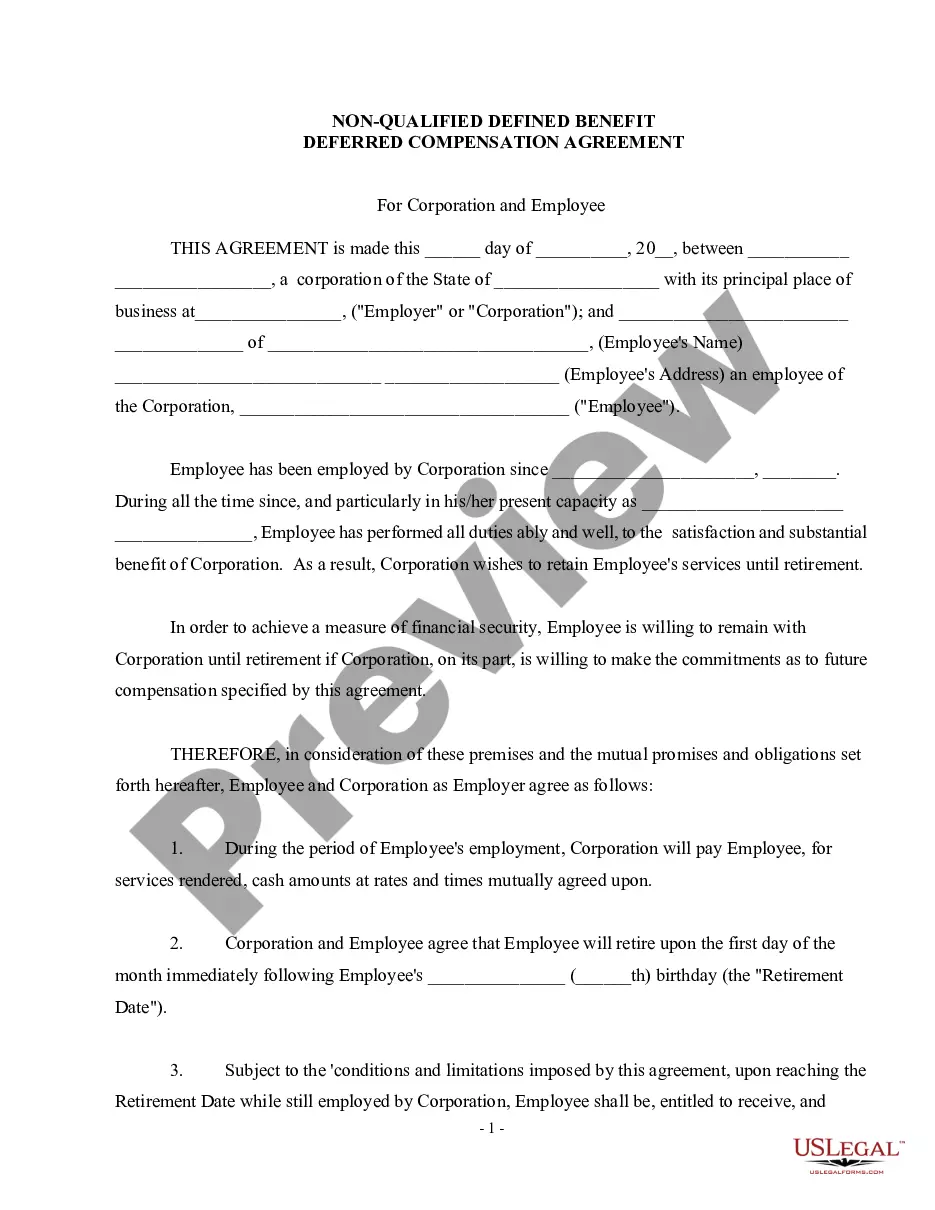
Deferred Compensation Agreement Template With Example In Maricopa
Description





Get your form ready online
Our built-in tools help you complete, sign, share, and store your documents in one place.
Make edits, fill in missing information, and update formatting in US Legal Forms—just like you would in MS Word.
Download a copy, print it, send it by email, or mail it via USPS—whatever works best for your next step.
Sign and collect signatures with our SignNow integration. Send to multiple recipients, set reminders, and more. Go Premium to unlock E-Sign.
If this form requires notarization, complete it online through a secure video call—no need to meet a notary in person or wait for an appointment.
We protect your documents and personal data by following strict security and privacy standards.

Make edits, fill in missing information, and update formatting in US Legal Forms—just like you would in MS Word.

Download a copy, print it, send it by email, or mail it via USPS—whatever works best for your next step.

Sign and collect signatures with our SignNow integration. Send to multiple recipients, set reminders, and more. Go Premium to unlock E-Sign.

If this form requires notarization, complete it online through a secure video call—no need to meet a notary in person or wait for an appointment.

We protect your documents and personal data by following strict security and privacy standards.
Looking for another form?









Form popularity
FAQ
2025 Elective Deferral Limits $23,500.00 This dollar limit is the maximum amount of elective deferrals that can be made to an eligible 457(b) plan by a participant.
Elective deferral limit The amount you can defer (including pre-tax and Roth contributions) to all your plans (not including 457(b) plans) is $23,000 in 2024 ($22,500 in 2023; $20,500 in 2022; $19,500 in 2020 and 2021; $19,000 in 2021).
If you take your deferred compensation payments over a period of 10 years or more, those payments will be taxed in the state where you reside, rather than in the state in which you earned the compensation, possibly reducing your state income taxes.
Traditional individual retirement accounts (IRAs) and 401(k)s are examples of qualified deferred compensation. With these plans, employees contribute pretax dollars via payroll deductions to their retirement savings account. The total contributions cannot exceed the prescribed IRS annual limit.
Generally, a designated beneficiary is required to liquidate the account by the end of the 10th year following the year of death of the IRA owner (this is known as the 10-year rule). An RMD may be required in years 1-9 when the decedent had already begun taking RMDs.
