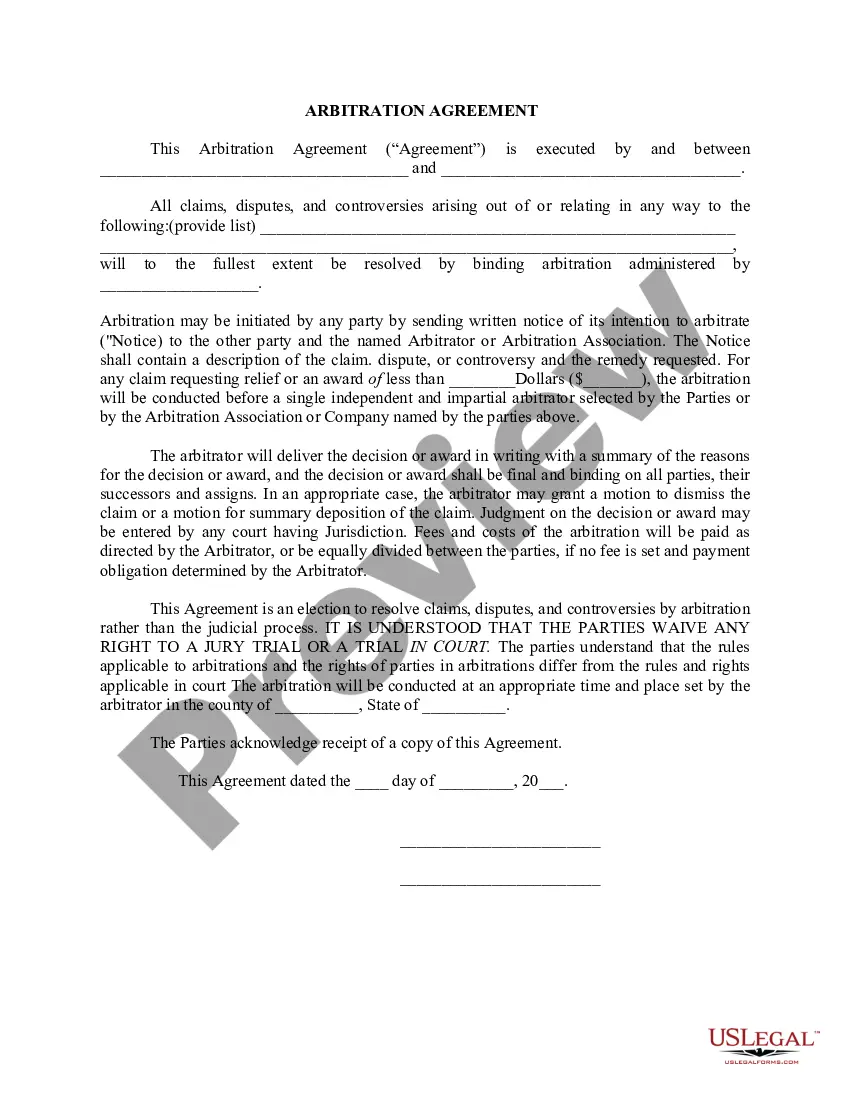
Arbitration Over Dispute In San Diego
Description

Get your form ready online
Our built-in tools help you complete, sign, share, and store your documents in one place.
Make edits, fill in missing information, and update formatting in US Legal Forms—just like you would in MS Word.
Download a copy, print it, send it by email, or mail it via USPS—whatever works best for your next step.
Sign and collect signatures with our SignNow integration. Send to multiple recipients, set reminders, and more. Go Premium to unlock E-Sign.
If this form requires notarization, complete it online through a secure video call—no need to meet a notary in person or wait for an appointment.
We protect your documents and personal data by following strict security and privacy standards.

Make edits, fill in missing information, and update formatting in US Legal Forms—just like you would in MS Word.

Download a copy, print it, send it by email, or mail it via USPS—whatever works best for your next step.

Sign and collect signatures with our SignNow integration. Send to multiple recipients, set reminders, and more. Go Premium to unlock E-Sign.

If this form requires notarization, complete it online through a secure video call—no need to meet a notary in person or wait for an appointment.

We protect your documents and personal data by following strict security and privacy standards.
Looking for another form?



Form popularity
FAQ
There are typically seven stages of the arbitration process: Claimant Files a Claim. Respondent Submits Answer. Parties Select Arbitrators. Parties Attend Initial Prehearing Conference. Parties Exchange Discovery. Parties Attend Hearings. Arbitrators Deliberate and Render Award.
There are typically seven stages of the arbitration process: Claimant Files a Claim. Respondent Submits Answer. Parties Select Arbitrators. Parties Attend Initial Prehearing Conference. Parties Exchange Discovery. Parties Attend Hearings. Arbitrators Deliberate and Render Award.
You both put your case to an independent person called an arbitrator. The arbitrator listens to both sides, looks at the evidence you've sent in and decides what the outcome should be. In some cases, the arbitrator may choose to have several meetings with you both.
Disputes that cannot be resolved through arbitration. Criminal offences. Matrimonial disputes. Guardianship matters. Insolvency petitions. Testamentary suits. Trust disputes. Labour and industrial disputes. Tenancy and eviction matters governed by rent control statutes.
Always get straight to the merits without berating the other side or whining about how badly it has treated you. Another threat to your credibility is the “kitchen sink” arbitration demand or a response that includes numerous claims or defenses that have little chance of succeeding.
Consumers are more likely to win in arbitration than in court. This research from ndp | analytics demonstrates that in disputes initiated by a consumer, consumers fare much better in arbitration than they do in litigation.
--(1) Where any industrial dispute exists or is apprehended and the employer and the workmen agree to refer the dispute to arbitration, they may, at any time before the dispute has been referred under section 10 to a Labour Court or Tribunal or National Tribunal, by a written agreement, refer the dispute to arbitration ...
You both put your case to an independent person called an arbitrator. The arbitrator listens to both sides, looks at the evidence you've sent in and decides what the outcome should be. In some cases, the arbitrator may choose to have several meetings with you both.