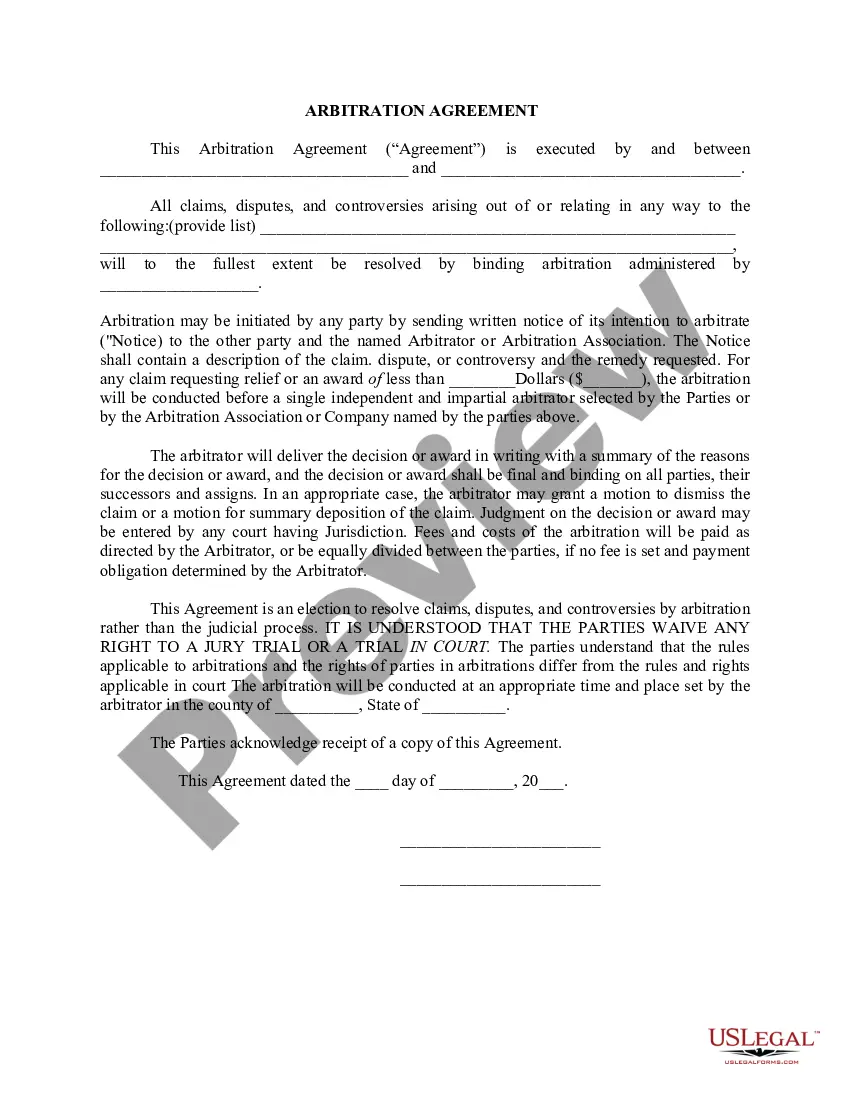
Arbitration Process For Dispute Resolution In San Antonio
Description

Get your form ready online
Our built-in tools help you complete, sign, share, and store your documents in one place.
Make edits, fill in missing information, and update formatting in US Legal Forms—just like you would in MS Word.
Download a copy, print it, send it by email, or mail it via USPS—whatever works best for your next step.
Sign and collect signatures with our SignNow integration. Send to multiple recipients, set reminders, and more. Go Premium to unlock E-Sign.
If this form requires notarization, complete it online through a secure video call—no need to meet a notary in person or wait for an appointment.
We protect your documents and personal data by following strict security and privacy standards.

Make edits, fill in missing information, and update formatting in US Legal Forms—just like you would in MS Word.

Download a copy, print it, send it by email, or mail it via USPS—whatever works best for your next step.

Sign and collect signatures with our SignNow integration. Send to multiple recipients, set reminders, and more. Go Premium to unlock E-Sign.

If this form requires notarization, complete it online through a secure video call—no need to meet a notary in person or wait for an appointment.

We protect your documents and personal data by following strict security and privacy standards.
Looking for another form?




Form popularity
FAQ
3. Seven Steps to Solving Workplace Conflicts Step 1: Identify the issue. Step 2: Try to find understanding. Step 3: Get organized. Step 4: Evaluate the resolution options. Step 5: Make a choice. Step 6: Document your agreement. Step 7: Agree on a contingency plan.
The most common ADR methods are negotiation, mediation, conciliation, arbitration, and private judging. Negotiation. Negotiation is usually the first approach to take before resorting to other ADR methods. Mediation. Mediation is a type of assisted negotiation. Conciliation. Arbitration. Private Judging. Conclusion.
The Five Steps to Conflict Resolution Step 1: Identify the source of the conflict. The more information about the cause of the conflict, the more easily it can be resolved. Step 2: Look beyond the incident. Step 3: Request solutions. Step 4: Identify solutions both disputants can support. Step 5: Agreement.
In arbitration, a neutral third party serves as a judge who is responsible for resolving the dispute. The arbitrator listens as each side argues its case and presents relevant evidence, then renders a binding decision.
In a 2023 Harvard Business Review article, Catherine Cote broke down the Thomas-Kilmann Conflict Model, which highlights five conflict resolution strategies: avoiding, competing, accommodating, compromising, and collaborating.
Typically, mediation is a good choice if both parties believe they can work together to come to an agreement on their own. In cases where this doesn't seem possible, arbitration may be a better choice. If you're not sure which option is best for you, consider talking to a lawyer.
How do you protect yourself when you have one arbitrator who's hearing your dispute instead of a jury trial? One, you need to probably seek legal counsel if you're in a dispute like this. Either the lawyer can help you behind the scenes, guide you through the process or represent you at the arbitration.
To file the parties' request for arbitration, mail or fax DWC Form-044 to: Chief Clerk of Proceedings, Hearings. Texas Department of Insurance, Division of Workers' Compensation. Hearings, Mail Code HRG. PO Box 12050. Austin, TX 78711-2050. or. 512-804-4011 (fax number)
1 of Act 49 of 1996. A reference to arbitration shall not be permissible in respect of- (a) any matrimonial cause or any matter incidental to any such cause; or (b) any matter relating to status.
Arguments should flow easily from the relevant facts and applicable law. Avoid exaggerating the strengths of your case as well as disparaging the opposing side. Remember that professionalism and credibility are critical to persuasiveness.