A Protective Covenant For Property In Cook
Description
Get your form ready online
Our built-in tools help you complete, sign, share, and store your documents in one place.
Make edits, fill in missing information, and update formatting in US Legal Forms—just like you would in MS Word.
Download a copy, print it, send it by email, or mail it via USPS—whatever works best for your next step.
Sign and collect signatures with our SignNow integration. Send to multiple recipients, set reminders, and more. Go Premium to unlock E-Sign.
If this form requires notarization, complete it online through a secure video call—no need to meet a notary in person or wait for an appointment.
We protect your documents and personal data by following strict security and privacy standards.

Make edits, fill in missing information, and update formatting in US Legal Forms—just like you would in MS Word.

Download a copy, print it, send it by email, or mail it via USPS—whatever works best for your next step.

Sign and collect signatures with our SignNow integration. Send to multiple recipients, set reminders, and more. Go Premium to unlock E-Sign.

If this form requires notarization, complete it online through a secure video call—no need to meet a notary in person or wait for an appointment.

We protect your documents and personal data by following strict security and privacy standards.
Looking for another form?








Form popularity
FAQ
Restrictive covenants are frequently put in place for the benefit of others, with the most routine example being that of a neighbouring property. This could be to protect the value of the property or simply to maintain a desirable state of homogeneity.
A covenant is a sacred agreement between God and His children. God sets specific conditions, and He promises to bless us as we obey these conditions. Making and keeping covenants qualifies us to receive the blessings God has promised.
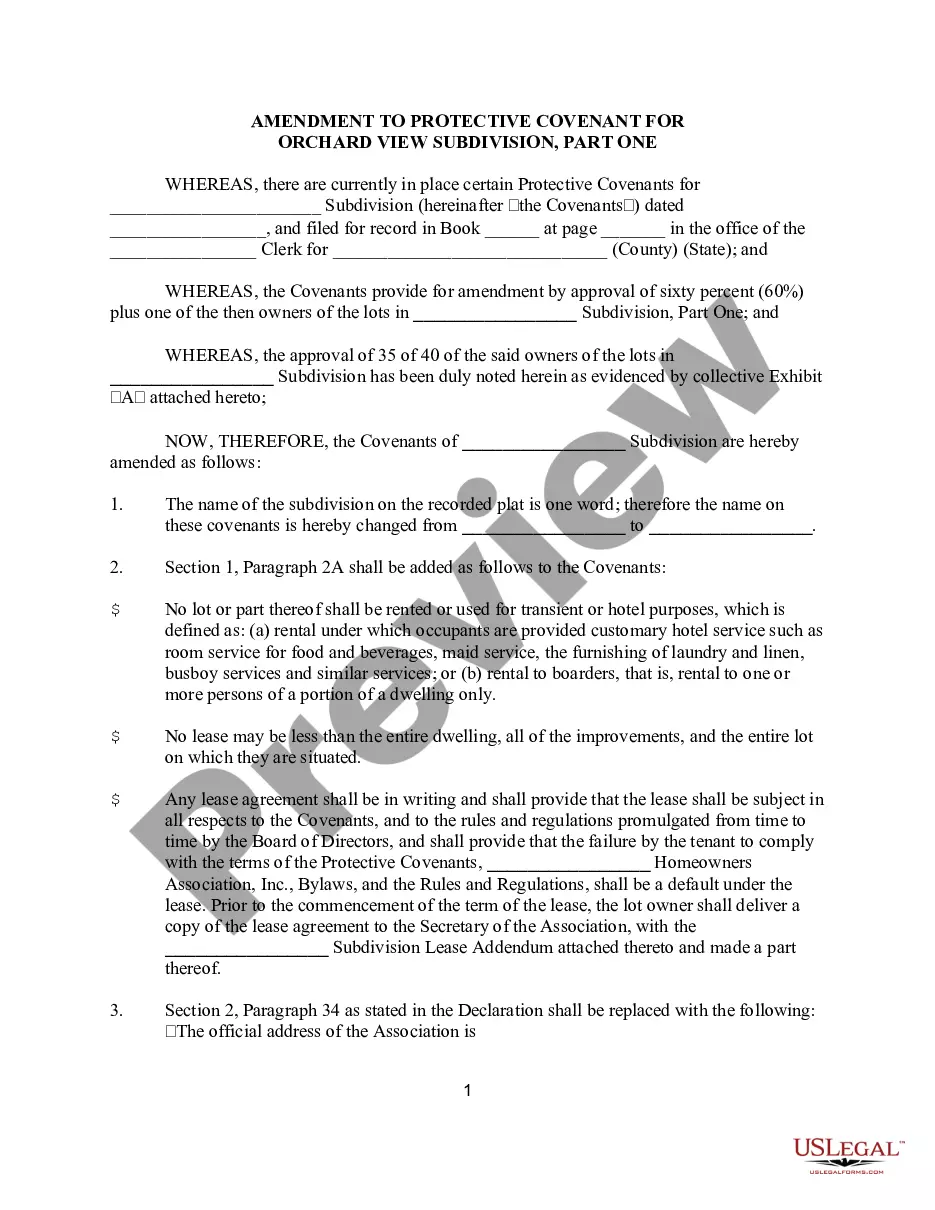
A protective covenant can be used to protect rights while using residential property. The restriction might be put from conducting any business activity on the property like using it for running office or business from the residential property.
Examples of protective covenants are: 1. A protective covenant can be used to protect rights while using residential property. The restriction might be put from conducting any business activity on the property like using it for running office or business from the residential property.
Covenants are agreements between multiple parties that create a legally binding agreement on how each party is to perform. Covenants can either promote activity to occur (positive covenant) or disallow an event or condition (negative covenant).
A covenant for title that comes with a deed or title to the property assures the purchaser that the grantor has the ownership rights that the deed purports to convey.
Application for admission into Covenant University's Postgraduate School is currently open to national and international applicants in the 2024/2025 academic session. to view the requirements into our postgraduate school.
If a deed restriction is not enforceable, you can choose to ignore it and take on the risk of a neighbor filing suit, or you can seek out a judge's ruling to have the covenant removed from the deed. Obtaining that ruling is easier when no one is actively enforcing the covenant.
Average GPA: 3.7 This makes Covenant College Strongly Competitive for GPAs. (Most schools use a weighted GPA out of 4.0, though some report an unweighted GPA. With a GPA of 3.7, Covenant College requires you to be above average in your high school class.
