Restrictive Covenants For Employees In Utah
Description

Get your form ready online
Our built-in tools help you complete, sign, share, and store your documents in one place.
Make edits, fill in missing information, and update formatting in US Legal Forms—just like you would in MS Word.
Download a copy, print it, send it by email, or mail it via USPS—whatever works best for your next step.
Sign and collect signatures with our SignNow integration. Send to multiple recipients, set reminders, and more. Go Premium to unlock E-Sign.
If this form requires notarization, complete it online through a secure video call—no need to meet a notary in person or wait for an appointment.
We protect your documents and personal data by following strict security and privacy standards.

Make edits, fill in missing information, and update formatting in US Legal Forms—just like you would in MS Word.

Download a copy, print it, send it by email, or mail it via USPS—whatever works best for your next step.

Sign and collect signatures with our SignNow integration. Send to multiple recipients, set reminders, and more. Go Premium to unlock E-Sign.

If this form requires notarization, complete it online through a secure video call—no need to meet a notary in person or wait for an appointment.

We protect your documents and personal data by following strict security and privacy standards.
Looking for another form?







Form popularity
FAQ
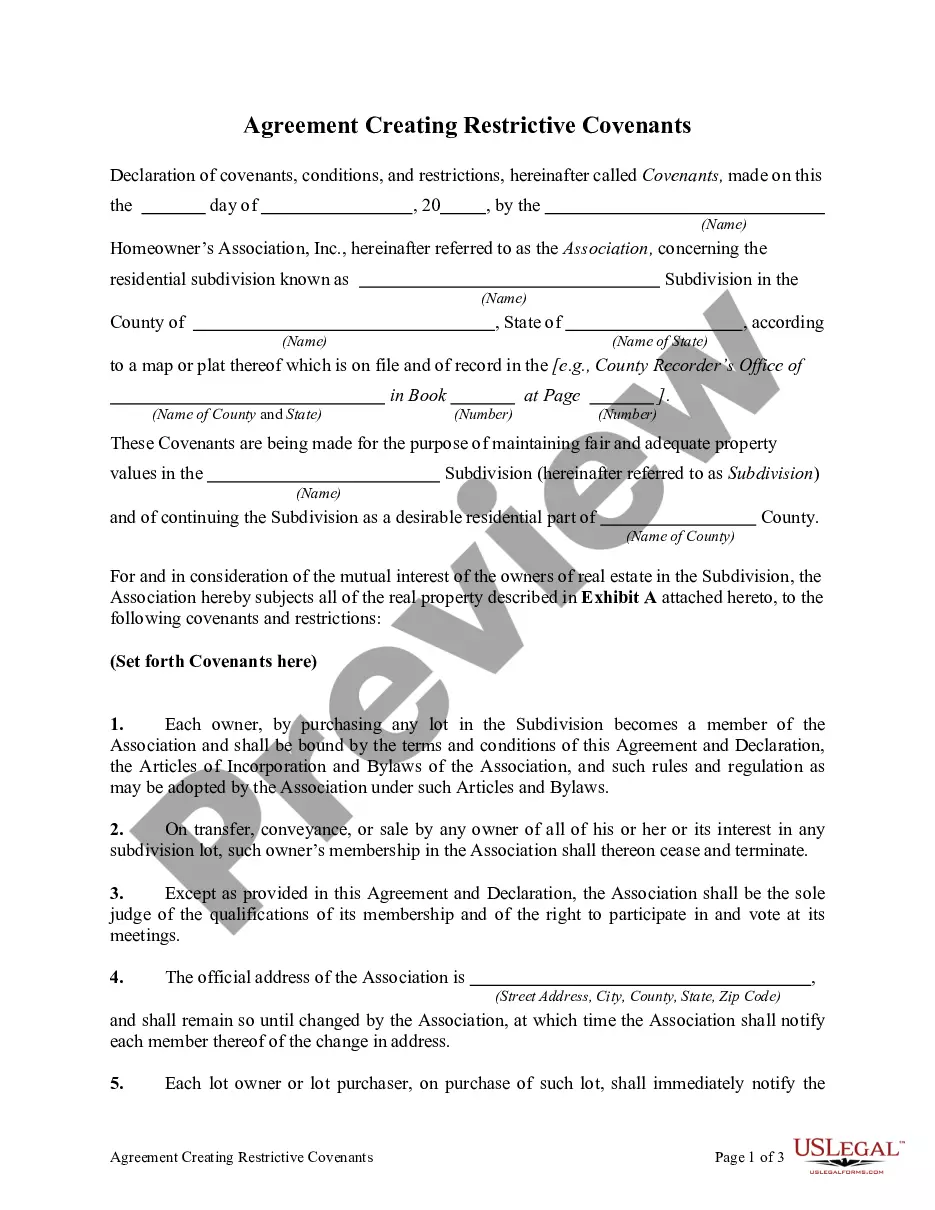
These agreements may also be called a “covenant not to compete” or a “restrictive covenant.” Non-competes ensure that the employee will not use information learned during employment to start a business and compete with the employer once work is over.
In the United States, employers generally use four types of restrictive covenants: (1) covenants not to compete for a certain period of time following the employee's termination from employment (or following a business transaction such as a sale, merger, etc.); (2) covenants not to solicit customers or clients for a ...
In the United States, employers generally use four types of restrictive covenants: (1) covenants not to compete for a certain period of time following the employee's termination from employment (or following a business transaction such as a sale, merger, etc.); (2) covenants not to solicit customers or clients for a ...
For example, restrictive covenants can prevent owners and tenants from making certain renovations, having pets, parking RVs in the driveway, or raising livestock.
A restrictive covenant is a contract between 2 landowners. One landowner promises the other landowner not to carry out certain acts on their own land. Restrictive covenants usually happen when somebody selling land wishes to restrict what the buyer can do with it.
Although an early Utah case upheld a five-year non-compete provision, more recent experience shows that time limits under a year can often be enforced, restrictions up to two years are sometimes enforced, and restrictions beyond two years are rarely enforced.
Employers often include in employment contracts what are referred to as “restrictive covenants.” This term is generally used to describe two main types of contractual clause: the non-solicitation clause and the non-compete clause.
Non-Competitive Activity at New Employer: One of the most straightforward ways to overcome a noncompete is by ensuring that your new role with a different employer is in a non-competitive capacity. If you're not engaging in activities that directly compete with your former employer's business, you may be in the clear.
This law states that a non-compete agreement may be enforced if it is part of “a reasonable severance agreement mutually and freely agreed upon at or after the time of termination.” The non-compete agreement must also meet the common law requirements imposed by Utah courts in order to be enforceable.
Employment contracts or settlement agreements containing nondisclosure agreements (NDAs) or non-disparagement clauses pertaining to sexual misconduct allegations are now void under Utah state law.
