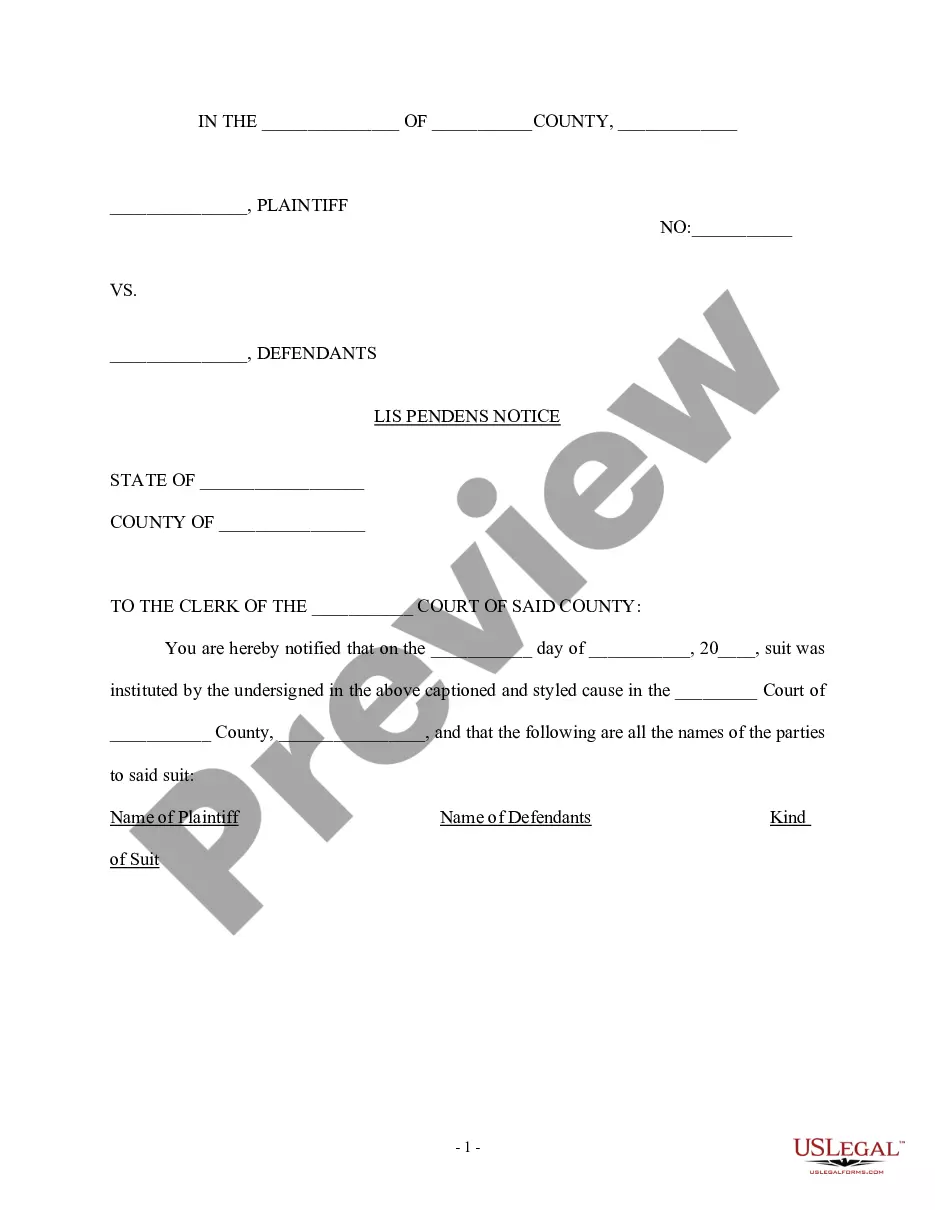
Form Lis Pendens Forum Non Conveniens In San Jose
Description

Get your form ready online
Our built-in tools help you complete, sign, share, and store your documents in one place.
Make edits, fill in missing information, and update formatting in US Legal Forms—just like you would in MS Word.
Download a copy, print it, send it by email, or mail it via USPS—whatever works best for your next step.
Sign and collect signatures with our SignNow integration. Send to multiple recipients, set reminders, and more. Go Premium to unlock E-Sign.
If this form requires notarization, complete it online through a secure video call—no need to meet a notary in person or wait for an appointment.
We protect your documents and personal data by following strict security and privacy standards.

Make edits, fill in missing information, and update formatting in US Legal Forms—just like you would in MS Word.

Download a copy, print it, send it by email, or mail it via USPS—whatever works best for your next step.

Sign and collect signatures with our SignNow integration. Send to multiple recipients, set reminders, and more. Go Premium to unlock E-Sign.

If this form requires notarization, complete it online through a secure video call—no need to meet a notary in person or wait for an appointment.

We protect your documents and personal data by following strict security and privacy standards.
Looking for another form?








Form popularity
FAQ
Generally, filing fees for legal documents, including Lis Pendens, are determined by the local government or court where the filing takes place. These fees can range from a relatively low amount to several hundred dollars.
A notice of pendency (also known as a lis pendens ) is a written notice of a judicial proceeding that affects the ownership of property.
The California Supreme Court has defined forum non conveniens as "an equitable doctrine embracing the discretionary power of a court to decline to exercise the jurisdiction it has over a transitory cause of action when it believes that the action before it may be more ap- propriately and justly tried elsewhere."2 The ...
1. The term forum non conveniens refers to discretionary power of a court to decline jurisdiction when convenience of parties and of justice would be better served if action were brought and tried in another forum.
In Voth, this Court adopted for Australia the test propounded by Deane J in Oceanic Sun, namely, that a stay should be granted if the local court is a clearly inappropriate forum, which will be the case if continuation of the proceedings in that court would be oppressive, in the sense of “seriously and unfairly ...
"The doctrine of forum non conveniens permits a US court to decline to exercise its judicial jurisdiction if the court would be a seriously inconvenient forum and if an adequate alternative forum exists."1 In all cases in which the doctrine ...
Under the doctrine of forum non conveniens, a court, in conflicts-of-laws cases, may refuse impositions on its jurisdiction where it is not the most “convenient” or available forum and the parties are not precluded from seeking remedies elsewhere.
The Australian principle of forum non conveniens is different to the English principle of the same name, which requires the respondent to show that there is another available forum for the resolution of the parties' dispute which is a more appropriate forum: Spiliada Maritime Corporation v Cansulex 1987 AC 460.
Occurred in new jersey. That's a form non-convenience.MoreOccurred in new jersey. That's a form non-convenience.
Latin for 'inconvenient/inappropriate forum'. Forum non conveniens is a common law principle that allows a court to dismiss a civil matter where it has jurisdiction on the basis that a more appropriate or convenient forum exists in which to hear the matter.
