Sample Letter To Close Trust Account With Attorney In Harris
Description




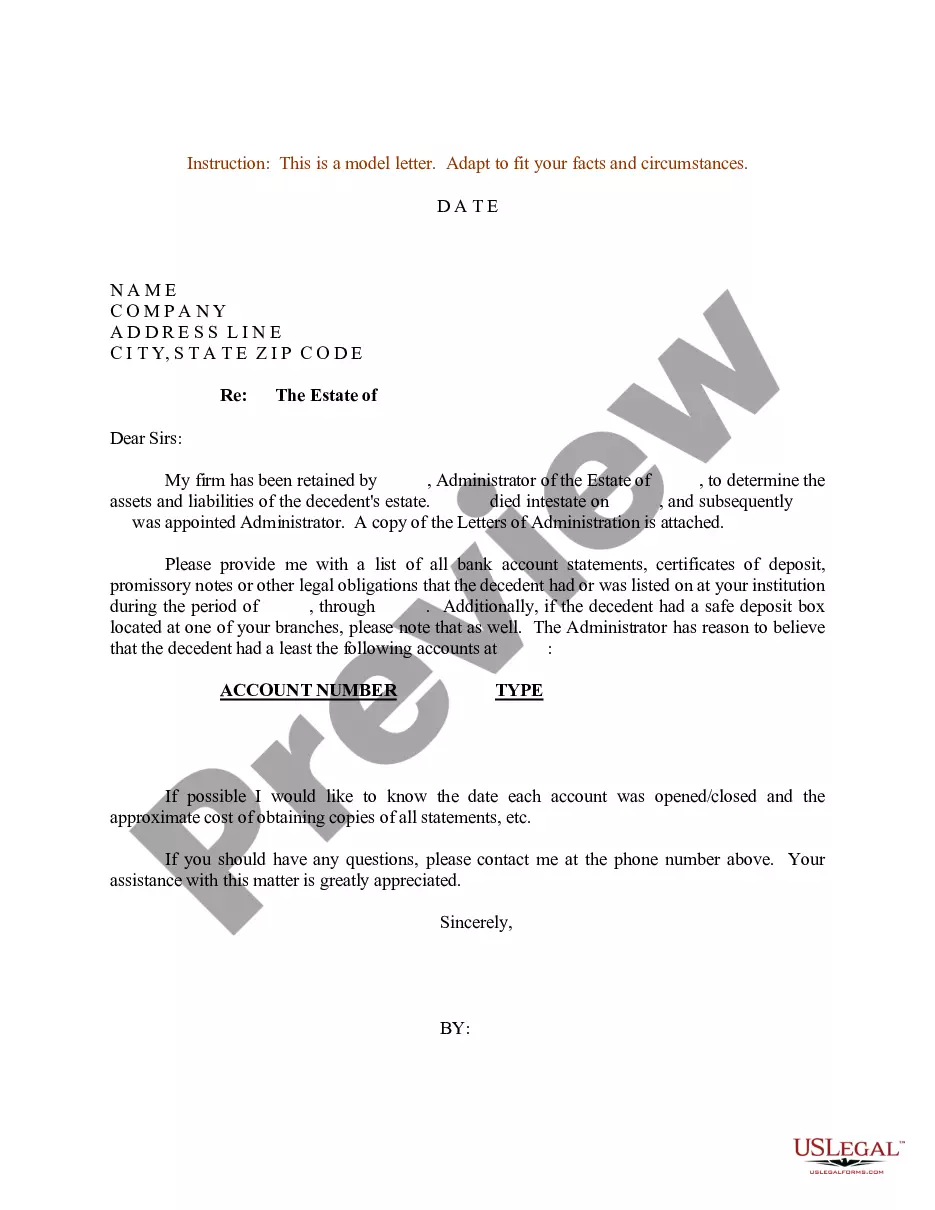
Get your form ready online
Our built-in tools help you complete, sign, share, and store your documents in one place.
Make edits, fill in missing information, and update formatting in US Legal Forms—just like you would in MS Word.
Download a copy, print it, send it by email, or mail it via USPS—whatever works best for your next step.
Sign and collect signatures with our SignNow integration. Send to multiple recipients, set reminders, and more. Go Premium to unlock E-Sign.
If this form requires notarization, complete it online through a secure video call—no need to meet a notary in person or wait for an appointment.
We protect your documents and personal data by following strict security and privacy standards.

Make edits, fill in missing information, and update formatting in US Legal Forms—just like you would in MS Word.

Download a copy, print it, send it by email, or mail it via USPS—whatever works best for your next step.

Sign and collect signatures with our SignNow integration. Send to multiple recipients, set reminders, and more. Go Premium to unlock E-Sign.

If this form requires notarization, complete it online through a secure video call—no need to meet a notary in person or wait for an appointment.

We protect your documents and personal data by following strict security and privacy standards.
Looking for another form?







Form popularity
FAQ
I am terminating this relationship because I have been calling your office for three months and have received no updates on my case status. I expect reasonable communication and sound legal advice and do not believe I have received either. Please do not take any further action on my behalf.
I am writing to officially notify you that I am terminating your services immediately. This is because {reason(s) for terminating the representation}. You do not have permission to send any demands on my behalf and I am advising the insurance company that you no longer represent me for this personal injury claim.
Any lawyer who handles client funds that are too small in amount or held too briefly to earn interest for the client must participate in the Interest on Lawyers' Trust Accounts (IOLTA) program. IOLTA accounts can only be kept at approved financial institutions.
An attorney closing letter (or an end of representation letter, client closing letter, or case closure letter, etc.) is a formal written document that signals the end of representation on a particular legal matter.
Generally, termination letters in each case should include: Date of the letter. Reasons for the termination (specific, real, concrete and objective). Date when employment ends. Previous verbal or written warnings (when dismissing for cause). Information about the right of appeal to courts.
Here are some of the most popular ways to end a formal letter, which you can use in various professional settings. 1 Sincerely. 2 Cordially. 3 Thank you. 4 Appreciatively. 5 Regards. 6 Best. 7 Respectfully. 8 Looking forward to ___
Best wishes, regards (to the family), bye, bye for now, love, from, your friend, have a good day (or a blessed Sunday or a good night, etc.).
End the letter with an appropriate closing phrase. "Sincerely" is an example of an appropriate closing phrase. Place a comma after the closing phrase (i.e. "Sincerely,"). The closing should be aligned with your address.
One of the teaching points is to end correspondence with “Yours sincerely” or a similar phrase when writing to someone by name. “Yours sincerely”, “Sincerely yours” and “Sincerely” are all possible. “Yours sincerely” is the most common. “Sincerely” is one often used by lawyers.
A few options include: Best regards, Sincerely, Kind regards, Warmest regards, Yours faithfully, Yours truly, With appreciation, All the best, Looking forward to hearing from you, Take care. The key is to tailor the closing to the tone and relationship with the recipient.