Sample Letter Of Death Notification To Bank For Credit Card In Chicago
Description



Get your form ready online
Our built-in tools help you complete, sign, share, and store your documents in one place.
Make edits, fill in missing information, and update formatting in US Legal Forms—just like you would in MS Word.
Download a copy, print it, send it by email, or mail it via USPS—whatever works best for your next step.
Sign and collect signatures with our SignNow integration. Send to multiple recipients, set reminders, and more. Go Premium to unlock E-Sign.
If this form requires notarization, complete it online through a secure video call—no need to meet a notary in person or wait for an appointment.
We protect your documents and personal data by following strict security and privacy standards.

Make edits, fill in missing information, and update formatting in US Legal Forms—just like you would in MS Word.

Download a copy, print it, send it by email, or mail it via USPS—whatever works best for your next step.

Sign and collect signatures with our SignNow integration. Send to multiple recipients, set reminders, and more. Go Premium to unlock E-Sign.

If this form requires notarization, complete it online through a secure video call—no need to meet a notary in person or wait for an appointment.

We protect your documents and personal data by following strict security and privacy standards.
Looking for another form?


Form popularity
FAQ
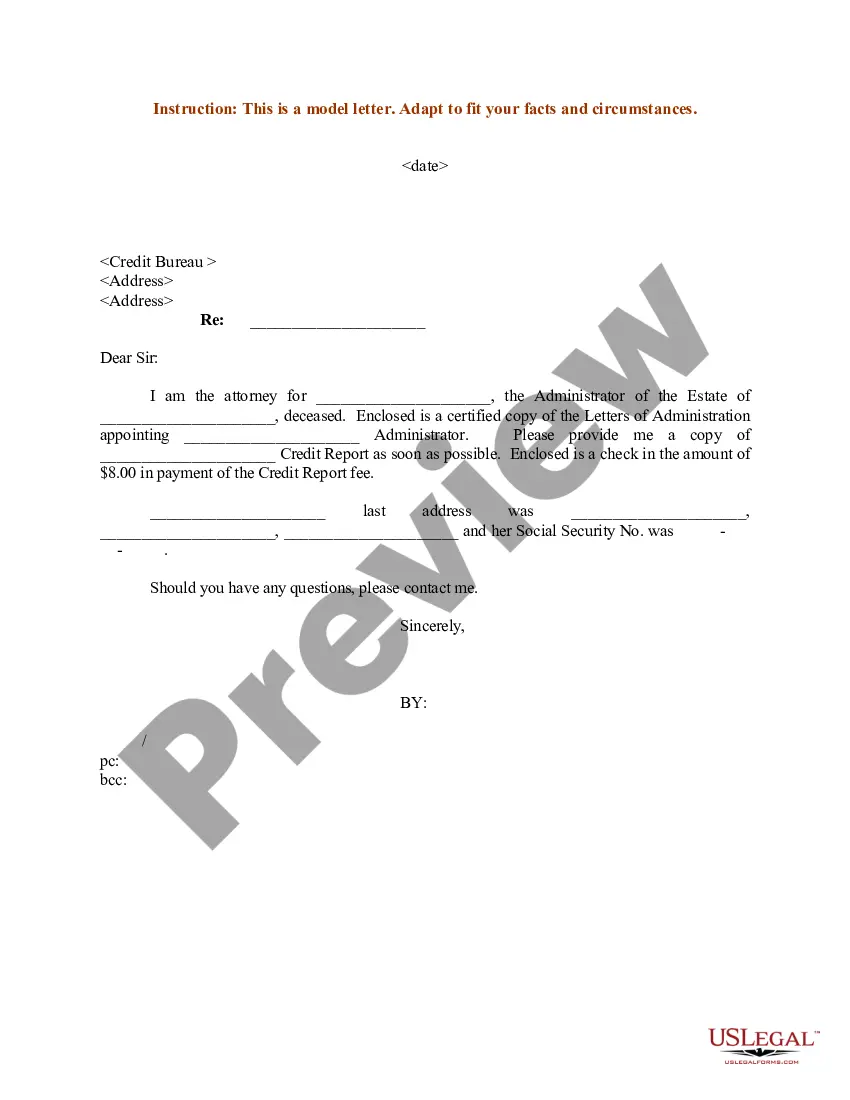
Dear name of credit bureau: I am writing to request that a formal death notice be placed on the credit file of: Deceased's full name (with middle initial if used): Most recent address: Social Security number: Birthdate: Enclosed please find one copy of decedant's death certificate.
Using the credit report as your guide, contact all banks and credit card companies at which the deceased had an open account and close those accounts as quickly as possible. You will need to provide a certified copy of the death certificate to close the account.
You can submit dispute letters to each credit bureau via mail. As stated previously, it is highly recommended to file via certified mail to preserve your rights. Review each agency's contact details below.
Send letters to each of the major credit bureaus — Experian,1 Equifax,2 and TransUnion3— and include the deceased's legal name, Social Security number, date of birth, date of death, and your full name and mailing address.
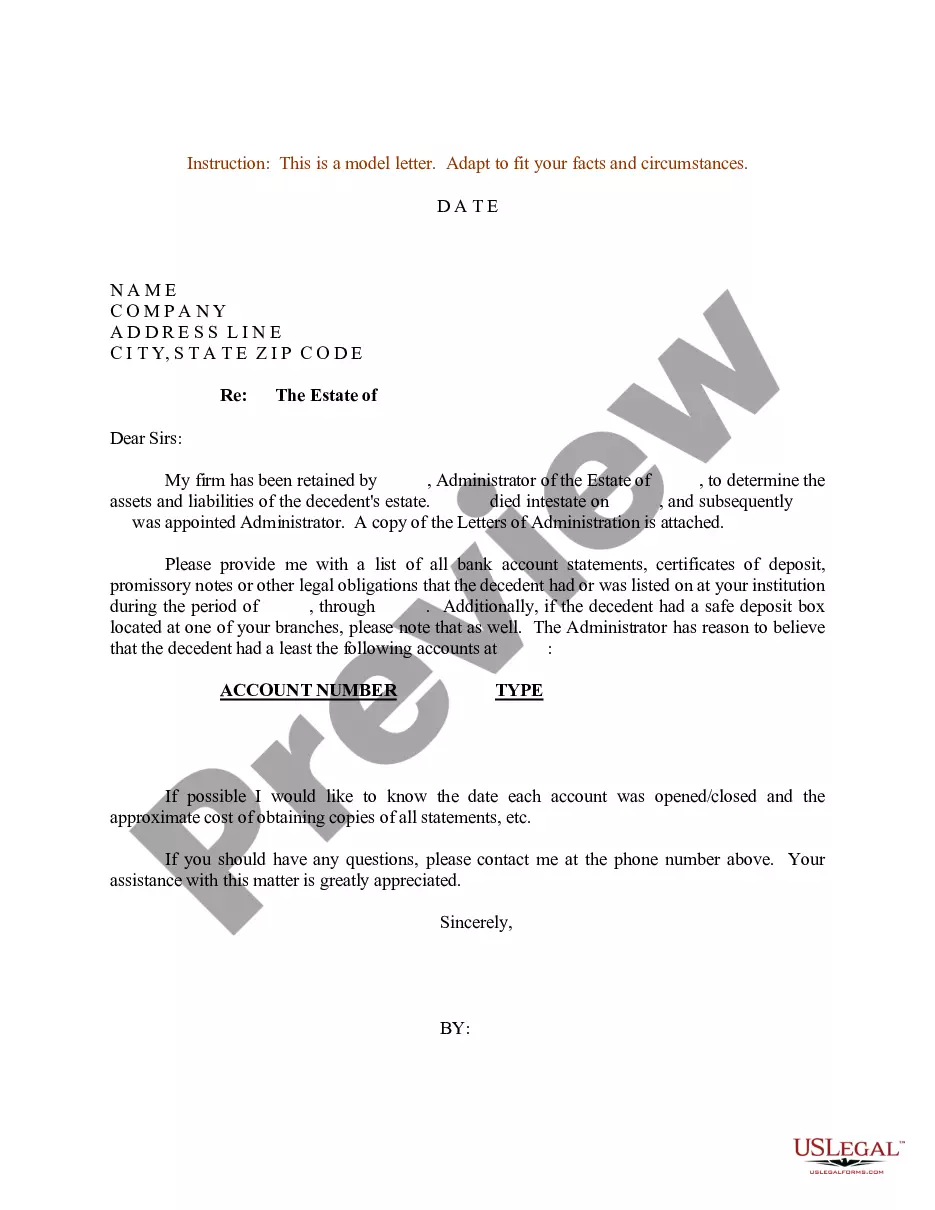
After receiving notification of an account holder's death, a bank will take prompt steps to secure the assets. For an account owned by a single individual, this typically includes: Account status review: The bank reviews the account to confirm its ownership status and determine whether it has a beneficiary designation.
The next of kin must notify their banks of the death when an account holder dies. This is usually done by delivering a certified copy of the death certificate to the bank, along with the deceased's name and Social Security number, bank account numbers, and other information.
The bank is likely to ask for two forms of your identification (usually a passport or driver's licence, or a proof of address with a utility bill) and a copy of the will. If there's no will, the bank could ask for evidence of your relationship to the deceased. You'll also need the death certificate.
