Issued Shares For Cash Journal Entry In King
Description


Get your form ready online
Our built-in tools help you complete, sign, share, and store your documents in one place.
Make edits, fill in missing information, and update formatting in US Legal Forms—just like you would in MS Word.
Download a copy, print it, send it by email, or mail it via USPS—whatever works best for your next step.
Sign and collect signatures with our SignNow integration. Send to multiple recipients, set reminders, and more. Go Premium to unlock E-Sign.
If this form requires notarization, complete it online through a secure video call—no need to meet a notary in person or wait for an appointment.
We protect your documents and personal data by following strict security and privacy standards.

Make edits, fill in missing information, and update formatting in US Legal Forms—just like you would in MS Word.

Download a copy, print it, send it by email, or mail it via USPS—whatever works best for your next step.

Sign and collect signatures with our SignNow integration. Send to multiple recipients, set reminders, and more. Go Premium to unlock E-Sign.

If this form requires notarization, complete it online through a secure video call—no need to meet a notary in person or wait for an appointment.

We protect your documents and personal data by following strict security and privacy standards.
Looking for another form?










Form popularity
FAQ
The number of issued shares is recorded on a company's balance sheet as capital stock or owners' equity, while the shares outstanding (issued shares minus any shares in the treasury) are listed on the company's quarterly filings with the Securities and Exchange Commission.
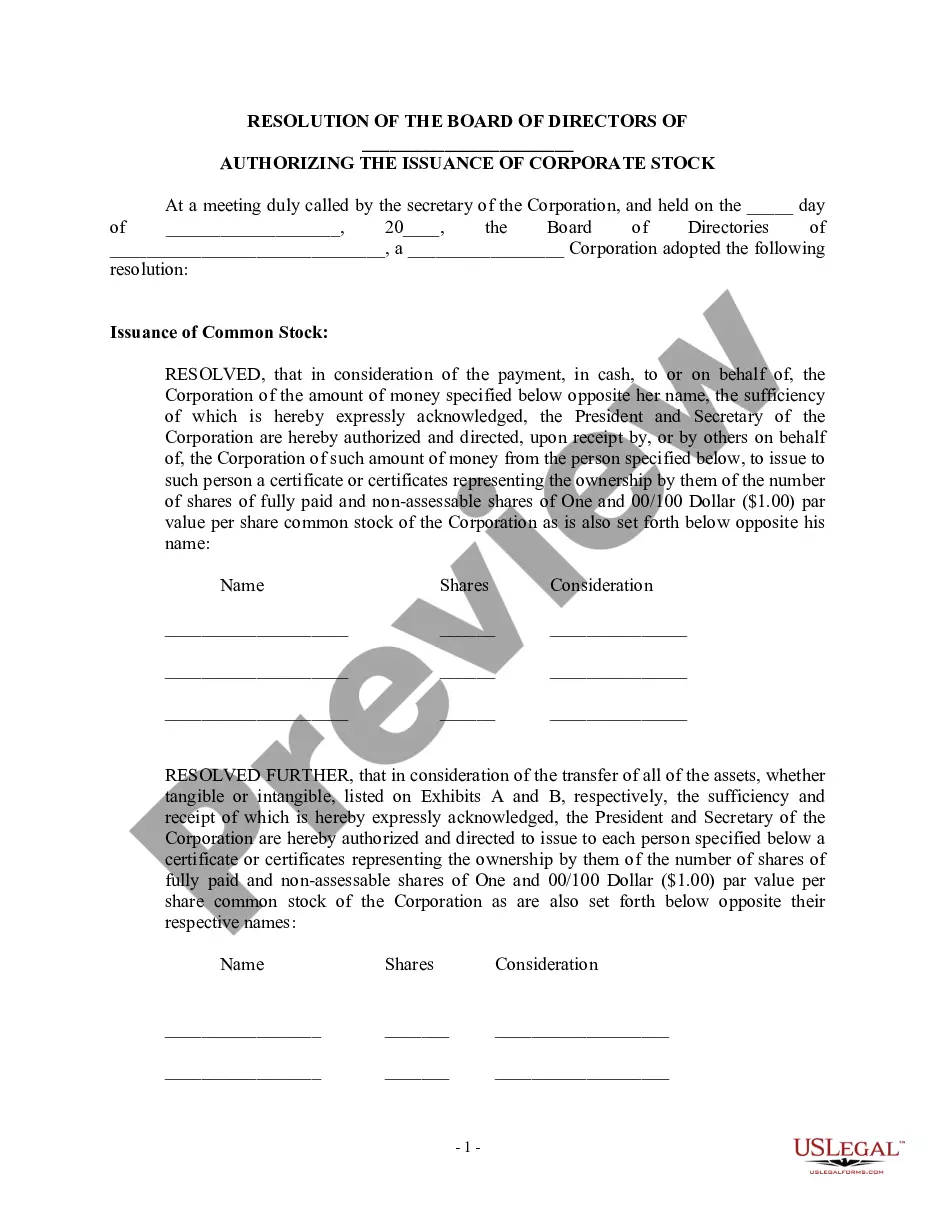
When issuing capital stock for property or services, companies must determine the dollar amount of the exchange. Accountants generally record the transaction at the fair value of (1) the property or services received or (2) the stock issued, whichever is more clearly evident.
Share capital is reported in the equity section of a company's balance sheet, which appears under liabilities. Often, there will be a line for preferred stock and common stock. Here, the par value and number of each type of shares issued will be revealed, followed by the total share capital figure.
The accounting treatment of rights share is the same as that of issue of ordinary shares and the following journal entry will be made: Bank A/c To Equity shares capital A/c Dr. Bank A/c To Equity Share Capital A/c To Securities Premium A/c Dr.
On the other hand we credit common stock to record the increase in the company's Equity. This meansMoreOn the other hand we credit common stock to record the increase in the company's Equity. This means that the company now has more funds available to invest in its operations.
The number of issued shares is recorded on a company's balance sheet as capital stock or owners' equity, while the shares outstanding (issued shares minus any shares in the treasury) are listed on the company's quarterly filings with the Securities and Exchange Commission.
In these cases, the shares should be recorded at the fair value of the asset acquired or service received. Note that this treatment is different than the treatment of non-monetary exchanges of assets, where the fair value of the asset given up is normally used as the transaction amount.