Sample Notice Of Removal To Federal Court For Motion In Phoenix
Description
Get your form ready online
Our built-in tools help you complete, sign, share, and store your documents in one place.
Make edits, fill in missing information, and update formatting in US Legal Forms—just like you would in MS Word.
Download a copy, print it, send it by email, or mail it via USPS—whatever works best for your next step.
Sign and collect signatures with our SignNow integration. Send to multiple recipients, set reminders, and more. Go Premium to unlock E-Sign.
If this form requires notarization, complete it online through a secure video call—no need to meet a notary in person or wait for an appointment.
We protect your documents and personal data by following strict security and privacy standards.

Make edits, fill in missing information, and update formatting in US Legal Forms—just like you would in MS Word.

Download a copy, print it, send it by email, or mail it via USPS—whatever works best for your next step.

Sign and collect signatures with our SignNow integration. Send to multiple recipients, set reminders, and more. Go Premium to unlock E-Sign.

If this form requires notarization, complete it online through a secure video call—no need to meet a notary in person or wait for an appointment.

We protect your documents and personal data by following strict security and privacy standards.
Looking for another form?
Form popularity
FAQ
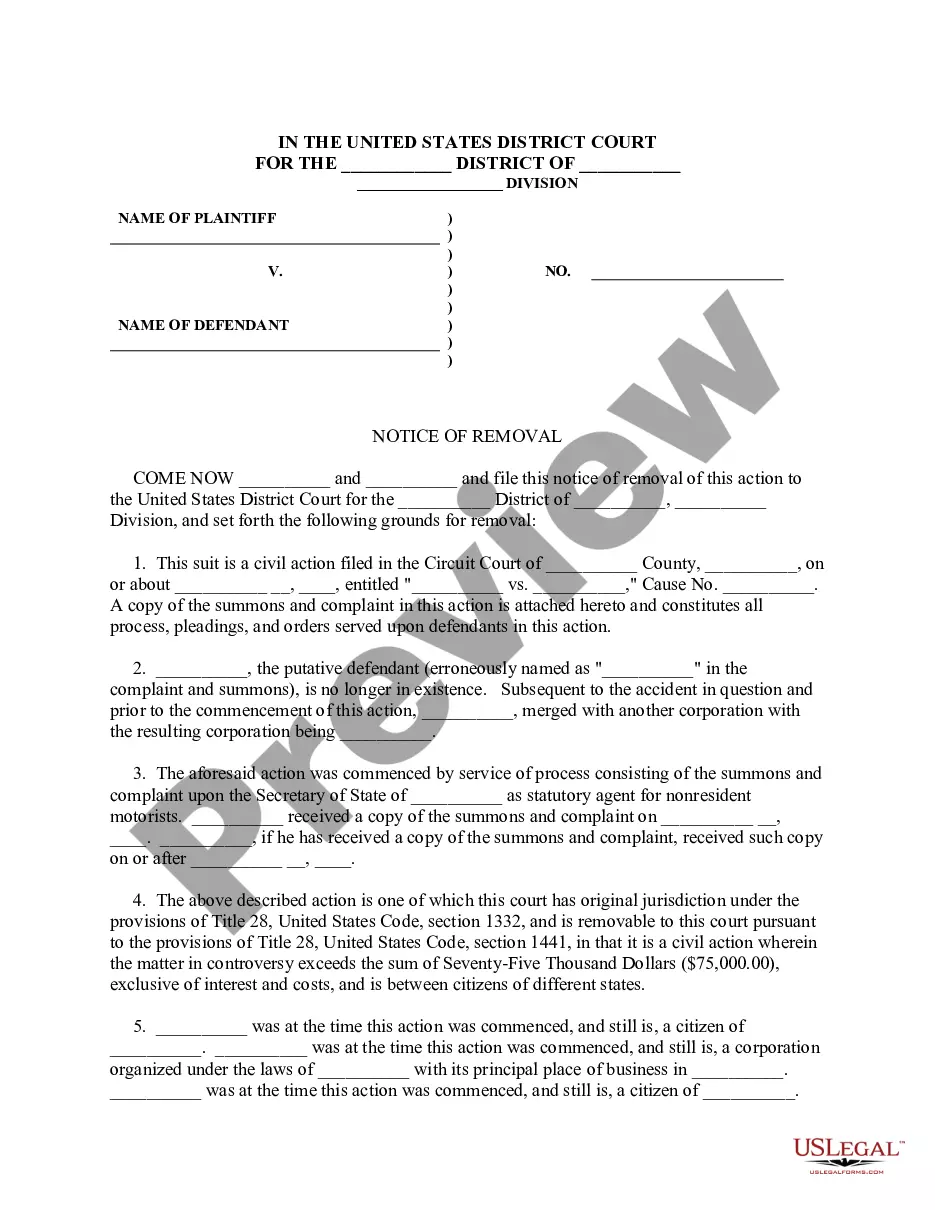
1. The main reason civil cases are removed from state to federal court is that while filed in state court, perhaps in good faith; it is discovered that one party, usually the defendant has moved to another state. Now you have a case which if other requirements are met 1.
Procedurally, it is simple. The defendant files a motion to remove in federal court, a notice to the same effect in state court, and gives notice to all the parties. The case is then docketed in federal court and proceeds there.
Withdrawal of Motions Motions may be withdrawn by the filing of a “Notice of Withdrawal” with the Court at least two (2) court days before a scheduled hearing. A proposed order need not be filed in connection with such a notice.
Write a short and clear introduction. Draft a factually accurate narrative. Know the standard that must be met and craft an explanation of the standard. Use the most persuasive components of the relevant law. Apply the law to the facts in a convincing and credible manner. Conclusion.
The notice of removal of a civil action or proceeding shall be filed within 30 days after the receipt by the defendant, through service or otherwise, of a copy of the initial pleading setting forth the claim for relief upon which such action or proceeding is based, or within 30 days after the service of summons upon ...
Federal courts tend to have more experience with certain types of lawsuits, so removal could mean that the case makes it through the court more efficiently. Rules of procedure and caselaw are often more consistent in federal court.
To bring a state law claim in federal court, all of the plaintiffs must be located in different states than all of the defendants, and the “amount in controversy” must be more than $75,000. (Note: the rules for diversity jurisdiction are much more complicated than explained here.)
The two most well-known bases for federal court subject-matter jurisdiction are: Federal question jurisdiction: The case arises under the US Constitution or a federal statute; and. Diversity jurisdiction: The plaintiff(s) and defendant(s) are from different states, and the amount in controversy is at least $75,000.
In general, a defendant must file a petition for removal in federal court, a notice of removal in the state court, and give notice of the removal to all parties in the action. 28 U.S.C. § 1446.