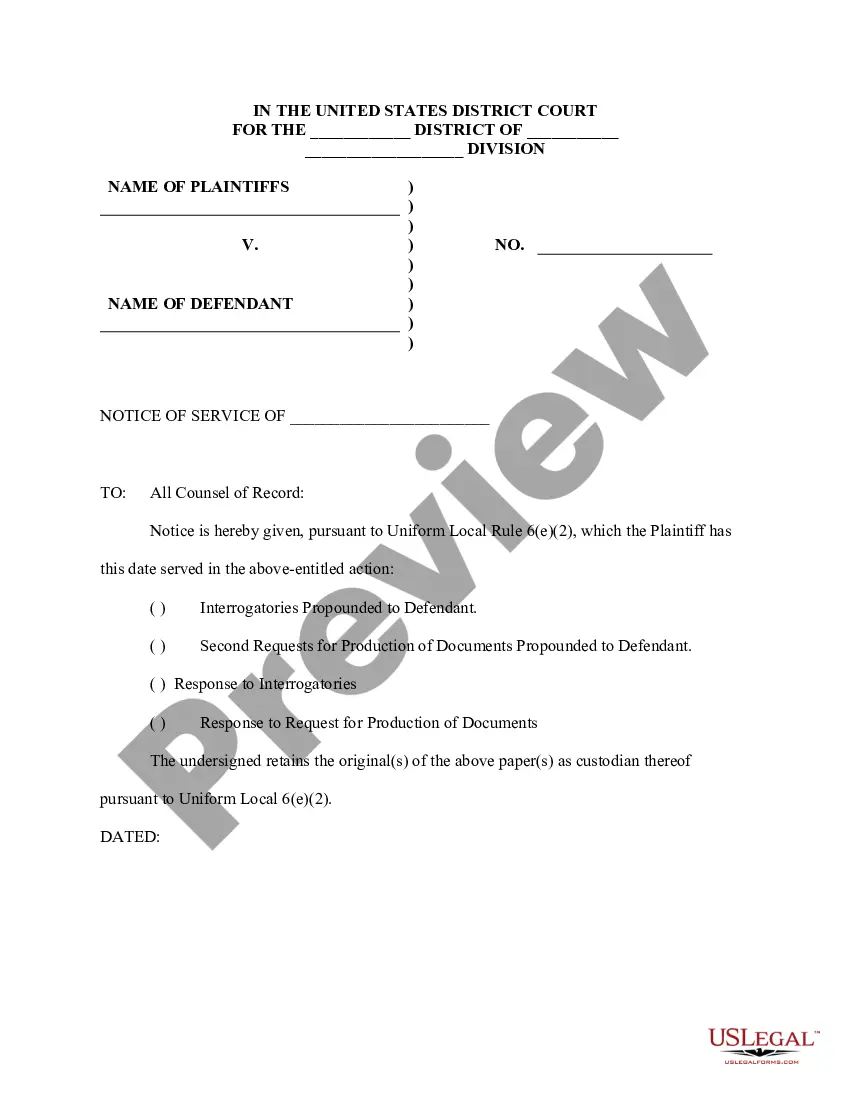
Notice Of Service Of Discovery Example In Ohio
Description

Get your form ready online
Our built-in tools help you complete, sign, share, and store your documents in one place.
Make edits, fill in missing information, and update formatting in US Legal Forms—just like you would in MS Word.
Download a copy, print it, send it by email, or mail it via USPS—whatever works best for your next step.
Sign and collect signatures with our SignNow integration. Send to multiple recipients, set reminders, and more. Go Premium to unlock E-Sign.
If this form requires notarization, complete it online through a secure video call—no need to meet a notary in person or wait for an appointment.
We protect your documents and personal data by following strict security and privacy standards.

Make edits, fill in missing information, and update formatting in US Legal Forms—just like you would in MS Word.

Download a copy, print it, send it by email, or mail it via USPS—whatever works best for your next step.

Sign and collect signatures with our SignNow integration. Send to multiple recipients, set reminders, and more. Go Premium to unlock E-Sign.

If this form requires notarization, complete it online through a secure video call—no need to meet a notary in person or wait for an appointment.

We protect your documents and personal data by following strict security and privacy standards.
Looking for another form?
Form popularity
FAQ
Ohio's discovery process is often referred to as reciprocal discovery, this means that both the prosecution and defense are legally bound to share certain information with each other. In the case of the prosecution, they are required to disclose a wide range of materials to the defense.
Unless otherwise limited by court order, the scope of discovery is as follows: Parties may obtain discovery regarding any nonprivileged matter that is relevant to any party's claim or defense and proportional to the needs of the case, considering the importance of the issues at stake in the action, the amount in ...
(3) Answers, objections or other responses to discovery requests shall be served within twenty-eight days after service of such requests unless the board orders or the parties agree to a different period of time.
As the Supreme Court of Ohio explains, the discovery rule provides that “a cause of action does not arise until the plaintiff discovers, or by the exercise of reasonable diligence should have discovered, that he or she was injured by the wrongful conduct of the defendant.” Id. at ¶ 14.
A discovery response is essentially a choice that you make after receiving a request for information. The question then becomes, Should you comply or not?
Discovery allows you to get information and evidence from the other party or other persons you can use in your lawsuit.
The discovery rule provides that the statute of limitations on bringing a claim does not begin to run until the date on which a claimant actually discovers (or should have discovered) an injury or loss—rather than on the date when the wrongful act giving rise to the injury or loss took place.
It is a document/pleading that the rules of criminal procedure require the parties to file with the court notifying the court and parties of certain things, like, for example, what defenses the defendant might present at trial etc.
(1) Discovery should be commenced by all parties promptly after the filing of a notice of appeal and should be completed within the applicable case management schedule established in rules 5717-1-07 and 5717-1-08 of the Administrative Code, such deadlines also serving as the last day for a party to seek involvement of ...
Upon the filing of the affidavit, the clerk shall cause service of notice to be made by publication in a newspaper of general circulation in the county in which the action or proceeding is filed. If no newspaper is published in that county, then publication shall be in a newspaper published in an adjoining county.