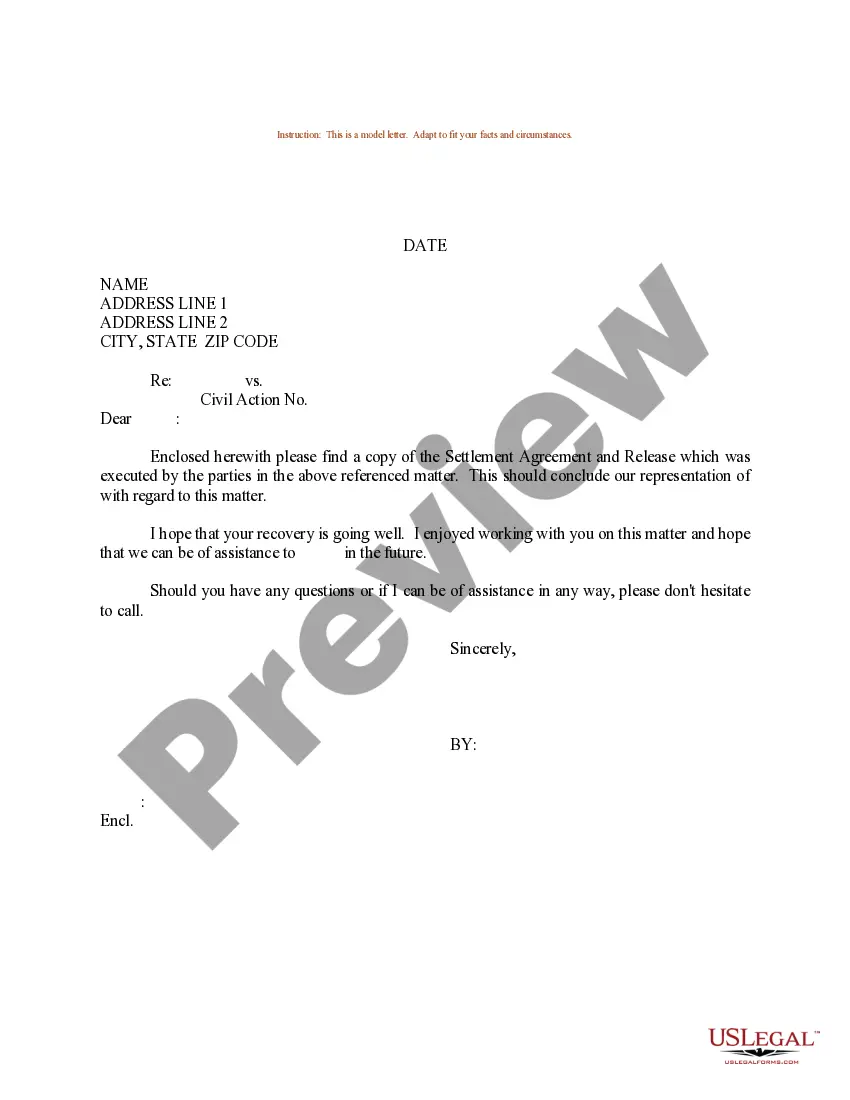
Settlement Confirmation Letter With Final In Nevada
Description


Get your form ready online
Our built-in tools help you complete, sign, share, and store your documents in one place.
Make edits, fill in missing information, and update formatting in US Legal Forms—just like you would in MS Word.
Download a copy, print it, send it by email, or mail it via USPS—whatever works best for your next step.
Sign and collect signatures with our SignNow integration. Send to multiple recipients, set reminders, and more. Go Premium to unlock E-Sign.
If this form requires notarization, complete it online through a secure video call—no need to meet a notary in person or wait for an appointment.
We protect your documents and personal data by following strict security and privacy standards.

Make edits, fill in missing information, and update formatting in US Legal Forms—just like you would in MS Word.

Download a copy, print it, send it by email, or mail it via USPS—whatever works best for your next step.

Sign and collect signatures with our SignNow integration. Send to multiple recipients, set reminders, and more. Go Premium to unlock E-Sign.

If this form requires notarization, complete it online through a secure video call—no need to meet a notary in person or wait for an appointment.

We protect your documents and personal data by following strict security and privacy standards.
Looking for another form?



Form popularity
FAQ
The purpose of a settlement conference is to facilitate good faith discussions to resolve a case in a manner that serves the interest of justice.
In a settlement conference, a judge or volunteer attorney assists the parties by evaluating the strengths and weaknesses of the case and attempting to negotiate a settlement of the dispute, but without making any decisions or orders in the case.
In a settlement conference, a judge or volunteer attorney will be there to help you and the other party find a solution to your dispute. They won't make any decisions or orders in the case, but they will evaluate the strengths and weaknesses of your arguments and try to negotiate a settlement.
I am writing this letter to state that on _ (Day) i.e. (Date), I got relieved from your _ (Company/ Organization) but my full and final settlement has not been done. I request you to kindly do the full and final settlement and send me all dues (if any).
One potential con is that engaging in settlement negotiations may portray to the other side that you are not confident in your case. However, this is most often not a concern and the potential risk can be mitigated by a skilled attorney.
Oftentimes, clients and their counsel will say, “Judge, what do you think is a fair settlement?”; and “Judge, how do you evaluate the case?” Parties can even take a more aggressive approach, urging me to “convince the other side why they're wrong and why they have no case.” I put them off in the initial caucus by ...
The court may, for good cause, issue an order to protect a party or person from annoyance, embarrassment, oppression, or undue burden or expense, including one or more of the following: (A) forbidding the disclosure or discovery; (B) specifying terms, including time and place or the allocation of expenses, for the ...
Rule 7.20 - Form of papers presented for filing; exhibits; documents; legal citations (a) All pleadings and papers presented for filing must be flat, unfolded, firmly bound together at the top, on white paper of standard quality, not less than 16-lb. weight and 8.5 x 11 inches in size.
If a nonmovant shows by affidavit or declaration that, for specified reasons, it cannot present facts essential to justify its opposition, the court may: (1) defer considering the motion or deny it; (2) allow time to obtain affidavits or declarations or to take discovery; or (3) issue any other appropriate order.
Rule 11 - Signing Pleadings, Motions, and Other Papers; Representations to the Court; Sanctions (a) Signature. Every pleading, written motion, and other paper must be signed by at least one attorney of record in the attorney's name-or by a party personally if the party is unrepresented.