Severance Agreement Form With Non Compete In Salt Lake
Description

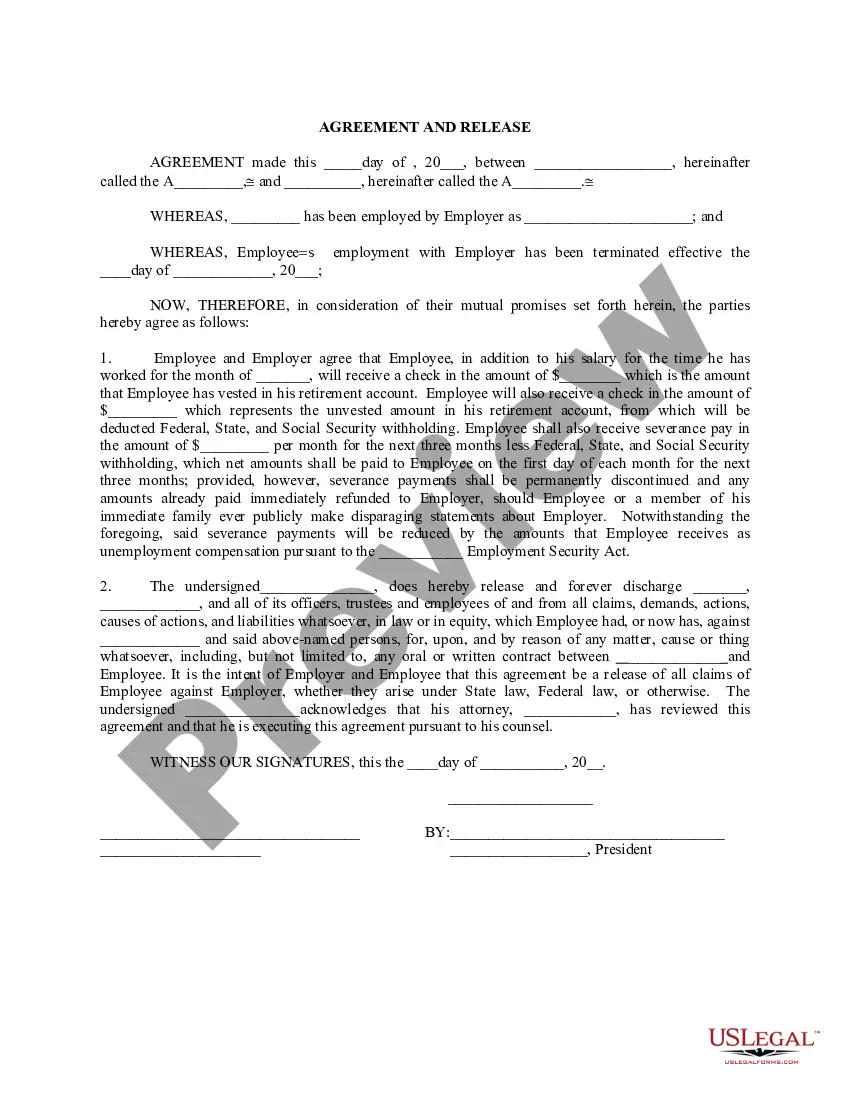
Get your form ready online
Our built-in tools help you complete, sign, share, and store your documents in one place.
Make edits, fill in missing information, and update formatting in US Legal Forms—just like you would in MS Word.
Download a copy, print it, send it by email, or mail it via USPS—whatever works best for your next step.
Sign and collect signatures with our SignNow integration. Send to multiple recipients, set reminders, and more. Go Premium to unlock E-Sign.
If this form requires notarization, complete it online through a secure video call—no need to meet a notary in person or wait for an appointment.
We protect your documents and personal data by following strict security and privacy standards.

Make edits, fill in missing information, and update formatting in US Legal Forms—just like you would in MS Word.

Download a copy, print it, send it by email, or mail it via USPS—whatever works best for your next step.

Sign and collect signatures with our SignNow integration. Send to multiple recipients, set reminders, and more. Go Premium to unlock E-Sign.

If this form requires notarization, complete it online through a secure video call—no need to meet a notary in person or wait for an appointment.

We protect your documents and personal data by following strict security and privacy standards.
Looking for another form?








Form popularity
FAQ
The following are the most common ways to get out of a non-compete agreement: Determine that the terms of the contract do not in fact prevent you from a desired course of action. Recognize when a non-compete contradicts the law. Negotiate a release agreement with the involved parties. Ignore the agreement.
In most cases, non-compete agreements are considered legally binding and can be enforced when an employee departs from the company, irrespective of whether they were terminated or voluntarily left.
The enforceability of non-compete agreements varies widely across states – although they will soon be non-enforceable nationwide if and when the federal rule is effective. In Utah, non-competes are widespread because agreements are enforceable in a broad set of circumstances.
Yes, a non-compete agreement stands even if the company lays you off. Under the Florida Statute, these agreements are enforceable if they protect legitimate business interests.
It is generally unlawful in California for an employer's severance agreement to state that you may not compete against the employer in a future job.
Yes, a non-compete agreement stands even if the company lays you off. Under the Florida Statute, these agreements are enforceable if they protect legitimate business interests.
Take a non-competitive job or role outside your current employer's specialty. Prove your employer breached the contract to invalidate the non-compete clause. Argue that the non-compete is overly restrictive or not enforceable. Negotiate or prove no legitimate business interests exist to uphold the agreement.
Noncompete agreements (often referred to as noncompetes) are postemployment restrictions that prohibit departing employees from joining or starting a competing enterprise, typically within time and geographic boundaries (for examples, see Figures OE1, OE2, and OE3 in the Online Appendix).
In Part 1 of this series, I explained that Utah courts will enforce Restrictive Covenants (like non-compete agreements, non-solicitation agreements, no-hire clauses, and similar provisions), as long as they are written to protect an employer's “legitimate business interests” and they place “no greater restraint” than ...
On April 23, 2024, the FTC passed a final rule to ban most non-compete clauses in employment agreements, finding such agreements to be unfair methods of competition (the “FTC Rule”).