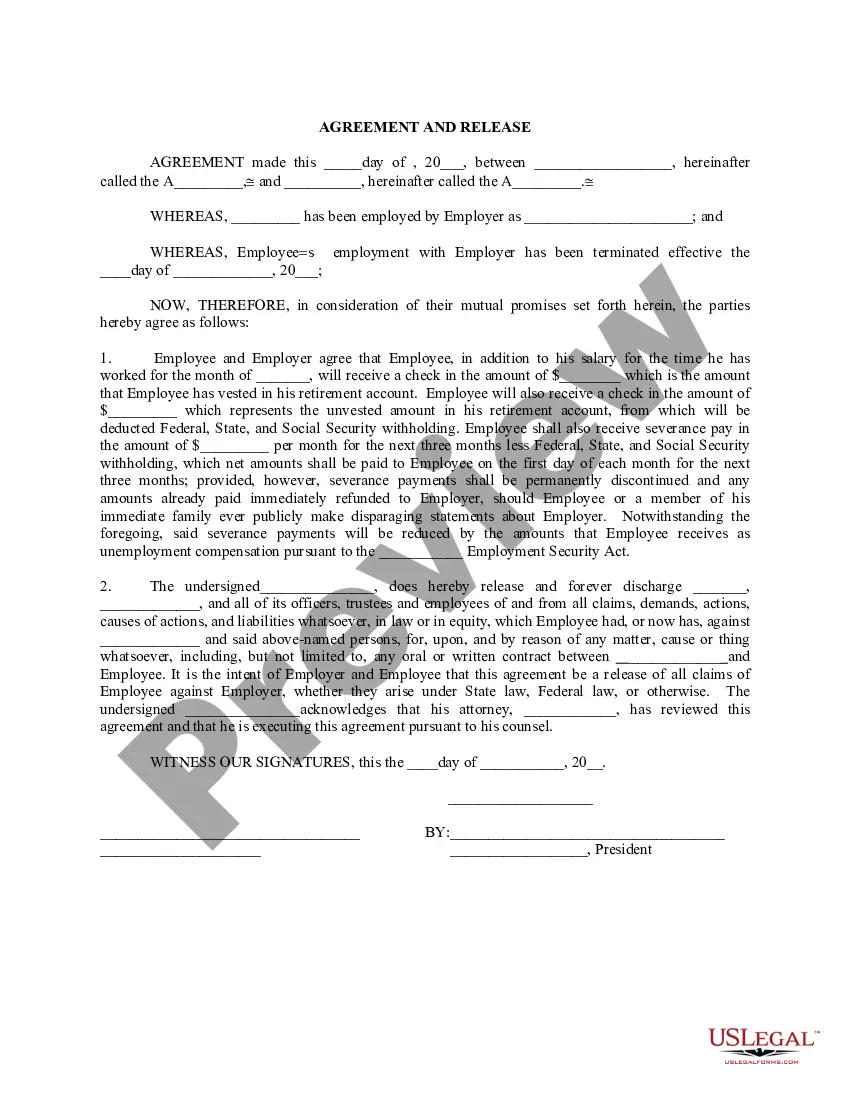
Severance Agreement Form Without Severance In Middlesex
Description

Get your form ready online
Our built-in tools help you complete, sign, share, and store your documents in one place.
Make edits, fill in missing information, and update formatting in US Legal Forms—just like you would in MS Word.
Download a copy, print it, send it by email, or mail it via USPS—whatever works best for your next step.
Sign and collect signatures with our SignNow integration. Send to multiple recipients, set reminders, and more. Go Premium to unlock E-Sign.
If this form requires notarization, complete it online through a secure video call—no need to meet a notary in person or wait for an appointment.
We protect your documents and personal data by following strict security and privacy standards.

Make edits, fill in missing information, and update formatting in US Legal Forms—just like you would in MS Word.

Download a copy, print it, send it by email, or mail it via USPS—whatever works best for your next step.

Sign and collect signatures with our SignNow integration. Send to multiple recipients, set reminders, and more. Go Premium to unlock E-Sign.

If this form requires notarization, complete it online through a secure video call—no need to meet a notary in person or wait for an appointment.

We protect your documents and personal data by following strict security and privacy standards.
Looking for another form?







Form popularity
FAQ
Lack of Voluntary Consent: Under California law, a severance agreement can be considered valid and enforceable only if the parties entered into it voluntarily. If your consent was obtained through coercion, duress, or fraud, the agreement will be deemed invalid.
Severance is never a requirement of any employer unless you have a signed employment agreement stating otherwise, or, it is a written policy of the company.
It makes no difference how long you've been with a company so yes, it's legal to lay off any and everyone without severance. The exceptions: a union agreement requiring severance, a personal contract calling for a severance. This is usually only for executives and ``key'' people.
Employers are not legally required to offer severance during layoffs, but many choose to do so to maintain goodwill and ease the transition for their former employees. If you are offered a severance agreement, remember that you don't have to sign it right away.
The McLaren Macomb decision put new restrictions limiting how employers can use non-disparagement clauses and confidentiality clauses in severance agreements, holding that typical non-disparagement clauses and confidentiality clauses interfere with employees' section 7 rights to engage in concerted activity.