Habeas Corpus Petition Form With Attorney General In Sacramento
Description


Get your form ready online
Our built-in tools help you complete, sign, share, and store your documents in one place.
Make edits, fill in missing information, and update formatting in US Legal Forms—just like you would in MS Word.
Download a copy, print it, send it by email, or mail it via USPS—whatever works best for your next step.
Sign and collect signatures with our SignNow integration. Send to multiple recipients, set reminders, and more. Go Premium to unlock E-Sign.
If this form requires notarization, complete it online through a secure video call—no need to meet a notary in person or wait for an appointment.
We protect your documents and personal data by following strict security and privacy standards.

Make edits, fill in missing information, and update formatting in US Legal Forms—just like you would in MS Word.

Download a copy, print it, send it by email, or mail it via USPS—whatever works best for your next step.

Sign and collect signatures with our SignNow integration. Send to multiple recipients, set reminders, and more. Go Premium to unlock E-Sign.

If this form requires notarization, complete it online through a secure video call—no need to meet a notary in person or wait for an appointment.

We protect your documents and personal data by following strict security and privacy standards.
Looking for another form?








Form popularity
FAQ
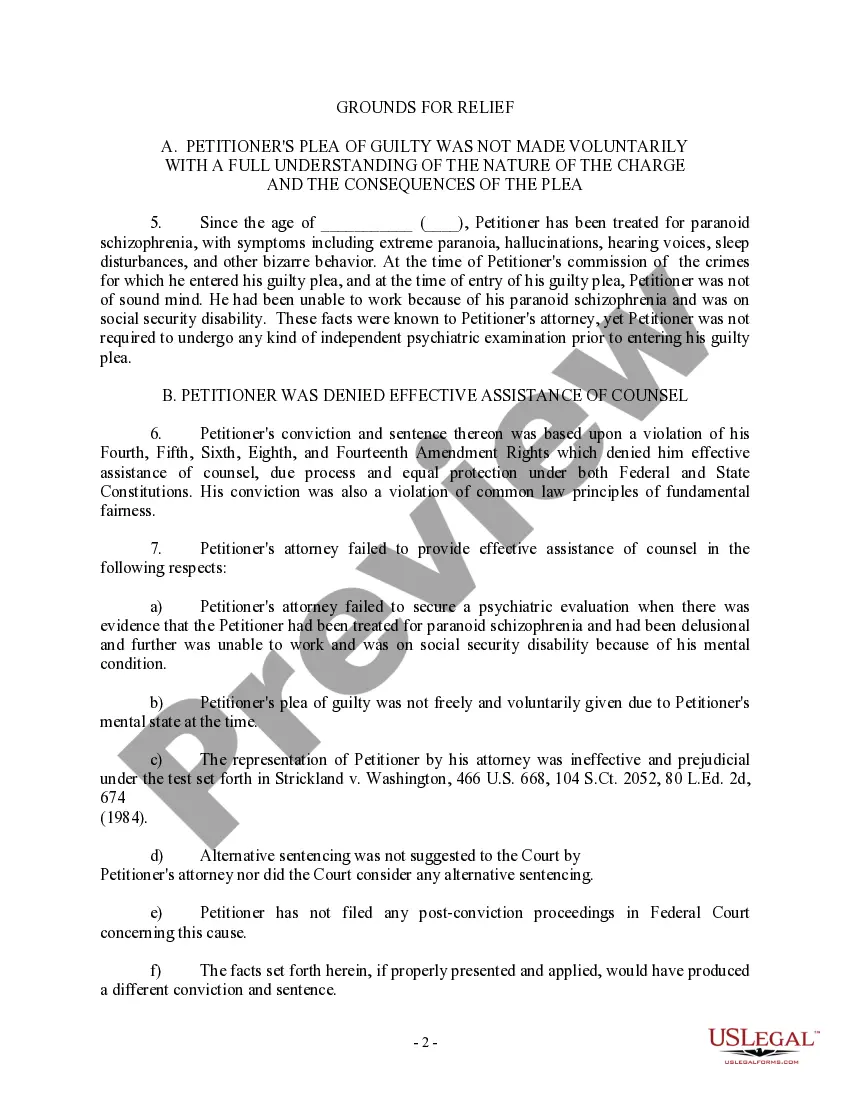
An example of a habeas corpus case is when a person believes they have been wrongfully imprisoned for a crime they did not commit. They may file a writ of habeas corpus to present new evidence or information that could potentially exonerate them.
The habeas petition must be in writing and signed and verified either by the petitioner seeking relief or by someone acting on his or her behalf. The petition must name the custodian as the respondent and state the facts concerning the applicant's custody and include the legal basis for the request.
A federal petition for writ of habeas corpus under 28 U.S.C. § 2254 is used by a (1) state prisoner (2) being held in state custody (3) to challenge the validity of a state criminal conviction or sentence (4) for the purpose of obtaining release from custody.
It found that 3.2 percent of the petitions were granted in whole or in part, and only l. 8 percent resulted in any type of release of the petitioner. Successful habeas corpus claims in most cases do not produce a prisoner's release, but rather a requirement for further judicial review.
The Suspension Clause of the Constitution (Article I, Section 9, Clause 2) , states: “The Privileges of the Writ of Habeas Corpus shall not be suspended unless when in Cases of Rebellion or Invasion the public Safety may require it.”
(A) On filing, the clerk of the court must immediately deliver the petition to the presiding judge or his or her designee. The court must rule on a petition for writ of habeas corpus within 60 days after the petition is filed.
The petitioner, typically through an attorney, files a writ of habeas corpus to the relevant court, usually the California Superior Court, and the arguments as to why the petitioner has been illegally detained. The petitioner's lawyer files a writ of habeas corpus to explain why they have been illegally detained.
1 Habeas Corpus translates to “produce the body”. 2 A habeas corpus application is used by persons who feel they are being wrongfully detained. Upon application, the individual is brought before a judge who will determine whether the detainment is lawful. Provincial courts must hear these applications quickly.
Habeas Corpus: Pertains to personal liberty in cases of illegal detention and wrongful arrest. Mandamus: Directs public officials, governments, and courts to perform their statutory duties.
