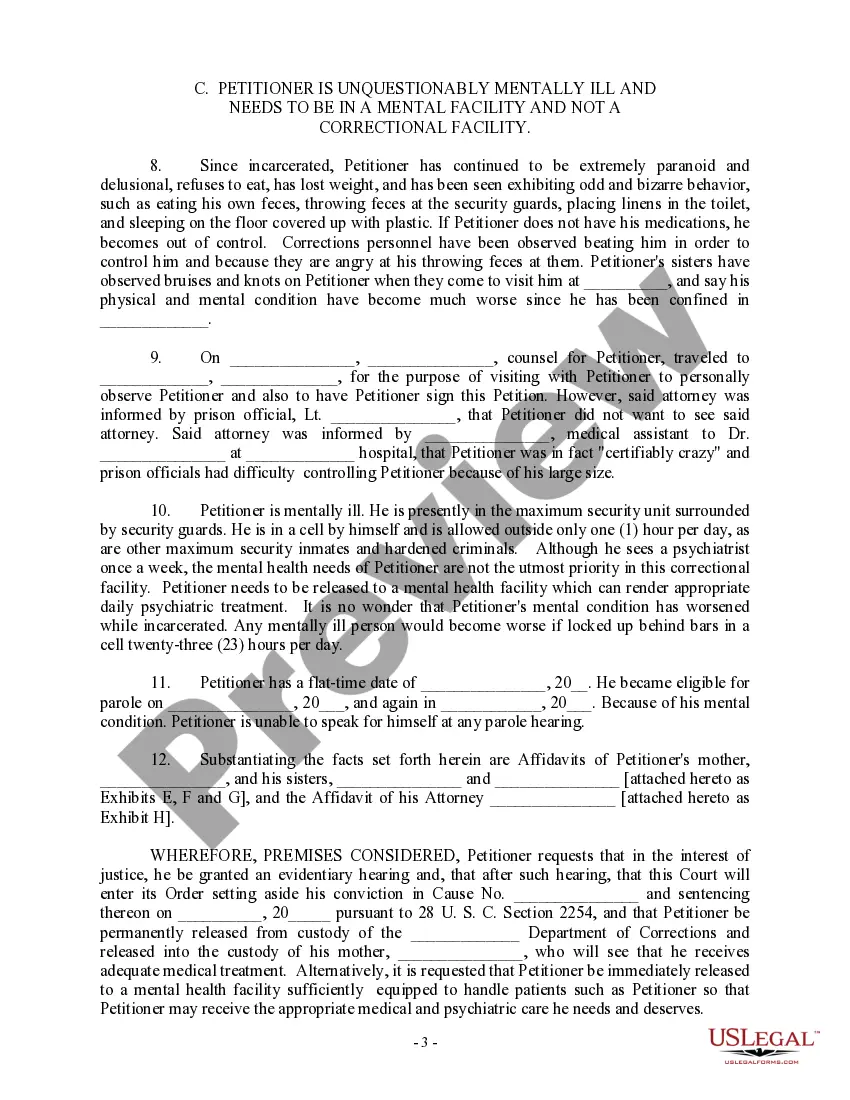
Federal Habeas Corpus For State Prisoners In Broward
Description

Get your form ready online
Our built-in tools help you complete, sign, share, and store your documents in one place.
Make edits, fill in missing information, and update formatting in US Legal Forms—just like you would in MS Word.
Download a copy, print it, send it by email, or mail it via USPS—whatever works best for your next step.
Sign and collect signatures with our SignNow integration. Send to multiple recipients, set reminders, and more. Go Premium to unlock E-Sign.
If this form requires notarization, complete it online through a secure video call—no need to meet a notary in person or wait for an appointment.
We protect your documents and personal data by following strict security and privacy standards.

Make edits, fill in missing information, and update formatting in US Legal Forms—just like you would in MS Word.

Download a copy, print it, send it by email, or mail it via USPS—whatever works best for your next step.

Sign and collect signatures with our SignNow integration. Send to multiple recipients, set reminders, and more. Go Premium to unlock E-Sign.

If this form requires notarization, complete it online through a secure video call—no need to meet a notary in person or wait for an appointment.

We protect your documents and personal data by following strict security and privacy standards.
Looking for another form?



Form popularity
FAQ
The following are some common grounds for writ of habeas corpus petitions: Introduction of new evidence that points to your innocence. Changes in the law. Incompetency during trial. Ineffective assistance of counsel. Conviction under unconstitutional law. Prosecutorial misconduct. No jurisdiction.
A Writ of Habeas Corpus usually addresses claims of ineffective assistance of counsel, prosecutorial misconduct, newly discovered evidence, jury misconduct, and claims of actual innocence.
The Difference Between State and Federal Writs of Habeas Corpus. Writs of habeas corpus can be filed in state or federal court. A state-court writ of habeas corpus is brought pursuant to California law, whereas a federal writ is brought under prevailing federal law.
Federal habeas corpus is a procedure under which a federal court may review the legality of an individual's incarceration. It is most often the stage of the criminal appellate process that follows direct appeal and any available state collateral review.
Federal habeas corpus petitions differ from state petitions primarily in their focus on violations of federal constitutional rights, while state petitions often address state law issues.
A federal petition for writ of habeas corpus under 28 U.S.C. § 2254 is used by a (1) state prisoner (2) being held in state custody (3) to challenge the validity of a state criminal conviction or sentence (4) for the purpose of obtaining release from custody.
The rules for filing a federal writ of habeas corpus are codified in 28 U.S.C. §§ 2241-2256. Generally, one cannot file a writ of habeas corpus unless they show the government has detained them. State prisoners cannot file a federal writ unless they exhaust all available state remedies.
Examples of 'writ of habeas corpus' in a sentence A number of people arrested and detained throughout the country sought writs of habeas corpus before the courts. He wanted them released through writs of habeas corpus, a right hitherto granted only to human prisoners.
Dozens of affidavits were contained within the corpus of the lawsuit. Still, what a corpus: almost two hundred books to date, of which sixty-six have headed the Times best-seller list. The rabbit hole that transports Alice to Wonderland might as well be a birth canal concealed within the vast corpus of the earth.
Habeas Corpus is a Latin word meaning which literally means 'to have the body of'. It is an order issued by the court to a person who has detained another person, to produce the body of the latter before it. The court then examines the cause and legality of detention. Further Reading: Types of Writs.