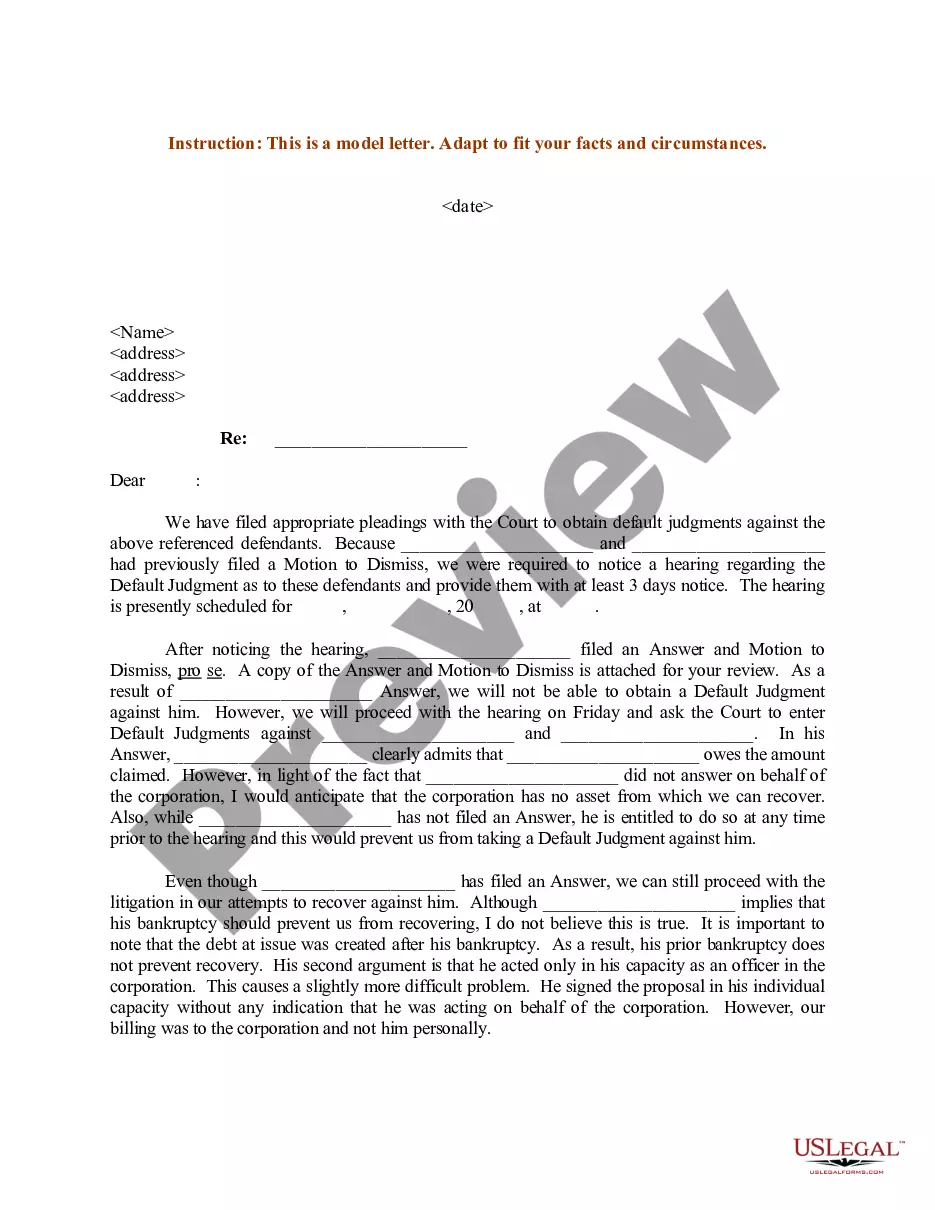
Letter For Judgment In Tarrant
Description




Get your form ready online
Our built-in tools help you complete, sign, share, and store your documents in one place.
Make edits, fill in missing information, and update formatting in US Legal Forms—just like you would in MS Word.
Download a copy, print it, send it by email, or mail it via USPS—whatever works best for your next step.
Sign and collect signatures with our SignNow integration. Send to multiple recipients, set reminders, and more. Go Premium to unlock E-Sign.
If this form requires notarization, complete it online through a secure video call—no need to meet a notary in person or wait for an appointment.
We protect your documents and personal data by following strict security and privacy standards.

Make edits, fill in missing information, and update formatting in US Legal Forms—just like you would in MS Word.

Download a copy, print it, send it by email, or mail it via USPS—whatever works best for your next step.

Sign and collect signatures with our SignNow integration. Send to multiple recipients, set reminders, and more. Go Premium to unlock E-Sign.

If this form requires notarization, complete it online through a secure video call—no need to meet a notary in person or wait for an appointment.

We protect your documents and personal data by following strict security and privacy standards.
Looking for another form?

Form popularity
FAQ
In Texas, there are three primary legal tools by which you as the defendant can overturn a default judgment: Filing a motion to set aside the default judgment. Filing a restricted appeal. Filing a bill of review.
The statute of limitations on debt in Texas is four years.
Collecting on a Judgment in Texas Enforcing a Judgment. There are several ways to collect on a judgment in Texas. Filing the Abstract of Judgment. Obtaining a Writ of Execution. Obtaining a Writ of Garnishment.
CALIFORNIA. A judgment and any lien created by an execution on the judgment expires ten years after the date of the entry of the judgment. Cal. Civ.
Do judgments expire in Texas? Judgments awarded in Texas to a non-government creditor are generally valid for ten years but can be renewed for longer. If a judgment is not renewed, it will become dormant. A creditor can request to revive a dormant judgment to continue to try and collect the debt.
You will need to select the court location, and then click on either Criminal Case Records or Case Records Search. You may search for your case using the court's full case number (JP05-17-SC0000x) or the party name.
To obtain copies of court filed public records from a criminal case in a County Criminal Court, go to the criminal division of the County Clerk webpage. The phone number is 817-884-2848.
If you require assistance in accessing the information, please contact Christie Reyenga at 817-884-2198. The hours of operation are Monday - Friday a.m. - 5 p.m. For more information on obtaining copies of documents filed with the County Clerk's office , please call 817-884-1770 during regular business hours.
Some justice courts have a form available on their website to request an abstract of judgment. Once the abstract of judgment has been issued, it may then be filed with the county clerk's office where the real property is located or where property may be located in the future.
You can access various court records through legal databases like Lexis, Westlaw, and Fastcase. State Law Library patrons can use Fastcase remotely to find final opinions for select Texas and federal appellate cases. Lexis and Westlaw are available at the library in person.

