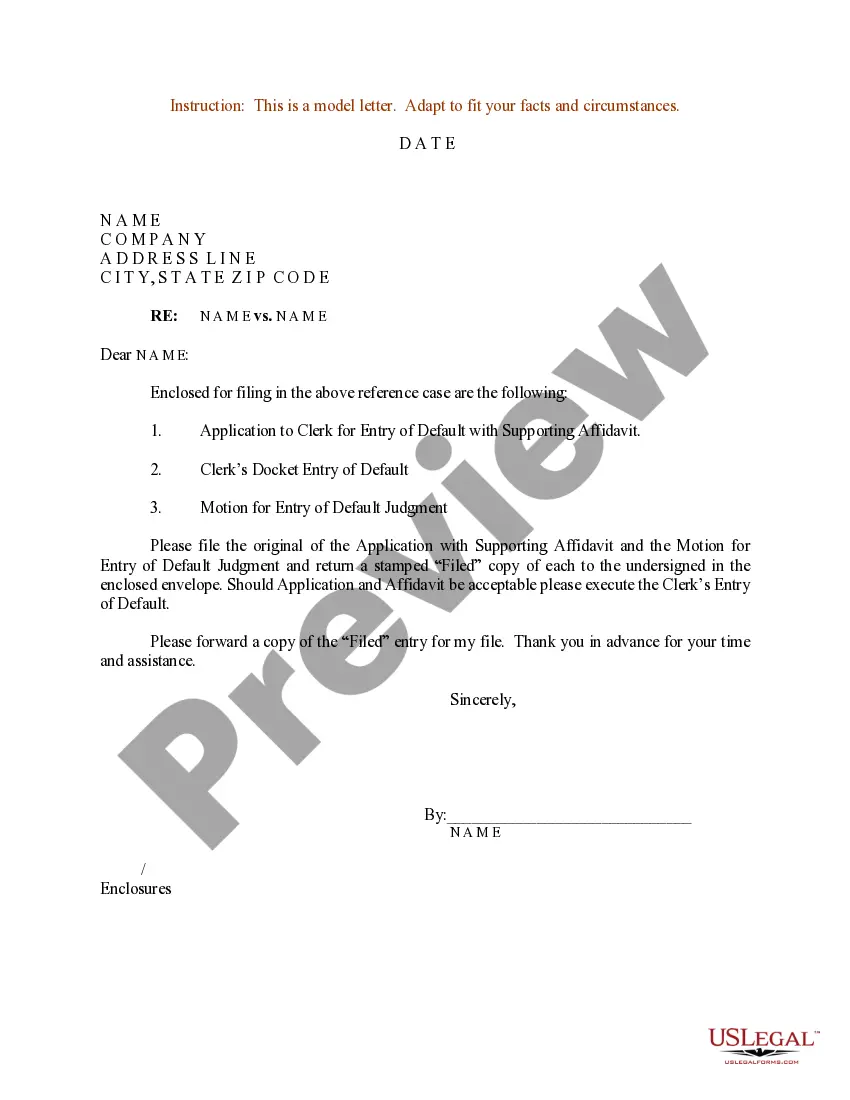
Letter Requesting Motion To Vacate Order Of Default Form In Phoenix
Description

Get your form ready online
Our built-in tools help you complete, sign, share, and store your documents in one place.
Make edits, fill in missing information, and update formatting in US Legal Forms—just like you would in MS Word.
Download a copy, print it, send it by email, or mail it via USPS—whatever works best for your next step.
Sign and collect signatures with our SignNow integration. Send to multiple recipients, set reminders, and more. Go Premium to unlock E-Sign.
If this form requires notarization, complete it online through a secure video call—no need to meet a notary in person or wait for an appointment.
We protect your documents and personal data by following strict security and privacy standards.

Make edits, fill in missing information, and update formatting in US Legal Forms—just like you would in MS Word.

Download a copy, print it, send it by email, or mail it via USPS—whatever works best for your next step.

Sign and collect signatures with our SignNow integration. Send to multiple recipients, set reminders, and more. Go Premium to unlock E-Sign.

If this form requires notarization, complete it online through a secure video call—no need to meet a notary in person or wait for an appointment.

We protect your documents and personal data by following strict security and privacy standards.
Looking for another form?








Form popularity
FAQ
A motion to vacate must be filed within a reasonable time. For reasons (1) and (2), the motion must be filed no more than 6 months after the entry of the judgment or the date of the proceeding, whichever is later. The moving party must deliver a copy of the motion to the other party on the date of filing.
If you do not think the default judgment was appropriately entered against you, you must file a motion with the court asking the judge to “set aside” (void or nullify) the judgment. If the judge grants your motion, the case starts back up again.
For good cause shown, and upon terms the court deems just, the court may set aside a judgment entered upon a failure to appear. A motion to set aside a default judgment shall be made in writing within 30 days after entry of the default judgment.
A motion to vacate the chair or motion to declare the chair vacant, commonly shortened to motion to vacate, is a procedure in which a member of a legislative body proposes that the presiding officer vacates their office.
Cases requesting $750 to $10,000 can go to small claims or civil court. Any cases recovering over $10,000 need to go to civil court or a local superior court.
Arizona's Justice Courts Every county in Arizona has at least two justice courts. The justice courts have exclusive authority to hear cases in which the amount in controversy is $10,000 or less. Cases in which the amount in controversy is greater than $10,000 must be filed in the superior court.
Every county in Arizona has at least two justice courts. The justice courts have exclusive authority to hear cases in which the amount in controversy is $10,000 or less. Cases in which the amount in controversy is greater than $10,000 must be filed in the superior court.
A civil action filed in a limited jurisdiction court is a claim against another party for damages of an amount up to $10,000.00. These lawsuits are designed to resolve civil disputes before a justice of the peace. Parties in a civil lawsuit may be represented by attorneys and appeal their case to a higher court.
Once the judgment is set aside, the case starts up again. If you do not file an answer with the court to defend against plaintiff's complaint, you could again be defaulted and another default judgment could be entered against you.
