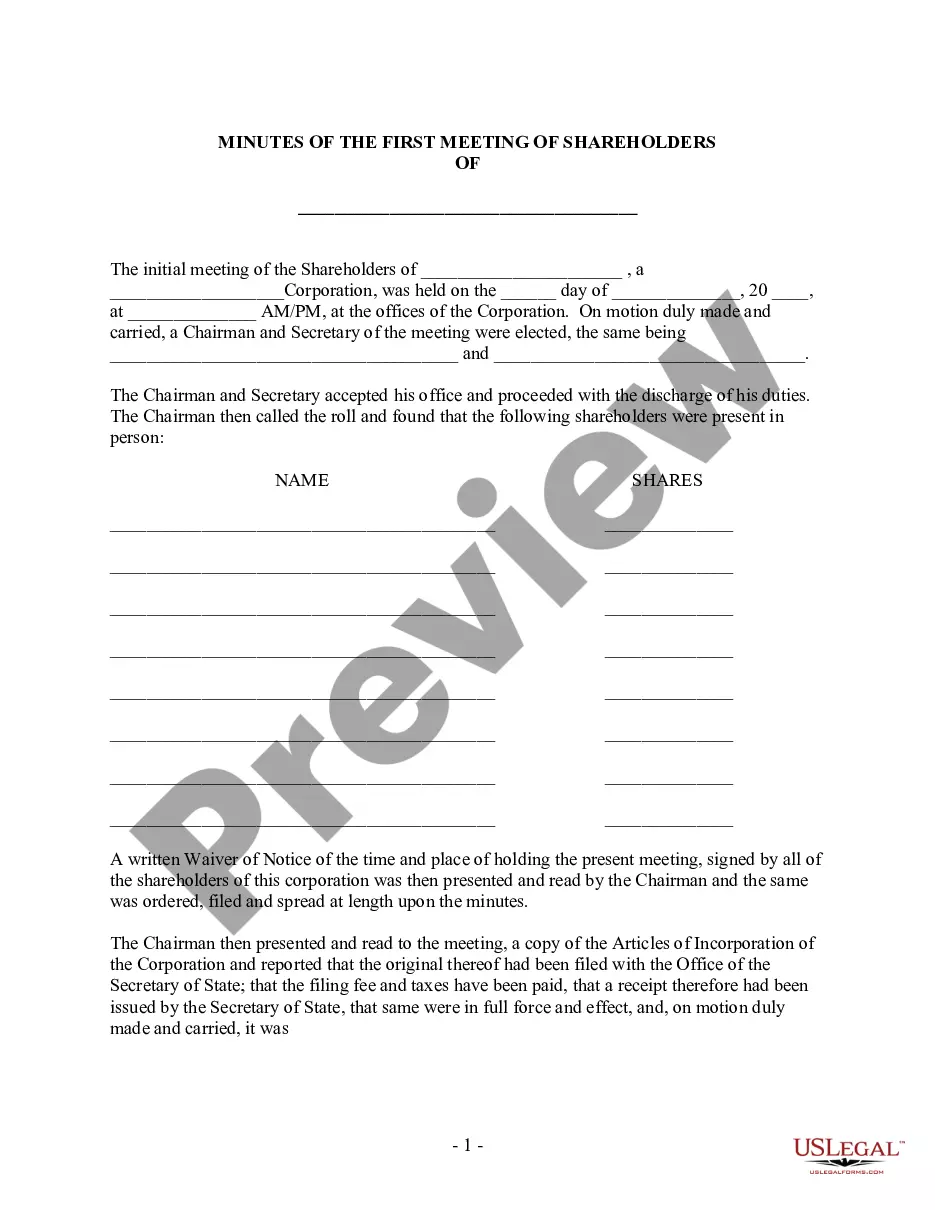
Meeting Board Directors Sample For Nonprofits In New York
Description




Get your form ready online
Our built-in tools help you complete, sign, share, and store your documents in one place.
Make edits, fill in missing information, and update formatting in US Legal Forms—just like you would in MS Word.
Download a copy, print it, send it by email, or mail it via USPS—whatever works best for your next step.
Sign and collect signatures with our SignNow integration. Send to multiple recipients, set reminders, and more. Go Premium to unlock E-Sign.
If this form requires notarization, complete it online through a secure video call—no need to meet a notary in person or wait for an appointment.
We protect your documents and personal data by following strict security and privacy standards.

Make edits, fill in missing information, and update formatting in US Legal Forms—just like you would in MS Word.

Download a copy, print it, send it by email, or mail it via USPS—whatever works best for your next step.

Sign and collect signatures with our SignNow integration. Send to multiple recipients, set reminders, and more. Go Premium to unlock E-Sign.

If this form requires notarization, complete it online through a secure video call—no need to meet a notary in person or wait for an appointment.

We protect your documents and personal data by following strict security and privacy standards.
Looking for another form?








Form popularity
FAQ
In most states the laws dictate the minimum size for nonprofit boards. Usually it is three, but in some states only one board member is required. Some boards function under a representational mandate; their composition needs to reflect the constituency, and this creates an upward pressure on the size.
Nonprofit leaders should avoid any secretively made recordings, whether actual or perceived. Tip: For events that involve some individuals meeting in person, do not assume everyone sees a camera and understands why it is present.
President: The president of your board of directors is the head of your nonprofit board. They preside at board meetings and create meeting agendas. This individual also supervises all of the business affairs of the board and acts as the primary contact for the group.
Most board meeting agendas follow a classic meeting structure: Calling meeting to order – ensure you have quorum. Approve the agenda and prior board meeting minutes. Executive and committee reports – allow 25% of time here for key topic discussion. Old/new/other business. Close the meeting and adjourn.
There are legal, ethical, and practical reasons to build a board when a nonprofit is created. These reasons create the foundation for good governance and are explained in-depth in this article from BoardSource. All nonprofit organizations need a board.
How many members usually sit on a board? A typical board of directors has nine members, but some have three, and others have 31. Typically, private companies have between three and seven directors on their boards. To avoid voting ties, boards are usually an odd number.
Nonprofit charities are under the jurisdiction of state and national laws, so they must comply with both legal systems. With that in mind, the federal government requires a minimum of three board members to acquire coveted 501c3 tax-exempt status.
How many board members does a charitable corporation have to have? A corporation formed in New York must have at least three board members.
While affluent connections are always helpful, you should also consider board members with connections who have a passion for the mission, have a connection to those you serve, and who can help you better serve the community.

