Sample Payoff Mortgage Form For Divorce In Salt Lake
Description
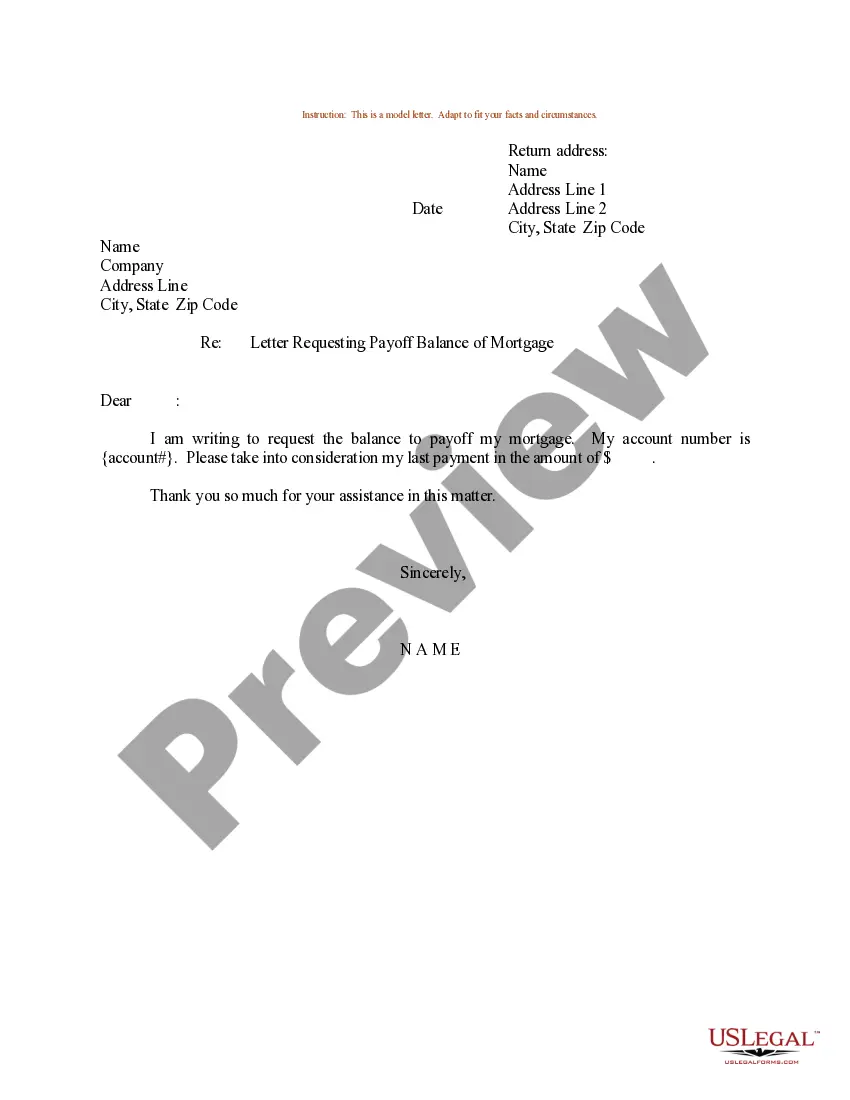
Get your form ready online
Our built-in tools help you complete, sign, share, and store your documents in one place.
Make edits, fill in missing information, and update formatting in US Legal Forms—just like you would in MS Word.
Download a copy, print it, send it by email, or mail it via USPS—whatever works best for your next step.
Sign and collect signatures with our SignNow integration. Send to multiple recipients, set reminders, and more. Go Premium to unlock E-Sign.
If this form requires notarization, complete it online through a secure video call—no need to meet a notary in person or wait for an appointment.
We protect your documents and personal data by following strict security and privacy standards.

Make edits, fill in missing information, and update formatting in US Legal Forms—just like you would in MS Word.

Download a copy, print it, send it by email, or mail it via USPS—whatever works best for your next step.

Sign and collect signatures with our SignNow integration. Send to multiple recipients, set reminders, and more. Go Premium to unlock E-Sign.

If this form requires notarization, complete it online through a secure video call—no need to meet a notary in person or wait for an appointment.

We protect your documents and personal data by following strict security and privacy standards.
Looking for another form?



Form popularity
FAQ
Under federal law, the servicer must generally send you a payoff statement within seven business days of your request, subject to a few exceptions. (12 C.F.R. § 1026.36.)
There are two ways to remove a divorced partner from a mortgage: obtaining a release of liability from the lender or refinancing the mortgage. A release from liability is easier, but counts on the lender granting permission.
There's a process to getting the mortgage payoff statement. First, you'll need to contact your lender and let them know you want the information. Depending on your lender, you may have to sign in to an online account, call a helpline, or send a formal letter to start the request process.
Utah law requires 30 days between filing and finalizing the divorce. This is called the waiting period. You can ask the court to waive the waiting period if there are extraordinary circumstances.
Uncontested divorce with or without children. Utah law imposes a 90-day waiting period after filing for a divorce before it may be granted, so even if you and your spouse agree on all the issues, it would take at least 90 days. However, you may try to waive the waiting period.
Utah law mandates a 90-day waiting period after filing for divorce before it can be granted. However, couples may petition to waive this period under certain circumstances. Note: For divorces involving children, there is a requirement to attend two classes: Divorce Orientation and Divorce Education for Parents.
In Utah, there is no minimum time period that you need to be separated before a divorce is granted. No matter how long you have been separated, the court will grant your divorce 91 days after filing.
Utah is an equitable distribution state. Essentially, this means that during a divorce, any property (including the marital home) is divided fairly but not always equally.
The way to ask that the waiting period be waived is to file a Motion to Waive Divorce Waiting Period. The motion will not be granted automatically; the moving party must show extraordinary circumstances. A copy of the Motion must be served on the other party following Utah Rule of Civil Procedure 5.
To get a copy of your divorce decree, contact the court that handled the divorce case. Use the Court Directory to find contact details.

